 Add to Chrome
 Add to Firefox
 Add to Edge
Where Models Converge and Humans Diverge: A Coverage Framework for Distributional Pluralism in Open-Ended Generation
Aug 06, 2026
When a large language model (LLM) writes Harry Potter fanfiction, it reliably produces fundamental elements of the Hogwarts universe, such as recognizable places and characters. Human-written Harry Potter fanfictions, however, typically include these fundamentals and much more, incorporating stylistically irregular content and relationship-diverse plotlines. This gap between LLM and human writing has been noted across a variety of domains. LLMs tend to produce "average" writing, while human writing contains more diverse content that covers a broader distribution. Existing work has shown the existence of this distributional "gap", but no work has proposed a systematic way to measure it. Our paper proposes a human-grounded framework that uses the empirical distribution of human writing on a topic to measure the distributional breadth of LLM-generated content on that same topic. We propose two metrics, LLM Coverage (LLM-Cov) and In-Boundary Rate (IBR), that separate the plausibility of LLM content from its distributional breadth. Across ideation and narrative tasks, we find that current LLMs produce plausible but narrow content that concentrates near the center of the human response space. Our framework can enable researchers to better assess the distributional breadth of LLM-authored content, which we term its "cultural reach".

SE Territory: Monaural Speech Enhancement Meets the Fixed Virtual Perceptual Space Mapping
Nov 03, 2023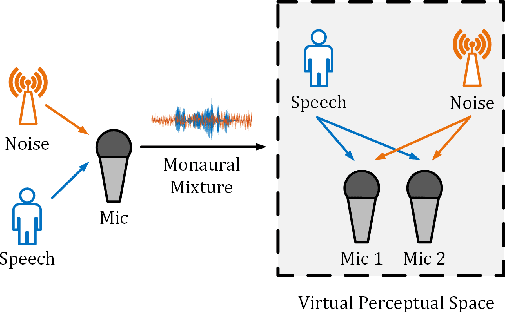
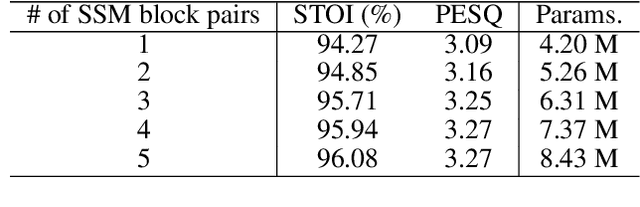
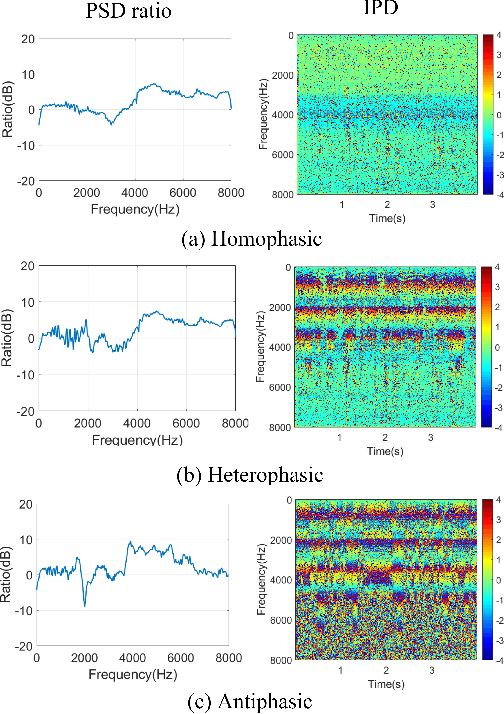
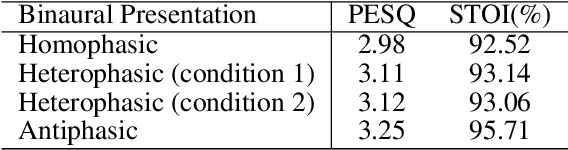
Monaural speech enhancement has achieved remarkable progress recently. However, its performance has been constrained by the limited spatial cues available at a single microphone. To overcome this limitation, we introduce a strategy to map monaural speech into a fixed simulation space for better differentiation between target speech and noise. Concretely, we propose SE-TerrNet, a novel monaural speech enhancement model featuring a virtual binaural speech mapping network via a two-stage multi-task learning framework. In the first stage, monaural noisy input is projected into a virtual space using supervised speech mapping blocks, creating binaural representations. These blocks synthesize binaural noisy speech from monaural input via an ideal binaural room impulse response. The synthesized output assigns speech and noise sources to fixed directions within the perceptual space. In the second stage, the obtained binaural features from the first stage are aggregated. This aggregation aims to decrease pattern discrepancies between the mapped binaural and original monaural features, achieved by implementing an intermediate fusion module. Furthermore, this stage incorporates the utilization of cross-attention to capture the injected virtual spatial information to improve the extraction of the target speech. Empirical studies highlight the effectiveness of virtual spatial cues in enhancing monaural speech enhancement. As a result, the proposed SE-TerrNet significantly surpasses the recent monaural speech enhancement methods in terms of both speech quality and intelligibility.