 Add to Chrome
 Add to Firefox
 Add to Edge
MolCrystalFlow: Molecular Crystal Structure Prediction via Flow Matching
Feb 17, 2026
Molecular crystal structure prediction represents a grand challenge in computational chemistry due to large sizes of constituent molecules and complex intra- and intermolecular interactions. While generative modeling has revolutionized structure discovery for molecules, inorganic solids, and metal-organic frameworks, extending such approaches to fully periodic molecular crystals is still elusive. Here, we present MolCrystalFlow, a flow-based generative model for molecular crystal structure prediction. The framework disentangles intramolecular complexity from intermolecular packing by embedding molecules as rigid bodies and jointly learning the lattice matrix, molecular orientations, and centroid positions. Centroids and orientations are represented on their native Riemannian manifolds, allowing geodesic flow construction and graph neural network operations that respects geometric symmetries. We benchmark our model against state-of-the-art generative models for large-size periodic crystals and rule-based structure generation methods on two open-source molecular crystal datasets. We demonstrate an integration of MolCrystalFlow model with universal machine learning potential to accelerate molecular crystal structure prediction, paving the way for data-driven generative discovery of molecular crystals.

MolGuidance: Advanced Guidance Strategies for Conditional Molecular Generation with Flow Matching
Dec 13, 2025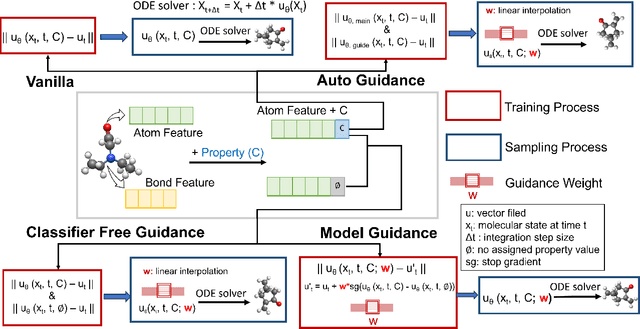
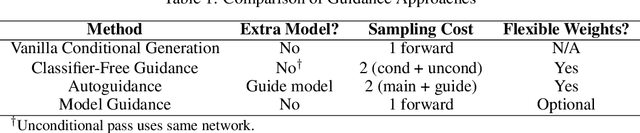
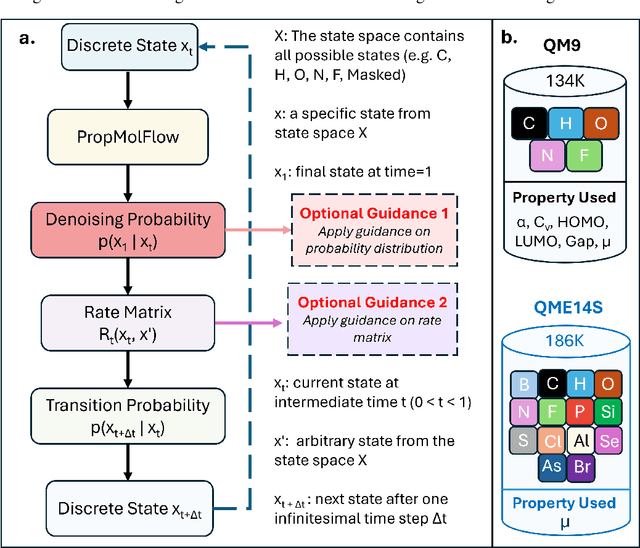
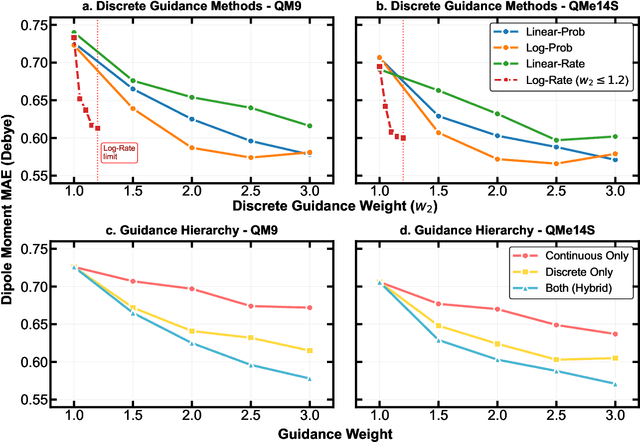
Key objectives in conditional molecular generation include ensuring chemical validity, aligning generated molecules with target properties, promoting structural diversity, and enabling efficient sampling for discovery. Recent advances in computer vision introduced a range of new guidance strategies for generative models, many of which can be adapted to support these goals. In this work, we integrate state-of-the-art guidance methods -- including classifier-free guidance, autoguidance, and model guidance -- in a leading molecule generation framework built on an SE(3)-equivariant flow matching process. We propose a hybrid guidance strategy that separately guides continuous and discrete molecular modalities -- operating on velocity fields and predicted logits, respectively -- while jointly optimizing their guidance scales via Bayesian optimization. Our implementation, benchmarked on the QM9 and QMe14S datasets, achieves new state-of-the-art performance in property alignment for de novo molecular generation. The generated molecules also exhibit high structural validity. Furthermore, we systematically compare the strengths and limitations of various guidance methods, offering insights into their broader applicability.
Open Materials Generation with Stochastic Interpolants
Feb 04, 2025The discovery of new materials is essential for enabling technological advancements. Computational approaches for predicting novel materials must effectively learn the manifold of stable crystal structures within an infinite design space. We introduce Open Materials Generation (OMG), a unifying framework for the generative design and discovery of inorganic crystalline materials. OMG employs stochastic interpolants (SI) to bridge an arbitrary base distribution to the target distribution of inorganic crystals via a broad class of tunable stochastic processes, encompassing both diffusion models and flow matching as special cases. In this work, we adapt the SI framework by integrating an equivariant graph representation of crystal structures and extending it to account for periodic boundary conditions in unit cell representations. Additionally, we couple the SI flow over spatial coordinates and lattice vectors with discrete flow matching for atomic species. We benchmark OMG's performance on two tasks: Crystal Structure Prediction (CSP) for specified compositions, and 'de novo' generation (DNG) aimed at discovering stable, novel, and unique structures. In our ground-up implementation of OMG, we refine and extend both CSP and DNG metrics compared to previous works. OMG establishes a new state-of-the-art in generative modeling for materials discovery, outperforming purely flow-based and diffusion-based implementations. These results underscore the importance of designing flexible deep learning frameworks to accelerate progress in materials science.
When More Data Hurts: Optimizing Data Coverage While Mitigating Diversity Induced Underfitting in an Ultra-Fast Machine-Learned Potential
Sep 11, 2024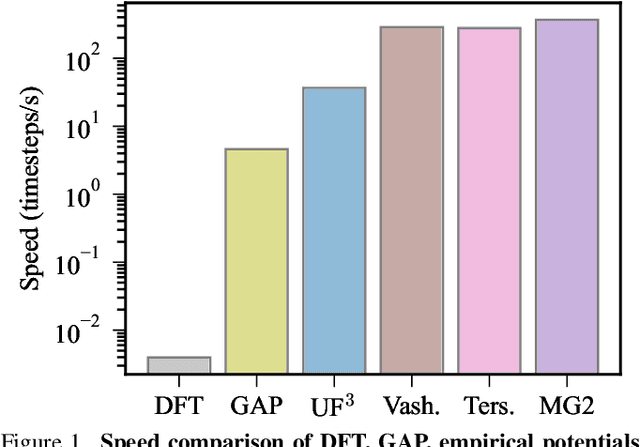
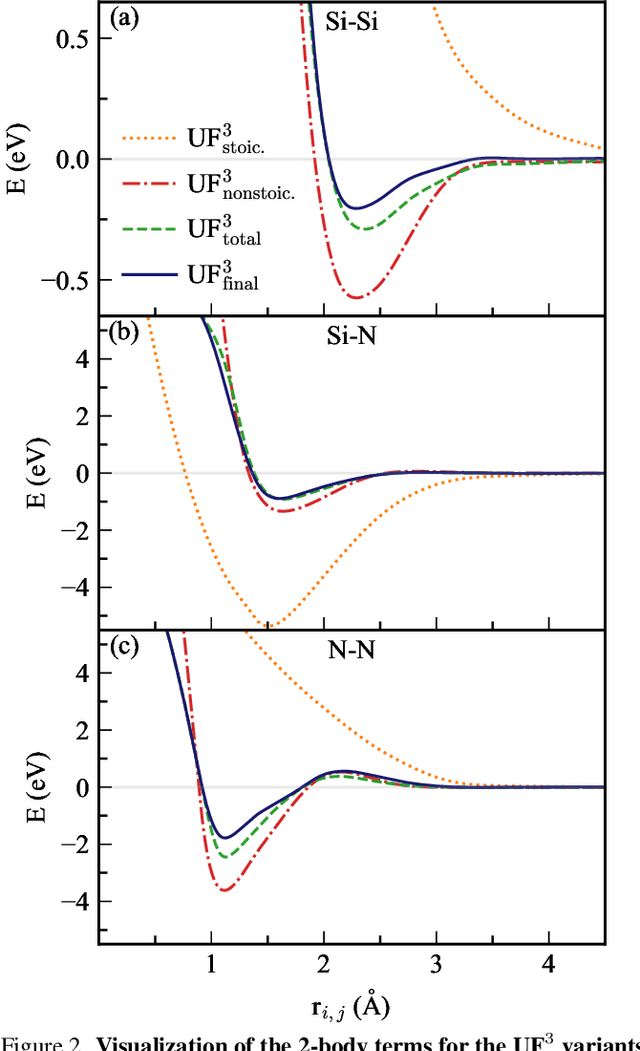
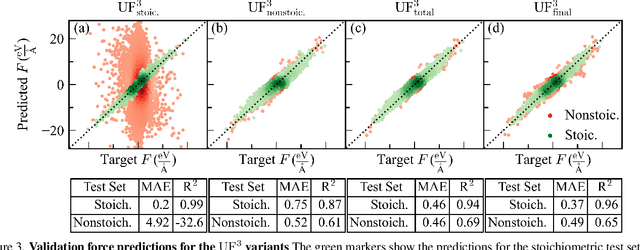
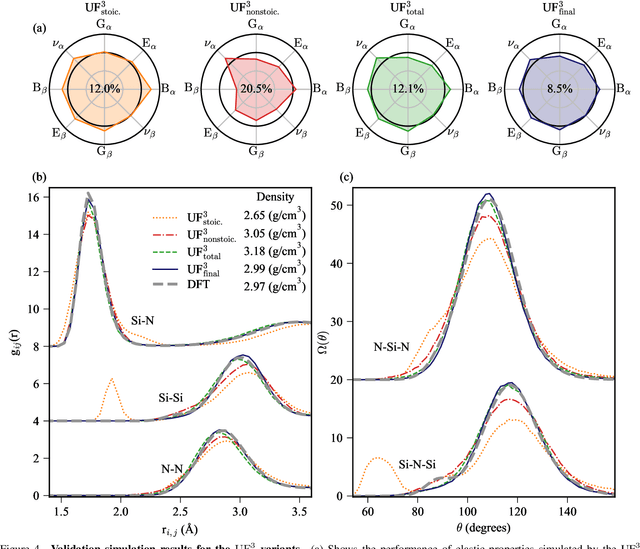
Machine-learned interatomic potentials (MLIPs) are becoming an essential tool in materials modeling. However, optimizing the generation of training data used to parameterize the MLIPs remains a significant challenge. This is because MLIPs can fail when encountering local enviroments too different from those present in the training data. The difficulty of determining \textit{a priori} the environments that will be encountered during molecular dynamics (MD) simulation necessitates diverse, high-quality training data. This study investigates how training data diversity affects the performance of MLIPs using the Ultra-Fast Force Field (UF$^3$) to model amorphous silicon nitride. We employ expert and autonomously generated data to create the training data and fit four force-field variants to subsets of the data. Our findings reveal a critical balance in training data diversity: insufficient diversity hinders generalization, while excessive diversity can exceed the MLIP's learning capacity, reducing simulation accuracy. Specifically, we found that the UF$^3$ variant trained on a subset of the training data, in which nitrogen-rich structures were removed, offered vastly better prediction and simulation accuracy than any other variant. By comparing these UF$^3$ variants, we highlight the nuanced requirements for creating accurate MLIPs, emphasizing the importance of application-specific training data to achieve optimal performance in modeling complex material behaviors.
Accelerating superconductor discovery through tempered deep learning of the electron-phonon spectral function
Jan 29, 2024Integrating deep learning with the search for new electron-phonon superconductors represents a burgeoning field of research, where the primary challenge lies in the computational intensity of calculating the electron-phonon spectral function, $\alpha^2F(\omega)$, the essential ingredient of Midgal-Eliashberg theory of superconductivity. To overcome this challenge, we adopt a two-step approach. First, we compute $\alpha^2F(\omega)$ for 818 dynamically stable materials. We then train a deep-learning model to predict $\alpha^2F(\omega)$, using an unconventional training strategy to temper the model's overfitting, enhancing predictions. Specifically, we train a Bootstrapped Ensemble of Tempered Equivariant graph neural NETworks (BETE-NET), obtaining an MAE of 0.21, 45 K, and 43 K for the Eliashberg moments derived from $\alpha^2F(\omega)$: $\lambda$, $\omega_{\log}$, and $\omega_{2}$, respectively, yielding an MAE of 2.5 K for the critical temperature, $T_c$. Further, we incorporate domain knowledge of the site-projected phonon density of states to impose inductive bias into the model's node attributes and enhance predictions. This methodological innovation decreases the MAE to 0.18, 29 K, and 28 K, respectively, yielding an MAE of 2.1 K for $T_c$. We illustrate the practical application of our model in high-throughput screening for high-$T_c$ materials. The model demonstrates an average precision nearly five times higher than random screening, highlighting the potential of ML in accelerating superconductor discovery. BETE-NET accelerates the search for high-$T_c$ superconductors while setting a precedent for applying ML in materials discovery, particularly when data is limited.