 Add to Chrome
 Add to Firefox
 Add to Edge
MolCrystalFlow: Molecular Crystal Structure Prediction via Flow Matching
Feb 17, 2026
Molecular crystal structure prediction represents a grand challenge in computational chemistry due to large sizes of constituent molecules and complex intra- and intermolecular interactions. While generative modeling has revolutionized structure discovery for molecules, inorganic solids, and metal-organic frameworks, extending such approaches to fully periodic molecular crystals is still elusive. Here, we present MolCrystalFlow, a flow-based generative model for molecular crystal structure prediction. The framework disentangles intramolecular complexity from intermolecular packing by embedding molecules as rigid bodies and jointly learning the lattice matrix, molecular orientations, and centroid positions. Centroids and orientations are represented on their native Riemannian manifolds, allowing geodesic flow construction and graph neural network operations that respects geometric symmetries. We benchmark our model against state-of-the-art generative models for large-size periodic crystals and rule-based structure generation methods on two open-source molecular crystal datasets. We demonstrate an integration of MolCrystalFlow model with universal machine learning potential to accelerate molecular crystal structure prediction, paving the way for data-driven generative discovery of molecular crystals.

MolGuidance: Advanced Guidance Strategies for Conditional Molecular Generation with Flow Matching
Dec 13, 2025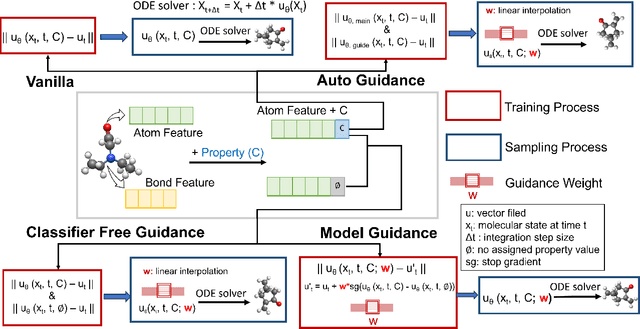
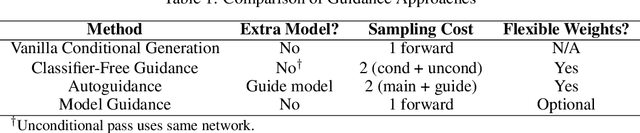
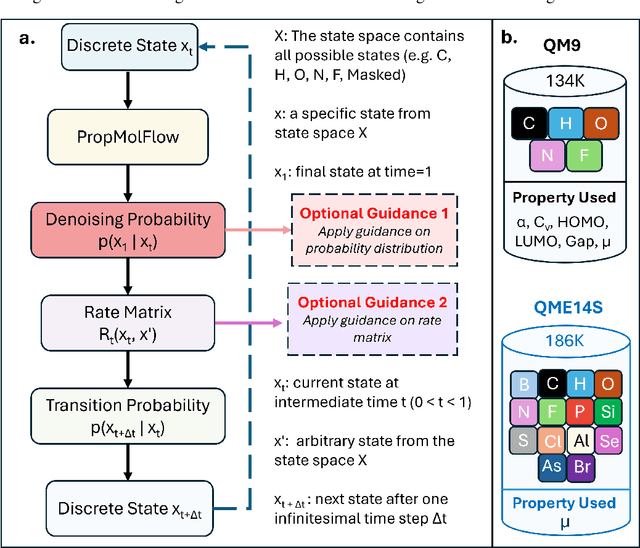
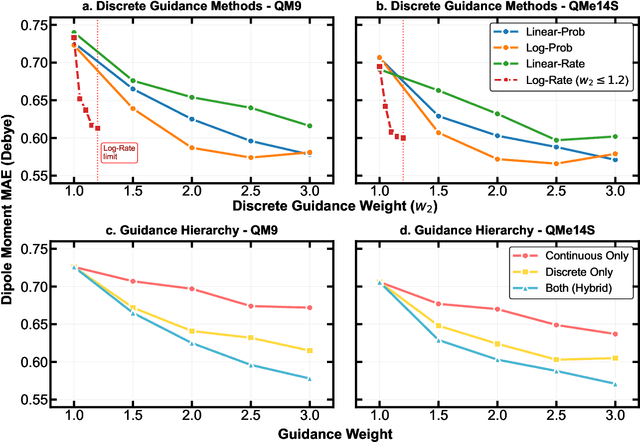
Key objectives in conditional molecular generation include ensuring chemical validity, aligning generated molecules with target properties, promoting structural diversity, and enabling efficient sampling for discovery. Recent advances in computer vision introduced a range of new guidance strategies for generative models, many of which can be adapted to support these goals. In this work, we integrate state-of-the-art guidance methods -- including classifier-free guidance, autoguidance, and model guidance -- in a leading molecule generation framework built on an SE(3)-equivariant flow matching process. We propose a hybrid guidance strategy that separately guides continuous and discrete molecular modalities -- operating on velocity fields and predicted logits, respectively -- while jointly optimizing their guidance scales via Bayesian optimization. Our implementation, benchmarked on the QM9 and QMe14S datasets, achieves new state-of-the-art performance in property alignment for de novo molecular generation. The generated molecules also exhibit high structural validity. Furthermore, we systematically compare the strengths and limitations of various guidance methods, offering insights into their broader applicability.