 Add to Chrome
 Add to Firefox
 Add to Edge
Optimal Prediction-Augmented Algorithms for Testing Independence of Distributions
Mar 04, 2026
Independence testing is a fundamental problem in statistical inference: given samples from a joint distribution $p$ over multiple random variables, the goal is to determine whether $p$ is a product distribution or is $ε$-far from all product distributions in total variation distance. In the non-parametric finite-sample regime, this task is notoriously expensive, as the minimax sample complexity scales polynomially with the support size. In this work, we move beyond these worst-case limitations by leveraging the framework of \textit{augmented distribution testing}. We design independence testers that incorporate auxiliary, but potentially untrustworthy, predictive information. Our framework ensures that the tester remains robust, maintaining worst-case validity regardless of the prediction's quality, while significantly improving sample efficiency when the prediction is accurate. Our main contributions include: (i) a bivariate independence tester for discrete distributions that adaptively reduces sample complexity based on the prediction error; (ii) a generalization to the high-dimensional multivariate setting for testing the independence of $d$ random variables; and (iii) matching minimax lower bounds demonstrating that our testers achieve optimal sample complexity.

Exploiting Low-Rank Structure in Max-K-Cut Problems
Feb 23, 2026We approach the Max-3-Cut problem through the lens of maximizing complex-valued quadratic forms and demonstrate that low-rank structure in the objective matrix can be exploited, leading to alternative algorithms to classical semidefinite programming (SDP) relaxations and heuristic techniques. We propose an algorithm for maximizing these quadratic forms over a domain of size $K$ that enumerates and evaluates a set of $O\left(n^{2r-1}\right)$ candidate solutions, where $n$ is the dimension of the matrix and $r$ represents the rank of an approximation of the objective. We prove that this candidate set is guaranteed to include the exact maximizer when $K=3$ (corresponding to Max-3-Cut) and the objective is low-rank, and provide approximation guarantees when the objective is a perturbation of a low-rank matrix. This construction results in a family of novel, inherently parallelizable and theoretically-motivated algorithms for Max-3-Cut. Extensive experimental results demonstrate that our approach achieves performance comparable to existing algorithms across a wide range of graphs, while being highly scalable.
CrysFormer: Protein Structure Prediction via 3d Patterson Maps and Partial Structure Attention
Oct 05, 2023


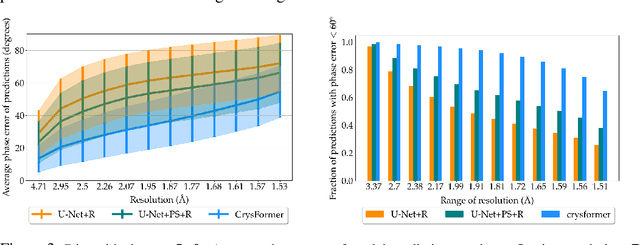
Determining the structure of a protein has been a decades-long open question. A protein's three-dimensional structure often poses nontrivial computation costs, when classical simulation algorithms are utilized. Advances in the transformer neural network architecture -- such as AlphaFold2 -- achieve significant improvements for this problem, by learning from a large dataset of sequence information and corresponding protein structures. Yet, such methods only focus on sequence information; other available prior knowledge, such as protein crystallography and partial structure of amino acids, could be potentially utilized. To the best of our knowledge, we propose the first transformer-based model that directly utilizes protein crystallography and partial structure information to predict the electron density maps of proteins. Via two new datasets of peptide fragments (2-residue and 15-residue) , we demonstrate our method, dubbed \texttt{CrysFormer}, can achieve accurate predictions, based on a much smaller dataset size and with reduced computation costs.