 Add to Chrome
 Add to Firefox
 Add to Edge
Completion of partial structures using Patterson maps with the CrysFormer machine learning model
Nov 13, 2025
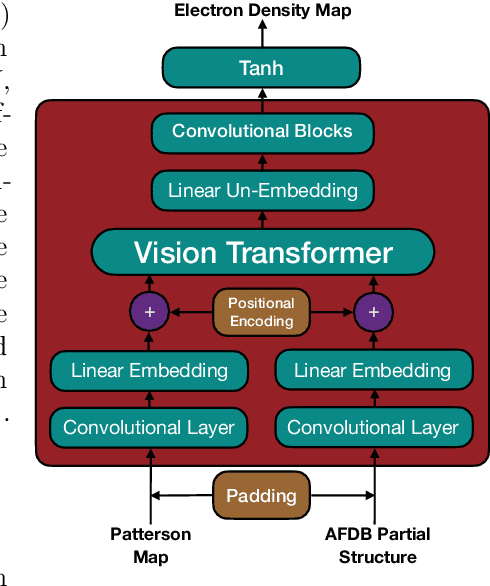
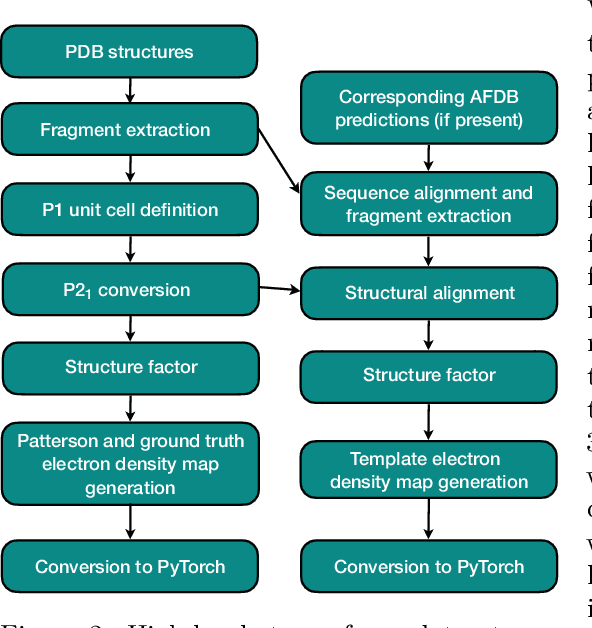
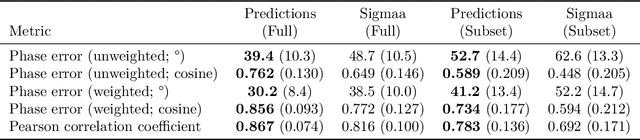
Protein structure determination has long been one of the primary challenges of structural biology, to which deep machine learning (ML)-based approaches have increasingly been applied. However, these ML models generally do not incorporate the experimental measurements directly, such as X-ray crystallographic diffraction data. To this end, we explore an approach that more tightly couples these traditional crystallographic and recent ML-based methods, by training a hybrid 3-d vision transformer and convolutional network on inputs from both domains. We make use of two distinct input constructs / Patterson maps, which are directly obtainable from crystallographic data, and ``partial structure'' template maps derived from predicted structures deposited in the AlphaFold Protein Structure Database with subsequently omitted residues. With these, we predict electron density maps that are then post-processed into atomic models through standard crystallographic refinement processes. Introducing an initial dataset of small protein fragments taken from Protein Data Bank entries and placing them in hypothetical crystal settings, we demonstrate that our method is effective at both improving the phases of the crystallographic structure factors and completing the regions missing from partial structure templates, as well as improving the agreement of the electron density maps with the ground truth atomic structures.

CrysFormer: Protein Structure Prediction via 3d Patterson Maps and Partial Structure Attention
Oct 05, 2023


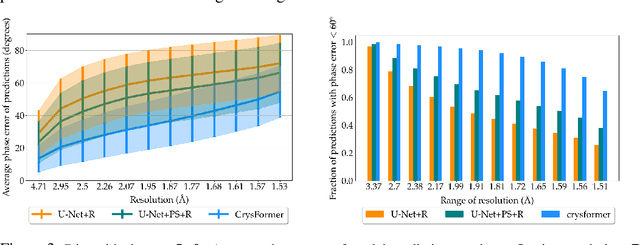
Determining the structure of a protein has been a decades-long open question. A protein's three-dimensional structure often poses nontrivial computation costs, when classical simulation algorithms are utilized. Advances in the transformer neural network architecture -- such as AlphaFold2 -- achieve significant improvements for this problem, by learning from a large dataset of sequence information and corresponding protein structures. Yet, such methods only focus on sequence information; other available prior knowledge, such as protein crystallography and partial structure of amino acids, could be potentially utilized. To the best of our knowledge, we propose the first transformer-based model that directly utilizes protein crystallography and partial structure information to predict the electron density maps of proteins. Via two new datasets of peptide fragments (2-residue and 15-residue) , we demonstrate our method, dubbed \texttt{CrysFormer}, can achieve accurate predictions, based on a much smaller dataset size and with reduced computation costs.