 Add to Chrome
 Add to Firefox
 Add to Edge
Separable neural architectures as a primitive for unified predictive and generative intelligence
Mar 12, 2026
Intelligent systems across physics, language and perception often exhibit factorisable structure, yet are typically modelled by monolithic neural architectures that do not explicitly exploit this structure. The separable neural architecture (SNA) addresses this by formalising a representational class that unifies additive, quadratic and tensor-decomposed neural models. By constraining interaction order and tensor rank, SNAs impose a structural inductive bias that factorises high-dimensional mappings into low-arity components. Separability need not be a property of the system itself: it often emerges in the coordinates or representations through which the system is expressed. Crucially, this coordinate-aware formulation reveals a structural analogy between chaotic spatiotemporal dynamics and linguistic autoregression. By treating continuous physical states as smooth, separable embeddings, SNAs enable distributional modelling of chaotic systems. This approach mitigates the nonphysical drift characteristics of deterministic operators whilst remaining applicable to discrete sequences. The compositional versatility of this approach is demonstrated across four domains: autonomous waypoint navigation via reinforcement learning, inverse generation of multifunctional microstructures, distributional modelling of turbulent flow and neural language modelling. These results establish the separable neural architecture as a domain-agnostic primitive for predictive and generative intelligence, capable of unifying both deterministic and distributional representations.

Agile Reinforcement Learning through Separable Neural Architecture
Jan 30, 2026Deep reinforcement learning (RL) is increasingly deployed in resource-constrained environments, yet the go-to function approximators - multilayer perceptrons (MLPs) - are often parameter-inefficient due to an imperfect inductive bias for the smooth structure of many value functions. This mismatch can also hinder sample efficiency and slow policy learning in this capacity-limited regime. Although model compression techniques exist, they operate post-hoc and do not improve learning efficiency. Recent spline-based separable architectures - such as Kolmogorov-Arnold Networks (KANs) - have been shown to offer parameter efficiency but are widely reported to exhibit significant computational overhead, especially at scale. In seeking to address these limitations, this work introduces SPAN (SPline-based Adaptive Networks), a novel function approximation approach to RL. SPAN adapts the low rank KHRONOS framework by integrating a learnable preprocessing layer with a separable tensor product B-spline basis. SPAN is evaluated across discrete (PPO) and high-dimensional continuous (SAC) control tasks, as well as offline settings (Minari/D4RL). Empirical results demonstrate that SPAN achieves a 30-50% improvement in sample efficiency and 1.3-9 times higher success rates across benchmarks compared to MLP baselines. Furthermore, SPAN demonstrates superior anytime performance and robustness to hyperparameter variations, suggesting it as a viable, high performance alternative for learning intrinsically efficient policies in resource-limited settings.
A Separable Architecture for Continuous Token Representation in Language Models
Jan 29, 2026Transformer scaling law analyses typically treat parameters as interchangeable; an abstraction that accurately predicts loss-compute relationships. Yet, in sub-billion-parameter small language models (SLMs), embedding matrices dominate the parameter budget. This work argues that this allocation is as suboptimal as it is counterintuitive. Leviathan is an architecture with a continuous embedding generator to replace the discrete lookup tables of canonical models. Evaluating on the Pile dataset under isoparametric settings, Leviathan consistently outperforms a standard, LLaMA-style architecture. By means of an empirical power-law fit, Leviathan exhibits a markedly superior effective parameter capacity. Across the regime studied, Leviathan behaves as a dense model with $1.47$ to $2.11 \times$ more parameters.
A Kernel-based Resource-efficient Neural Surrogate for Multi-fidelity Prediction of Aerodynamic Field
Dec 11, 2025Surrogate models provide fast alternatives to costly aerodynamic simulations and are extremely useful in design and optimization applications. This study proposes the use of a recent kernel-based neural surrogate, KHRONOS. In this work, we blend sparse high-fidelity (HF) data with low-fidelity (LF) information to predict aerodynamic fields under varying constraints in computational resources. Unlike traditional approaches, KHRONOS is built upon variational principles, interpolation theory, and tensor decomposition. These elements provide a mathematical basis for heavy pruning compared to dense neural networks. Using the AirfRANS dataset as a high-fidelity benchmark and NeuralFoil to generate low-fidelity counterparts, this work compares the performance of KHRONOS with three contemporary model architectures: a multilayer perceptron (MLP), a graph neural network (GNN), and a physics-informed neural network (PINN). We consider varying levels of high-fidelity data availability (0%, 10%, and 30%) and increasingly complex geometry parameterizations. These are used to predict the surface pressure coefficient distribution over the airfoil. Results indicate that, whilst all models eventually achieve comparable predictive accuracy, KHRONOS excels in resource-constrained conditions. In this domain, KHRONOS consistently requires orders of magnitude fewer trainable parameters and delivers much faster training and inference than contemporary dense neural networks at comparable accuracy. These findings highlight the potential of KHRONOS and similar architectures to balance accuracy and efficiency in multi-fidelity aerodynamic field prediction.
A Unified Generative-Predictive Framework for Deterministic Inverse Design
Dec 10, 2025Inverse design of heterogeneous material microstructures is a fundamentally ill-posed and famously computationally expensive problem. This is exacerbated by the high-dimensional design spaces associated with finely resolved images, multimodal input property streams, and a highly nonlinear forward physics. Whilst modern generative models excel at accurately modeling such complex forward behavior, most of them are not intrinsically structured to support fast, stable \emph{deterministic} inversion with a physics-informed bias. This work introduces Janus, a unified generative-predictive framework to address this problem. Janus couples a deep encoder-decoder architecture with a predictive KHRONOS head, a separable neural architecture. Topologically speaking, Janus learns a latent manifold simultaneously isometric for generative inversion and pruned for physical prediction; the joint objective inducing \emph{disentanglement} of the latent space. Janus is first validated on the MNIST dataset, demonstrating high-fidelity reconstruction, accurate classification and diverse generative inversion of all ten target classes. It is then applied to the inverse design of heterogeneous microstructures labeled with thermal conductivity. It achieves a forward prediction accuracy $R^2=0.98$ (2\% relative error) and sub-5\% pixelwise reconstruction error. Inverse solutions satisfy target properties to within $1\%$ relative error. Inverting a sweep through properties reveal smooth traversal of the latent manifold, and UMAP visualization confirms the emergence of a low-dimensional, disentangled manifold. By unifying prediction and generation within a single latent space, Janus enables real-time, physics-informed inverse microstructure generation at a lower computational cost typically associated with classical optimization-based approaches.
KHRONOS: a Kernel-Based Neural Architecture for Rapid, Resource-Efficient Scientific Computation
May 19, 2025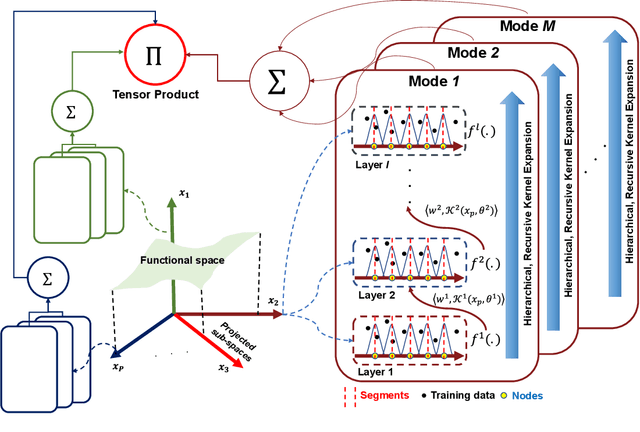
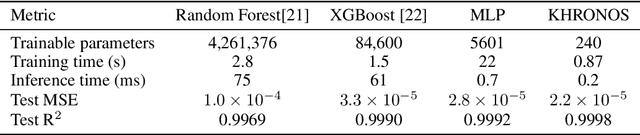
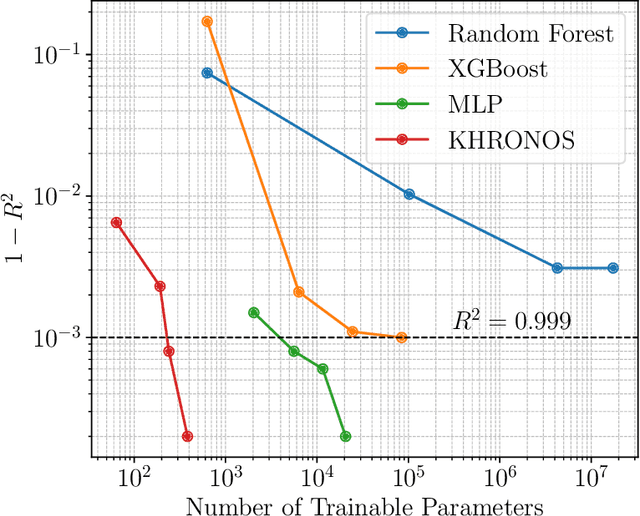
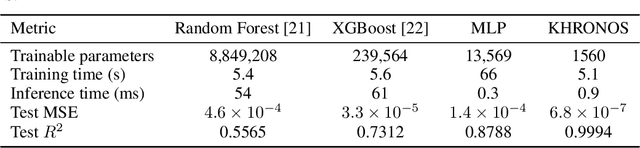
Contemporary models of high dimensional physical systems are constrained by the curse of dimensionality and a reliance on dense data. We introduce KHRONOS (Kernel Expansion Hierarchy for Reduced Order, Neural Optimized Surrogates), an AI framework for model based, model free and model inversion tasks. KHRONOS constructs continuously differentiable target fields with a hierarchical composition of per-dimension kernel expansions, which are tensorized into modes and then superposed. We evaluate KHRONOS on a canonical 2D, Poisson equation benchmark: across 16 to 512 degrees of freedom (DoFs), it obtained L2 square errors of 5e-4 down to 6e-10. This represents a 100 time gain over Kolmogorov Arnold Networks (which itself reports a 100 times improvement on MLPs/PINNs with 100 times fewer parameters) when controlling for the number of parameters. This also represents a 1e4 times improvement in L2 square error compared to standard linear FEM at comparable DoFs. Inference complexity is dominated by inner products, yielding sub-millisecond full-field predictions that scale to an arbitrary resolution. For inverse problems, KHRONOS facilitates rapid, iterative level set recovery in only a few forward evaluations, with sub-microsecond per sample latency. KHRONOS scalability, expressivity, and interpretability open new avenues in constrained edge computing, online control, computer vision, and beyond.