 Add to Chrome
 Add to Firefox
 Add to Edge
Separable neural architectures as a primitive for unified predictive and generative intelligence
Mar 12, 2026
Intelligent systems across physics, language and perception often exhibit factorisable structure, yet are typically modelled by monolithic neural architectures that do not explicitly exploit this structure. The separable neural architecture (SNA) addresses this by formalising a representational class that unifies additive, quadratic and tensor-decomposed neural models. By constraining interaction order and tensor rank, SNAs impose a structural inductive bias that factorises high-dimensional mappings into low-arity components. Separability need not be a property of the system itself: it often emerges in the coordinates or representations through which the system is expressed. Crucially, this coordinate-aware formulation reveals a structural analogy between chaotic spatiotemporal dynamics and linguistic autoregression. By treating continuous physical states as smooth, separable embeddings, SNAs enable distributional modelling of chaotic systems. This approach mitigates the nonphysical drift characteristics of deterministic operators whilst remaining applicable to discrete sequences. The compositional versatility of this approach is demonstrated across four domains: autonomous waypoint navigation via reinforcement learning, inverse generation of multifunctional microstructures, distributional modelling of turbulent flow and neural language modelling. These results establish the separable neural architecture as a domain-agnostic primitive for predictive and generative intelligence, capable of unifying both deterministic and distributional representations.

A Kernel-based Resource-efficient Neural Surrogate for Multi-fidelity Prediction of Aerodynamic Field
Dec 11, 2025Surrogate models provide fast alternatives to costly aerodynamic simulations and are extremely useful in design and optimization applications. This study proposes the use of a recent kernel-based neural surrogate, KHRONOS. In this work, we blend sparse high-fidelity (HF) data with low-fidelity (LF) information to predict aerodynamic fields under varying constraints in computational resources. Unlike traditional approaches, KHRONOS is built upon variational principles, interpolation theory, and tensor decomposition. These elements provide a mathematical basis for heavy pruning compared to dense neural networks. Using the AirfRANS dataset as a high-fidelity benchmark and NeuralFoil to generate low-fidelity counterparts, this work compares the performance of KHRONOS with three contemporary model architectures: a multilayer perceptron (MLP), a graph neural network (GNN), and a physics-informed neural network (PINN). We consider varying levels of high-fidelity data availability (0%, 10%, and 30%) and increasingly complex geometry parameterizations. These are used to predict the surface pressure coefficient distribution over the airfoil. Results indicate that, whilst all models eventually achieve comparable predictive accuracy, KHRONOS excels in resource-constrained conditions. In this domain, KHRONOS consistently requires orders of magnitude fewer trainable parameters and delivers much faster training and inference than contemporary dense neural networks at comparable accuracy. These findings highlight the potential of KHRONOS and similar architectures to balance accuracy and efficiency in multi-fidelity aerodynamic field prediction.
Efficient Aircraft Design Optimization Using Multi-Fidelity Models and Multi-fidelity Physics Informed Neural Networks
Dec 24, 2024Aircraft design optimization traditionally relies on computationally expensive simulation techniques such as Finite Element Method (FEM) and Finite Volume Method (FVM), which, while accurate, can significantly slow down the design iteration process. The challenge lies in reducing the computational complexity while maintaining high accuracy for quick evaluations of multiple design alternatives. This research explores advanced methods, including surrogate models, reduced-order models (ROM), and multi-fidelity machine learning techniques, to achieve more efficient aircraft design evaluations. Specifically, the study investigates the application of Multi-fidelity Physics-Informed Neural Networks (MPINN) and autoencoders for manifold alignment, alongside the potential of Generative Adversarial Networks (GANs) for refining design geometries. Through a proof-of-concept task, the research demonstrates the ability to predict high-fidelity results from low-fidelity simulations, offering a path toward faster and more cost effective aircraft design iterations.
Graph neural network framework for energy mapping of hybrid monte-carlo molecular dynamics simulations of Medium Entropy Alloys
Nov 20, 2024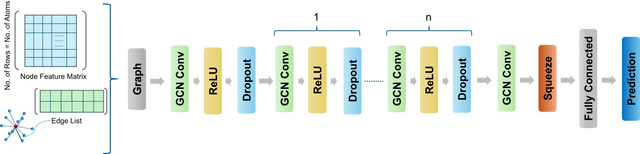
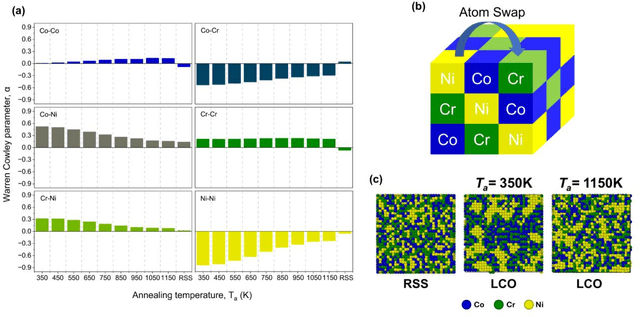
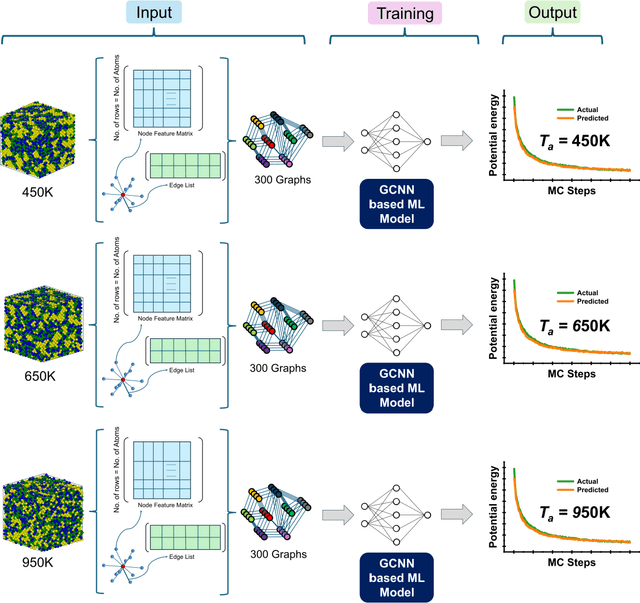
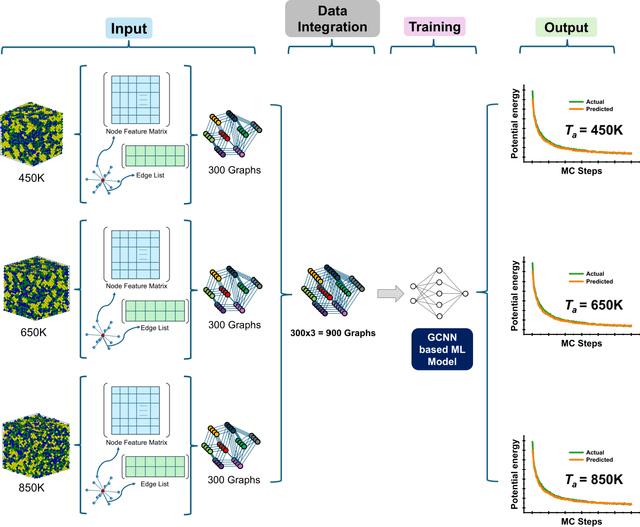
Machine learning (ML) methods have drawn significant interest in material design and discovery. Graph neural networks (GNNs), in particular, have demonstrated strong potential for predicting material properties. The present study proposes a graph-based representation for modeling medium-entropy alloys (MEAs). Hybrid Monte-Carlo molecular dynamics (MC/MD) simulations are employed to achieve thermally stable structures across various annealing temperatures in an MEA. These simulations generate dump files and potential energy labels, which are used to construct graph representations of the atomic configurations. Edges are created between each atom and its 12 nearest neighbors without incorporating explicit edge features. These graphs then serve as input for a Graph Convolutional Neural Network (GCNN) based ML model to predict the system's potential energy. The GCNN architecture effectively captures the local environment and chemical ordering within the MEA structure. The GCNN-based ML model demonstrates strong performance in predicting potential energy at different steps, showing satisfactory results on both the training data and unseen configurations. Our approach presents a graph-based modeling framework for MEAs and high-entropy alloys (HEAs), which effectively captures the local chemical order (LCO) within the alloy structure. This allows us to predict key material properties influenced by LCO in both MEAs and HEAs, providing deeper insights into how atomic-scale arrangements affect the properties of these alloys.