 Add to Chrome
 Add to Firefox
 Add to Edge
MMORF: A Multi-agent Framework for Designing Multi-objective Retrosynthesis Planning Systems
Apr 06, 2026
Multi-objective retrosynthesis planning is a critical chemistry task requiring dynamic balancing of quality, safety, and cost objectives. Language model-based multi-agent systems (MAS) offer a promising approach for this task: leveraging interactions of specialized agents to incorporate multiple objectives into retrosynthesis planning. We present MMORF, a framework for constructing MAS for multi-objective retrosynthesis planning. MMORF features modular agentic components, which can be flexibly combined and configured into different systems, enabling principled evaluation and comparison of different system designs. Using MMORF, we construct two representative MAS: MASIL and RFAS. On a newly curated benchmark consisting of 218 multi-objective retrosynthesis planning tasks, MASIL achieves strong safety and cost metrics on soft-constraint tasks, frequently Pareto-dominating baseline routes, while RFAS achieves a 48.6% success rate on hard-constraint tasks, outperforming state-of-the-art baselines. Together, these results show the effectiveness of MMORF as a foundational framework for exploring MAS for multi-objective retrosynthesis planning. Code and data are available at https://anonymous.4open.science/r/MMORF/.

Uncertainty as a Planning Signal: Multi-Turn Decision Making for Goal-Oriented Conversation
Apr 05, 2026Goal-oriented conversational systems require making sequential decisions under uncertainty about the user's intent, where the algorithm must balance information acquisition and target commitment over multiple turns. Existing approaches address this challenge from different perspectives: structured methods enable multi-step planning but rely on predefined schemas, while LLM-based approaches support flexible interactions but lack long-horizon decision making, resulting in poor coordination between information acquisition and target commitment. To address this limitation, we formulate goal-oriented conversation as an uncertainty-aware sequential decision problem, where uncertainty serves as a guiding signal for multi-turn decision making. We propose a Conversation Uncertainty-aware Planning framework (CUP) that integrates language models with structured planning: a language model proposes feasible actions, and a planner evaluates their long-term impact on uncertainty reduction. Experiments on multiple conversational benchmarks show that CUP consistently improves success rates while requiring fewer interaction turns. Further analysis demonstrates that uncertainty-aware planning contributes to more efficient information acquisition and earlier confident commitment.
LIDDIA: Language-based Intelligent Drug Discovery Agent
Feb 19, 2025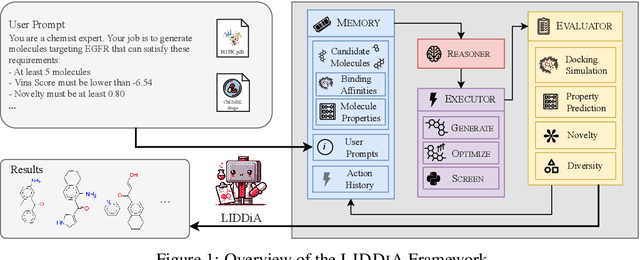
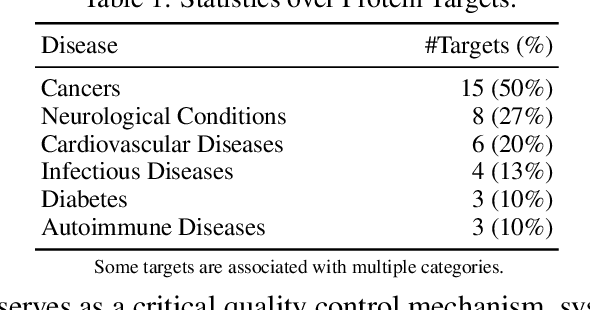
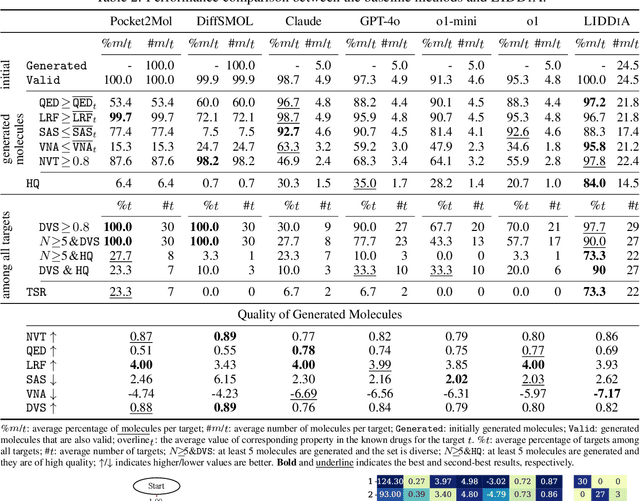
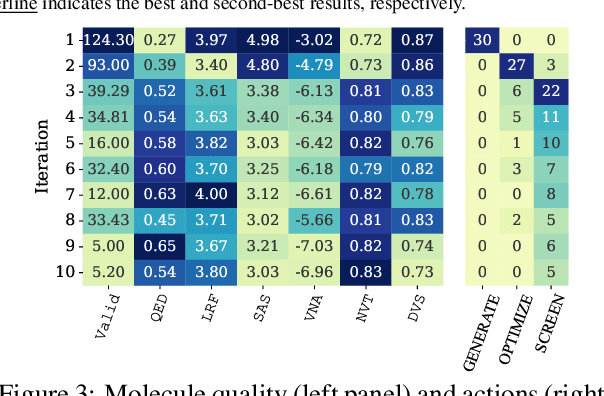
Drug discovery is a long, expensive, and complex process, relying heavily on human medicinal chemists, who can spend years searching the vast space of potential therapies. Recent advances in artificial intelligence for chemistry have sought to expedite individual drug discovery tasks; however, there remains a critical need for an intelligent agent that can navigate the drug discovery process. Towards this end, we introduce LIDDiA, an autonomous agent capable of intelligently navigating the drug discovery process in silico. By leveraging the reasoning capabilities of large language models, LIDDiA serves as a low-cost and highly-adaptable tool for autonomous drug discovery. We comprehensively examine LIDDiA, demonstrating that (1) it can generate molecules meeting key pharmaceutical criteria on over 70% of 30 clinically relevant targets, (2) it intelligently balances exploration and exploitation in the chemical space, and (3) it can identify promising novel drug candidates on EGFR, a critical target for cancers.
Entity Decomposition with Filtering: A Zero-Shot Clinical Named Entity Recognition Framework
Jul 05, 2024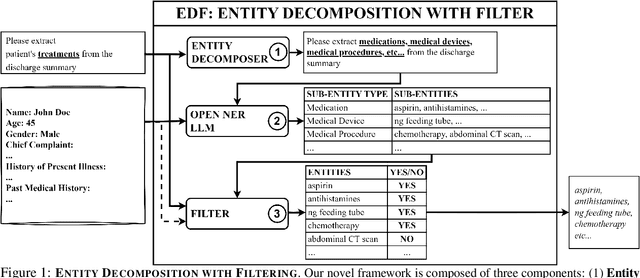
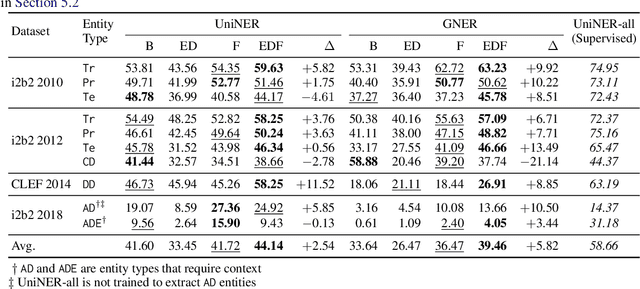
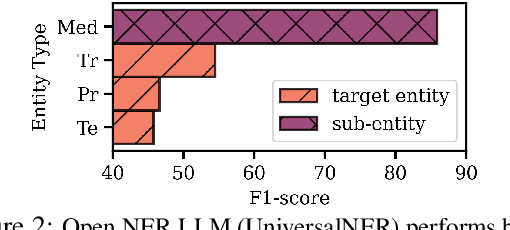
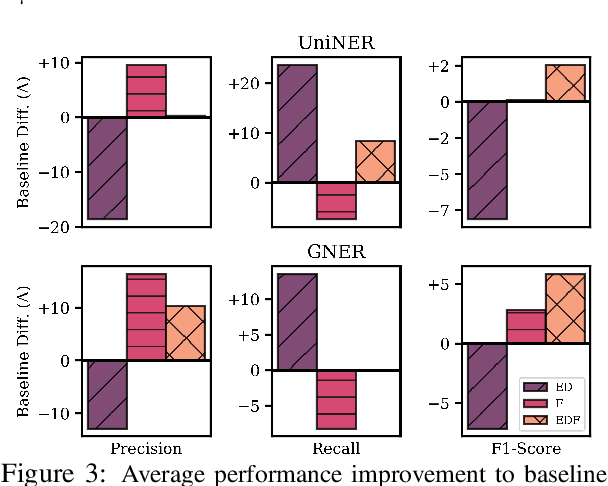
Clinical named entity recognition (NER) aims to retrieve important entities within clinical narratives. Recent works have demonstrated that large language models (LLMs) can achieve strong performance in this task. While previous works focus on proprietary LLMs, we investigate how open NER LLMs, trained specifically for entity recognition, perform in clinical NER. In this paper, we aim to improve them through a novel framework, entity decomposition with filtering, or EDF. Our key idea is to decompose the entity recognition task into several retrievals of sub-entity types. We also introduce a filtering mechanism to remove incorrect entities. Our experimental results demonstrate the efficacy of our framework across all metrics, models, datasets, and entity types. Our analysis reveals that entity decomposition can recognize previously missed entities with substantial improvement. We further provide a comprehensive evaluation of our framework and an in-depth error analysis to pave future works.
Unified Out-Of-Distribution Detection: A Model-Specific Perspective
Apr 13, 2023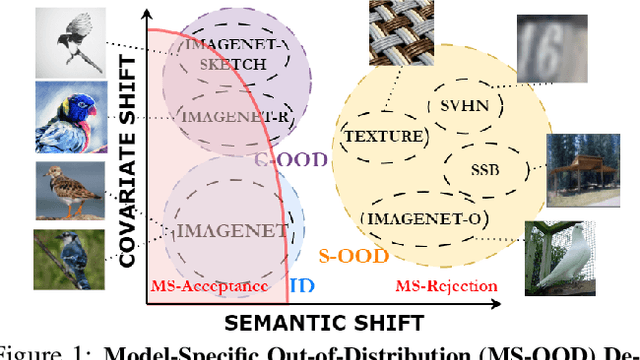
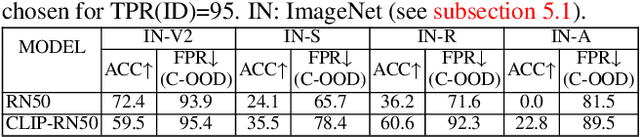
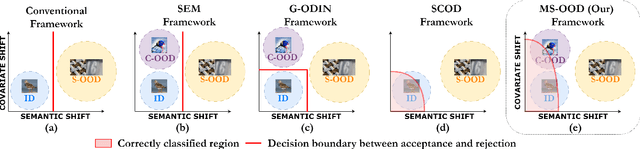
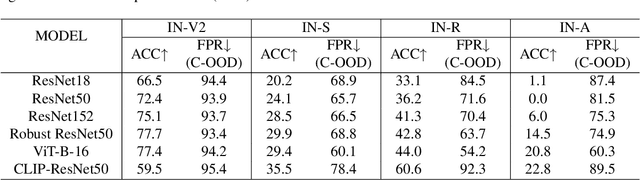
Out-of-distribution (OOD) detection aims to identify test examples that do not belong to the training distribution and are thus unlikely to be predicted reliably. Despite a plethora of existing works, most of them focused only on the scenario where OOD examples come from semantic shift (e.g., unseen categories), ignoring other possible causes (e.g., covariate shift). In this paper, we present a novel, unifying framework to study OOD detection in a broader scope. Instead of detecting OOD examples from a particular cause, we propose to detect examples that a deployed machine learning model (e.g., an image classifier) is unable to predict correctly. That is, whether a test example should be detected and rejected or not is ``model-specific''. We show that this framework unifies the detection of OOD examples caused by semantic shift and covariate shift, and closely addresses the concern of applying a machine learning model to uncontrolled environments. We provide an extensive analysis that involves a variety of models (e.g., different architectures and training strategies), sources of OOD examples, and OOD detection approaches, and reveal several insights into improving and understanding OOD detection in uncontrolled environments.