 Add to Chrome
 Add to Firefox
 Add to Edge
Uncertainty as a Planning Signal: Multi-Turn Decision Making for Goal-Oriented Conversation
Apr 05, 2026
Goal-oriented conversational systems require making sequential decisions under uncertainty about the user's intent, where the algorithm must balance information acquisition and target commitment over multiple turns. Existing approaches address this challenge from different perspectives: structured methods enable multi-step planning but rely on predefined schemas, while LLM-based approaches support flexible interactions but lack long-horizon decision making, resulting in poor coordination between information acquisition and target commitment. To address this limitation, we formulate goal-oriented conversation as an uncertainty-aware sequential decision problem, where uncertainty serves as a guiding signal for multi-turn decision making. We propose a Conversation Uncertainty-aware Planning framework (CUP) that integrates language models with structured planning: a language model proposes feasible actions, and a planner evaluates their long-term impact on uncertainty reduction. Experiments on multiple conversational benchmarks show that CUP consistently improves success rates while requiring fewer interaction turns. Further analysis demonstrates that uncertainty-aware planning contributes to more efficient information acquisition and earlier confident commitment.

Captions Speak Louder than Images (CASLIE): Generalizing Foundation Models for E-commerce from High-quality Multimodal Instruction Data
Oct 22, 2024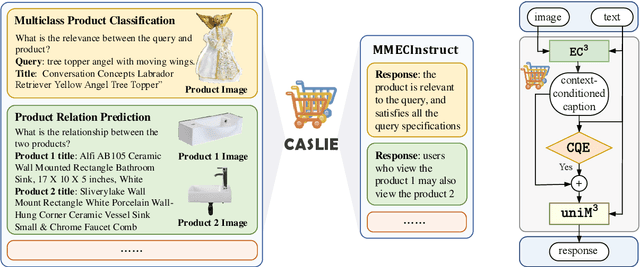


Leveraging multimodal data to drive breakthroughs in e-commerce applications through Multimodal Foundation Models (MFMs) is gaining increasing attention from the research community. However, there are significant challenges that hinder the optimal use of multimodal e-commerce data by foundation models: (1) the scarcity of large-scale, high-quality multimodal benchmark datasets; and (2) the lack of effective multimodal information integration methods. To address these challenges, in this paper, we introduce MMECInstruct, the first-ever, large-scale, and high-quality multimodal instruction dataset for e-commerce. We also develop CASLIE, a simple, lightweight, yet effective framework for integrating multimodal information for e-commerce. Leveraging MMECInstruct, we fine-tune a series of e-commerce MFMs within CASLIE, denoted as CASLIE models. Our comprehensive evaluation demonstrates that CASLIE models substantially outperform 5 categories of advanced baseline models in the in-domain evaluation. Moreover, CASLIE models show strong generalizability to out-of-domain settings. MMECInstruct and CASLIE models are publicly accessible through https://ninglab.github.io/CASLIE/.
eCeLLM: Generalizing Large Language Models for E-commerce from Large-scale, High-quality Instruction Data
Feb 13, 2024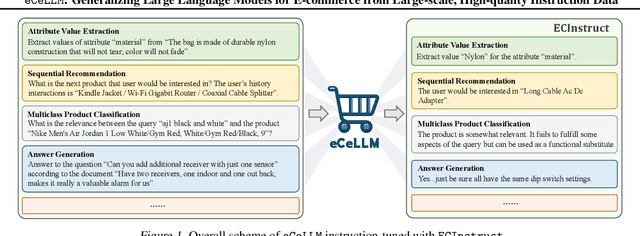

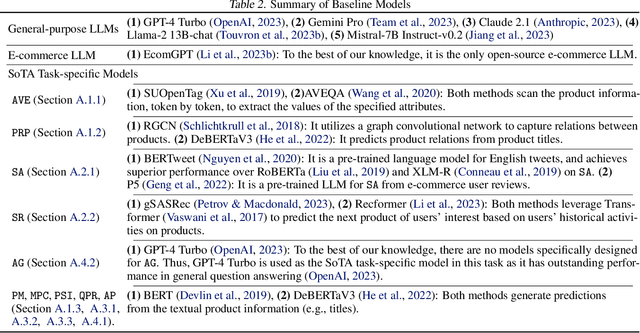

With tremendous efforts on developing effective e-commerce models, conventional e-commerce models show limited success in generalist e-commerce modeling, and suffer from unsatisfactory performance on new users and new products - a typical out-of-domain generalization challenge. Meanwhile, large language models (LLMs) demonstrate outstanding performance in generalist modeling and out-of-domain generalizability in many fields. Toward fully unleashing their power for e-commerce, in this paper, we construct ECInstruct, the first open-sourced, large-scale, and high-quality benchmark instruction dataset for e-commerce. Leveraging ECInstruct, we develop eCeLLM, a series of e-commerce LLMs, by instruction-tuning general-purpose LLMs. Our comprehensive experiments and evaluation demonstrate that eCeLLM models substantially outperform baseline models, including the most advanced GPT-4, and the state-of-the-art task-specific models in in-domain evaluation. Moreover, eCeLLM exhibits excellent generalizability to out-of-domain settings, including unseen products and unseen instructions, highlighting its superiority as a generalist e-commerce model. Both the ECInstruct dataset and the eCeLLM models show great potential in empowering versatile and effective LLMs for e-commerce. ECInstruct and eCeLLM models are publicly accessible through https://ninglab.github.io/eCeLLM.