 Add to Chrome
 Add to Firefox
 Add to Edge
Unbiased Multimodal Reranking for Long-Tail Short-Video Search
Mar 26, 2026
Kuaishou serving hundreds of millions of searches daily, the quality of short-video search is paramount. However, it suffers from a severe Matthew effect on long-tail queries: sparse user behavior data causes models to amplify low-quality content such as clickbait and shallow content. The recent advancements in Large Language Models (LLMs) offer a new paradigm, as their inherent world knowledge provides a powerful mechanism to assess content quality, agnostic to sparse user interactions. To this end, we propose a LLM-driven multimodal reranking framework, which estimates user experience without real user behavior. The approach involves a two-stage training process: the first stage uses multimodal evidence to construct high-quality annotations for supervised fine-tuning, while the second stage incorporates pairwise preference optimization to help the model learn partial orderings among candidates. At inference time, the resulting experience scores are used to promote high-quality but underexposed videos in reranking, and further guide page-level optimization through reinforcement learning. Experiments show that the proposed method achieves consistent improvements over strong baselines in offline metrics including AUC, NDCG@K, and human preference judgement. An online A/B test covering 15\% of traffic further demonstrates gains in both user experience and consumption metrics, confirming the practical value of the approach in long-tail video search scenarios.

SaFRO: Satisfaction-Aware Fusion via Dual-Relative Policy Optimization for Short-Video Search
Mar 20, 2026Multi-Task Fusion plays a pivotal role in industrial short-video search systems by aggregating heterogeneous prediction signals into a unified ranking score. However, existing approaches predominantly optimize for immediate engagement metrics, which often fail to align with long-term user satisfaction. While Reinforcement Learning (RL) offers a promising avenue for user satisfaction optimization, its direct application to search scenarios is non-trivial due to the inherent data sparsity and intent constraints compared to recommendation feeds. To this end, we propose SaFRO, a novel framework designed to optimize user satisfaction in short-video search. We first construct a satisfaction-aware reward model that utilizes query-level behavioral proxies to capture holistic user satisfaction beyond item-level interactions. Then we introduce Dual-Relative Policy Optimization (DRPO), an efficient policy learning method that updates the fusion policy through relative preference comparisons within groups and across batches. Furthermore, we design a Task-Relation-Aware Fusion module to explicitly model the interdependencies among different objectives, enabling context-sensitive weight adaptation. Extensive offline evaluations and large-scale online A/B tests on Kuaishou short-video search platform demonstrate that SaFRO significantly outperforms state-of-the-art baselines, delivering substantial gains in both short-term ranking quality and long-term user retention.
Generalizable Task Representation Learning for Offline Meta-Reinforcement Learning with Data Limitations
Dec 26, 2023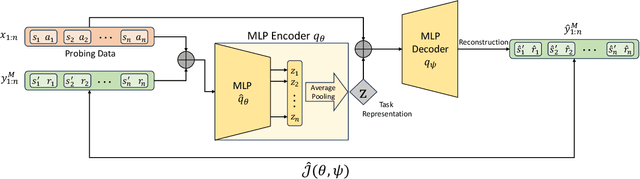
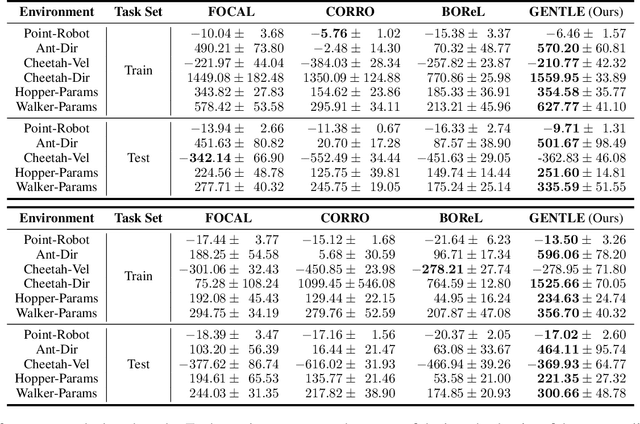
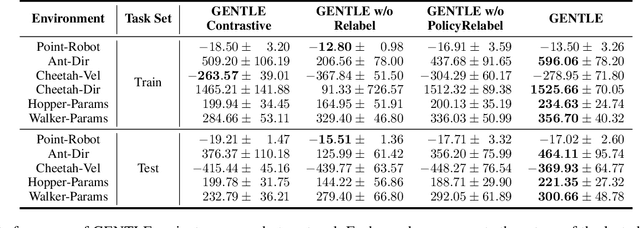
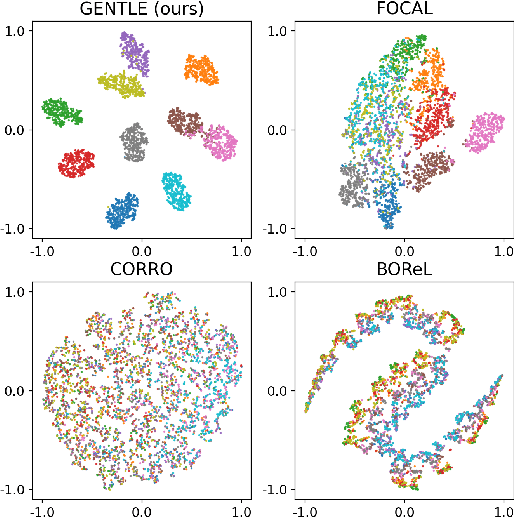
Generalization and sample efficiency have been long-standing issues concerning reinforcement learning, and thus the field of Offline Meta-Reinforcement Learning~(OMRL) has gained increasing attention due to its potential of solving a wide range of problems with static and limited offline data. Existing OMRL methods often assume sufficient training tasks and data coverage to apply contrastive learning to extract task representations. However, such assumptions are not applicable in several real-world applications and thus undermine the generalization ability of the representations. In this paper, we consider OMRL with two types of data limitations: limited training tasks and limited behavior diversity and propose a novel algorithm called GENTLE for learning generalizable task representations in the face of data limitations. GENTLE employs Task Auto-Encoder~(TAE), which is an encoder-decoder architecture to extract the characteristics of the tasks. Unlike existing methods, TAE is optimized solely by reconstruction of the state transition and reward, which captures the generative structure of the task models and produces generalizable representations when training tasks are limited. To alleviate the effect of limited behavior diversity, we consistently construct pseudo-transitions to align the data distribution used to train TAE with the data distribution encountered during testing. Empirically, GENTLE significantly outperforms existing OMRL methods on both in-distribution tasks and out-of-distribution tasks across both the given-context protocol and the one-shot protocol.