 Add to Chrome
 Add to Firefox
 Add to Edge
Physiological World Models for Human State Transitions
Aug 15, 2026
Continuous multimodal sensing now allows human physiology to be observed throughout daily life rather than only during occasional clinical visits. However, most health artificial intelligence systems are designed to recognize current states, estimate risks or analyse individual biomarkers. They do not directly model how physiological states change in response to real-world events, behaviours, contexts and interventions. Here we propose the Physiological World Model (PWM), an event-conditioned framework for learning these changes at the level of the whole person. We introduce the HumanState Transition Token, a structured, quality-scored unit that connects the physiological state before an event with the event or action, relevant context and intervention information, the physiological trajectory after the event, observed outcomes and data quality. We describe four capability levels, from state representation to bounded intervention planning, together with four data acquisition and validation protocols. We also propose six benchmark tasks covering HumanState representation, forecasting across multiple timescales, individualized response prediction, simulation of alternative interventions, bounded planning and reliability under distribution shift. Together, this framework provides a practical path towards personalized health management, behavioural intervention design and clinician-supervised decision support, while clearly separating prediction from causal inference and making uncertainty, safety, governance and limits of use explicit.

FocusChat: Text-guided Long Video Understanding via Spatiotemporal Information Filtering
Dec 17, 2024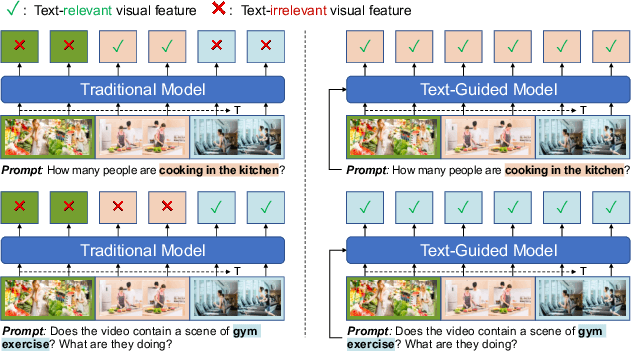
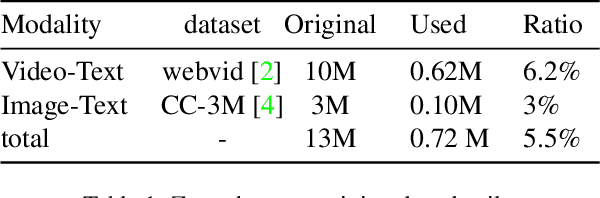
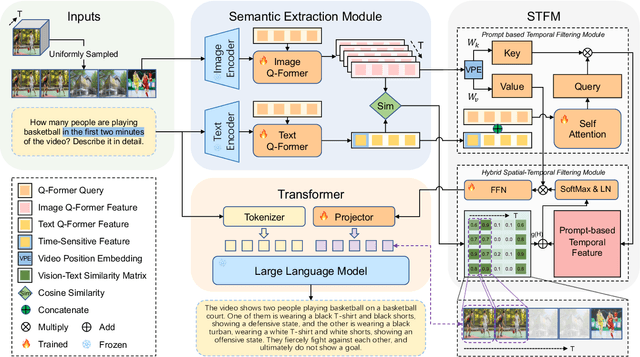
Recently, multi-modal large language models have made significant progress. However, visual information lacking of guidance from the user's intention may lead to redundant computation and involve unnecessary visual noise, especially in long, untrimmed videos. To address this issue, we propose FocusChat, a text-guided multi-modal large language model (LLM) that emphasizes visual information correlated to the user's prompt. In detail, Our model first undergoes the semantic extraction module, which comprises a visual semantic branch and a text semantic branch to extract image and text semantics, respectively. The two branches are combined using the Spatial-Temporal Filtering Module (STFM). STFM enables explicit spatial-level information filtering and implicit temporal-level feature filtering, ensuring that the visual tokens are closely aligned with the user's query. It lowers the essential number of visual tokens inputted into the LLM. FocusChat significantly outperforms Video-LLaMA in zero-shot experiments, using an order of magnitude less training data with only 16 visual tokens occupied. It achieves results comparable to the state-of-the-art in few-shot experiments, with only 0.72M pre-training data.