 Add to Chrome
 Add to Firefox
 Add to Edge
KeySI: An Interaction Framework for Tuning Text Embeddings Based on Human Feedback
Jul 24, 2026
In large-scale text analysis tasks, pre-trained language models are often used to embed text corpora for downstream analysis. However, such models may struggle to capture domain-specific semantics and adapting them typically requires large amounts of labeled data and technical expertise to implement training pipelines. Recent approaches have demonstrated how visual interactions in document projections can capture human feedback as training signals for model tuning. However, these methods operate on document-level feedback, which requires users to open and assess individual documents in order to provide effective feedback. In this paper, we propose KeySI, an interaction framework that enables feature-level feedback through keyword-based concept specification. Users specify feedback by organizing extracted keywords into groups representing concepts, which KeySI translates into document-level supervision for subsequent tuning. By operating on keywords as the primary interaction medium, KeySI reduces the need for manual document inspection and labeling and lowers the barrier to adapting embedding models. We present a prototype implementation that, given a corpus, curates representative keywords, visualizes keywords and document embeddings via dimensionality reduction, allows interactive specification of keyword groups, and supports iterative refinement through system feedback. We evaluate KeySI through a user study, usage scenarios, and quantitative experiments demonstrating its effectiveness in capturing user intent and improving embedding alignment.

Scalable Semantic Steering of Embedding Projections
Jul 04, 2026Low-dimensional projections support interactive visual analysis of high-dimensional data embeddings, but their structure often does not align with analyst-defined semantic relationships. Recent LLM-augmented semantic steering methods address this gap by externalizing analyst intent from user-defined groups of seed examples, but they propagate intent through per-item LLM reasoning, causing LLM calls and cost to grow linearly with collection size. We propose a scalable semantic steering method that shifts semantic computation from individual items to user-defined groups. A single LLM call generates structured profiles for all groups, which are embedded and combined with seed centroids to form hybrid semantic prototypes. The method then propagates intent without retraining, using embedding-space soft assignment, abstention, and alignment-scaled updates before reprojection. On a 5K-document LitCovid corpus, our method achieves global alignment comparable to per-item LLM steering while reducing LLM calls by over three orders of magnitude. An image case study shows that the same prototype-based mechanism extends to multimodal embeddings. These results suggest that group-level representations can make semantic steering more practical for larger embedding collections.
Context-Aware Explanations for Spatialized Document Layouts
Jun 26, 2026Spatialized document layouts are widely used for exploratory analysis of text corpora, but interpreting the spatial organization of documents and the relationships between regions remains challenging. Existing approaches primarily summarize document content or explain how layouts are generated, providing limited support for understanding spatial relationships within the layout itself. We present CAPE, a context-aware explanation framework that generates natural-language explanations grounded in both document semantics and layout-derived spatial context. CAPE identifies salient spatial patterns (e.g., clusters, subgroups, outliers, and bridging documents) and constructs multi-level contextual representations to guide LLM-based explanation generation. It supports both AI-guided overview and user-driven exploration, with explanations available at multiple levels of detail. We demonstrate CAPE on news and scholarly document layouts and evaluate it in a controlled user study against keyword-based and content-only LLM baselines. Our results suggest that spatially grounded explanations are perceived as more helpful than content-only baselines for interpreting the spatial organization of document layouts.
LLM-Augmented Semantic Steering of Text Embedding Projection Spaces
May 03, 2026Low-dimensional projections of text embeddings support visual analysis of document collections, but their spatial organization may not reflect the relationships an analyst intends to examine. Existing semantic interaction approaches encode semantic intent indirectly through geometric constraints or model updates, limiting interpretability and flexibility. We introduce LLM-augmented semantic steering, which enables analysts to express semantic intent by grouping a small set of example documents within the projection. A large language model externalizes this intent as natural-language representations and selectively extends it to related documents; the resulting semantic information is then incorporated into document representations via text augmentation or embedding-level blending, without retraining the underlying models. A case study illustrates how the same corpus can be reorganized from different semantic perspectives, while simulation-based evaluation shows that semantic steering improves global and local alignment with target semantic structures using only minimal interaction. Embedding-level blending further enables continuous and controllable steering of projection layouts. These results position projection spaces as intent-dependent semantic workspaces that can be reshaped through explicit, interpretable, language-mediated interaction.
Visualizing Temporal Topic Embeddings with a Compass
Sep 18, 2024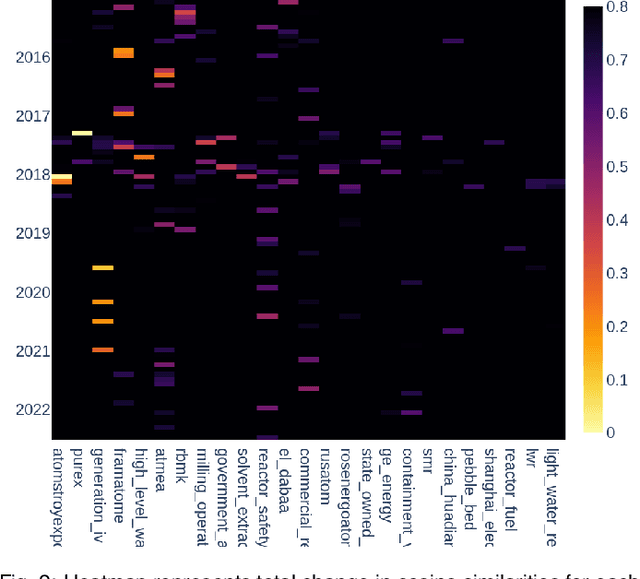
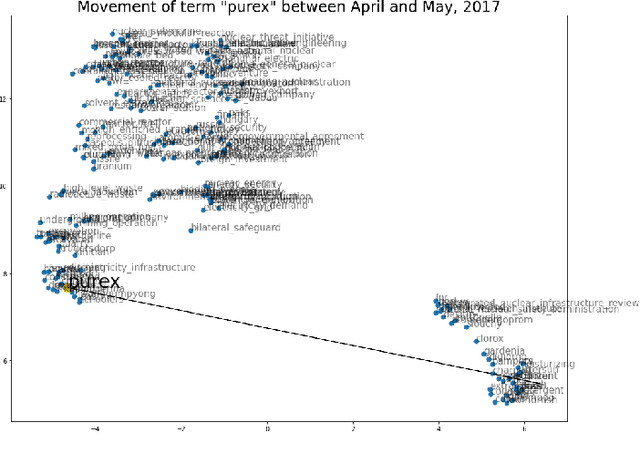
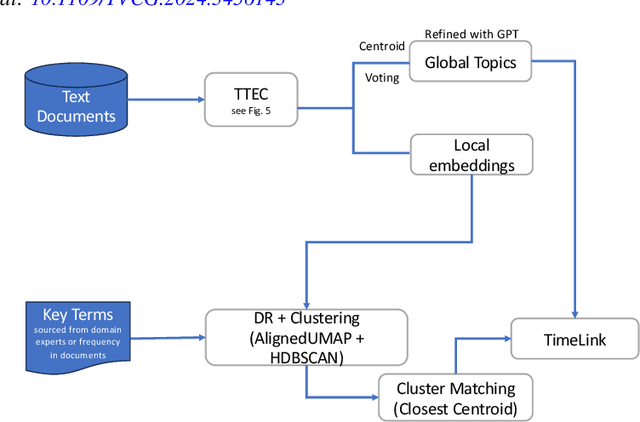
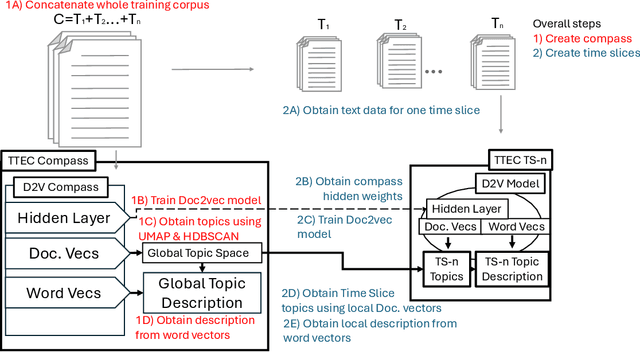
Dynamic topic modeling is useful at discovering the development and change in latent topics over time. However, present methodology relies on algorithms that separate document and word representations. This prevents the creation of a meaningful embedding space where changes in word usage and documents can be directly analyzed in a temporal context. This paper proposes an expansion of the compass-aligned temporal Word2Vec methodology into dynamic topic modeling. Such a method allows for the direct comparison of word and document embeddings across time in dynamic topics. This enables the creation of visualizations that incorporate temporal word embeddings within the context of documents into topic visualizations. In experiments against the current state-of-the-art, our proposed method demonstrates overall competitive performance in topic relevancy and diversity across temporal datasets of varying size. Simultaneously, it provides insightful visualizations focused on temporal word embeddings while maintaining the insights provided by global topic evolution, advancing our understanding of how topics evolve over time.