 Add to Chrome
 Add to Firefox
 Add to Edge
Context-Aware Explanations for Spatialized Document Layouts
Jun 26, 2026
Spatialized document layouts are widely used for exploratory analysis of text corpora, but interpreting the spatial organization of documents and the relationships between regions remains challenging. Existing approaches primarily summarize document content or explain how layouts are generated, providing limited support for understanding spatial relationships within the layout itself. We present CAPE, a context-aware explanation framework that generates natural-language explanations grounded in both document semantics and layout-derived spatial context. CAPE identifies salient spatial patterns (e.g., clusters, subgroups, outliers, and bridging documents) and constructs multi-level contextual representations to guide LLM-based explanation generation. It supports both AI-guided overview and user-driven exploration, with explanations available at multiple levels of detail. We demonstrate CAPE on news and scholarly document layouts and evaluate it in a controlled user study against keyword-based and content-only LLM baselines. Our results suggest that spatially grounded explanations are perceived as more helpful than content-only baselines for interpreting the spatial organization of document layouts.

NetReAct: Interactive Learning for Network Summarization
Dec 22, 2020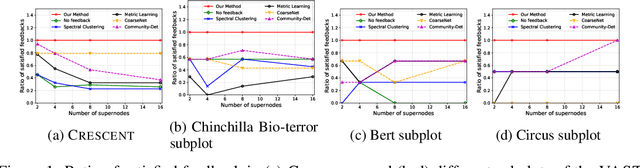
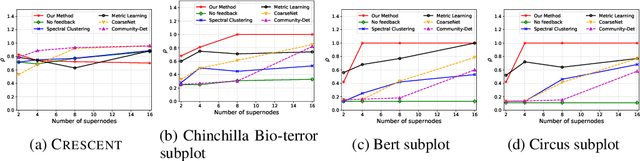
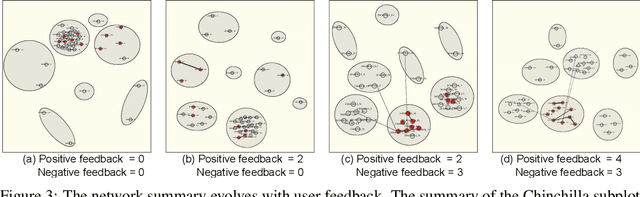
Generating useful network summaries is a challenging and important problem with several applications like sensemaking, visualization, and compression. However, most of the current work in this space do not take human feedback into account while generating summaries. Consider an intelligence analysis scenario, where the analyst is exploring a similarity network between documents. The analyst can express her agreement/disagreement with the visualization of the network summary via iterative feedback, e.g. closing or moving documents ("nodes") together. How can we use this feedback to improve the network summary quality? In this paper, we present NetReAct, a novel interactive network summarization algorithm which supports the visualization of networks induced by text corpora to perform sensemaking. NetReAct incorporates human feedback with reinforcement learning to summarize and visualize document networks. Using scenarios from two datasets, we show how NetReAct is successful in generating high-quality summaries and visualizations that reveal hidden patterns better than other non-trivial baselines.