 Add to Chrome
 Add to Firefox
 Add to Edge
Controllable Generative Sandbox for Causal Inference
Mar 03, 2026
Method validation and study design in causal inference rely on synthetic data with known counterfactuals. Existing simulators trade off distributional realism, the ability to capture mixed-type and multimodal tabular data, against causal controllability, including explicit control over overlap, unmeasured confounding, and treatment effect heterogeneity. We introduce CausalMix, a variational generative framework that closes this gap by coupling a mixture of Gaussian latent priors with data-type-specific decoders for continuous, binary, and categorical variables. The model incorporates explicit causal controls: an overlap regularizer shaping propensity-score distributions, alongside direct parameterizations of confounding strength and effect heterogeneity. This unified objective preserves fidelity to the observed data while enabling factorial manipulation of causal mechanisms, allowing overlap, confounding strength, and treatment effect heterogeneity to be varied independently at design time. Across benchmarks, CausalMix achieves state-of-the-art distributional metrics on mixed-type tables while providing stable, fine-grained causal control. We demonstrate practical utility in a comparative safety study of metastatic castration-resistant prostate cancer treatments, using CausalMix to compare estimators under calibrated data-generating processes, tune hyperparameters, and conduct simulation-based power analyses under targeted treatment effect heterogeneity scenarios.

Coarsening Bias from Variable Discretization in Causal Functionals
Feb 25, 2026A class of causal effect functionals requires integration over conditional densities of continuous variables, as in mediation effects and nonparametric identification in causal graphical models. Estimating such densities and evaluating the resulting integrals can be statistically and computationally demanding. A common workaround is to discretize the variable and replace integrals with finite sums. Although convenient, discretization alters the population-level functional and can induce non-negligible approximation bias, even under correct identification. Under smoothness conditions, we show that this coarsening bias is first order in the bin width and arises at the level of the target functional, distinct from statistical estimation error. We propose a simple bias-reduced functional that evaluates the outcome regression at within-bin conditional means, eliminating the leading term and yielding a second-order approximation error. We derive plug-in and one-step estimators for the bias-reduced functional. Simulations demonstrate substantial bias reduction and near-nominal confidence interval coverage, even under coarse binning. Our results provide a simple framework for controlling the impact of variable discretization on parameter approximation and estimation.
Weighting-Based Identification and Estimation in Graphical Models of Missing Data
Feb 11, 2026We propose a constructive algorithm for identifying complete data distributions in graphical models of missing data. The complete data distribution is unrestricted, while the missingness mechanism is assumed to factorize according to a conditional directed acyclic graph. Our approach follows an interventionist perspective in which missingness indicators are treated as variables that can be intervened on. A central challenge in this setting is that sequences of interventions on missingness indicators may induce and propagate selection bias, so that identification can fail even when a propensity score is invariant to available interventions. To address this challenge, we introduce a tree-based identification algorithm that explicitly tracks the creation and propagation of selection bias and determines whether it can be avoided through admissible intervention strategies. The resulting tree provides both a diagnostic and a constructive characterization of identifiability under a given missingness mechanism. Building on these results, we develop recursive inverse probability weighting procedures that mirror the intervention logic of the identification algorithm, yielding valid estimating equations for both the missingness mechanism and functionals of the complete data distribution. Simulation studies and a real-data application illustrate the practical performance of the proposed methods. An accompanying R package, flexMissing, implements all proposed procedures.
Causal Inference for Preprocessed Outcomes with an Application to Functional Connectivity
Feb 02, 2026In biomedical research, repeated measurements within each subject are often processed to remove artifacts and unwanted sources of variation. The resulting data are used to construct derived outcomes that act as proxies for scientific outcomes that are not directly observable. Although intra-subject processing is widely used, its impact on inter-subject statistical inference has not been systematically studied, and a principled framework for causal analysis in this setting is lacking. In this article, we propose a semiparametric framework for causal inference with derived outcomes obtained after intra-subject processing. This framework applies to settings with a modular structure, where intra-subject analyses are conducted independently across subjects and are followed by inter-subject analyses based on parameters from the intra-subject stage. We develop multiply robust estimators of causal parameters under rate conditions on both intra-subject and inter-subject models, which allows the use of flexible machine learning. We specialize the framework to a mediation setting and focus on the natural direct effect. For high dimensional inference, we employ a step-down procedure that controls the exceedance rate of the false discovery proportion. Simulation studies demonstrate the superior performance of the proposed approach. We apply our method to estimate the impact of stimulant medication on brain connectivity in children with autism spectrum disorder.
Causal Inference with the "Napkin Graph"
Dec 22, 2025Unmeasured confounding can render identification strategies based on adjustment functionals invalid. We study the "Napkin graph", a causal structure that encapsulates patterns of M-bias, instrumental variables, and the classical back-door and front-door models within a single graphical framework, yet requires a nonstandard identification strategy: the average treatment effect is expressed as a ratio of two g-formulas. We develop novel estimators for this functional, including doubly robust one-step and targeted minimum loss-based estimators that remain asymptotically linear when nuisance functions are estimated at slower-than-parametric rates using machine learning. We also show how a generalized independence restriction encoded by the Napkin graph, known as a Verma constraint, can be exploited to improve efficiency, illustrating more generally how such constraints in hidden variable DAGs can inform semiparametric inference. The proposed methods are validated through simulations and applied to the Finnish Life Course study to estimate the effect of educational attainment on income. An accompanying R package, napkincausal, implements all proposed procedures.
Assessing Racial Disparities in Healthcare Expenditures Using Causal Path-Specific Effects
Apr 30, 2025
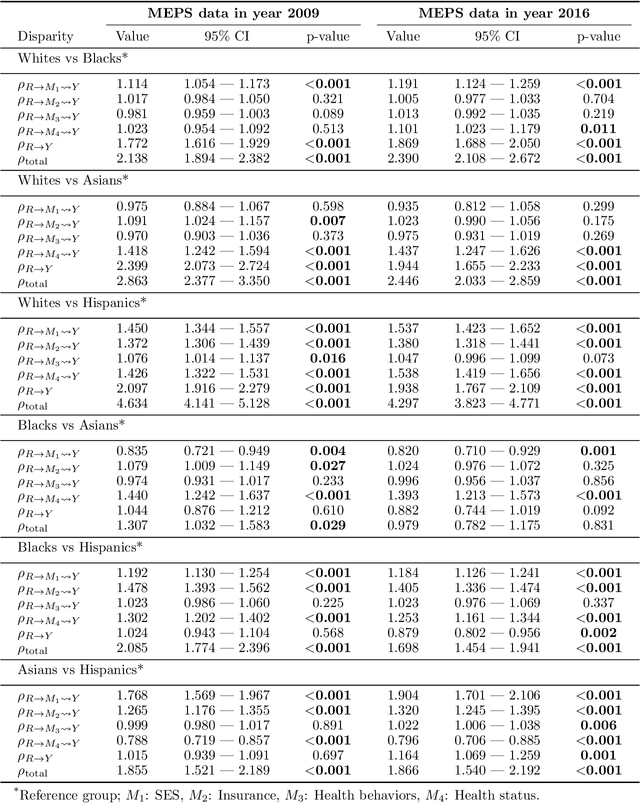
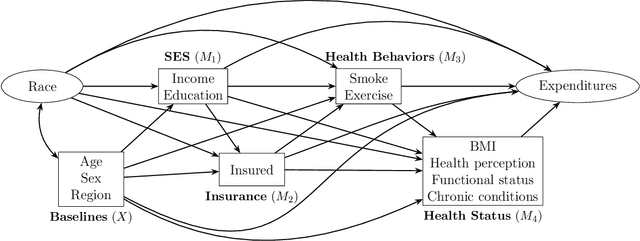
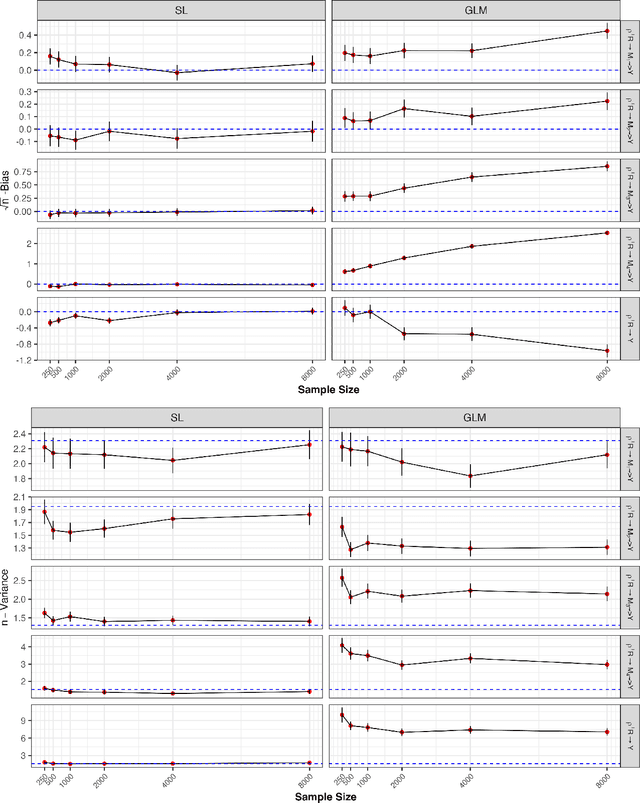
Racial disparities in healthcare expenditures are well-documented, yet the underlying drivers remain complex and require further investigation. This study employs causal and counterfactual path-specific effects to quantify how various factors, including socioeconomic status, insurance access, health behaviors, and health status, mediate these disparities. Using data from the Medical Expenditures Panel Survey, we estimate how expenditures would differ under counterfactual scenarios in which the values of specific mediators were aligned across racial groups along selected causal pathways. A key challenge in this analysis is ensuring robustness against model misspecification while addressing the zero-inflation and right-skewness of healthcare expenditures. For reliable inference, we derive asymptotically linear estimators by integrating influence function-based techniques with flexible machine learning methods, including super learners and a two-part model tailored to the zero-inflated, right-skewed nature of healthcare expenditures.
MissNODAG: Differentiable Cyclic Causal Graph Learning from Incomplete Data
Oct 24, 2024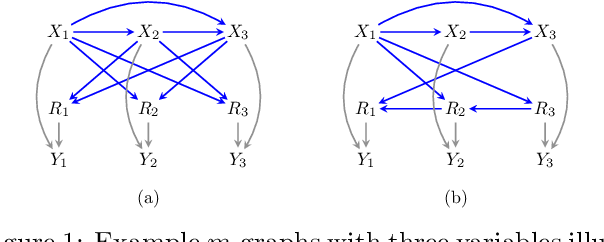

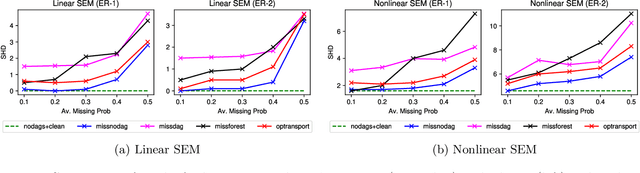
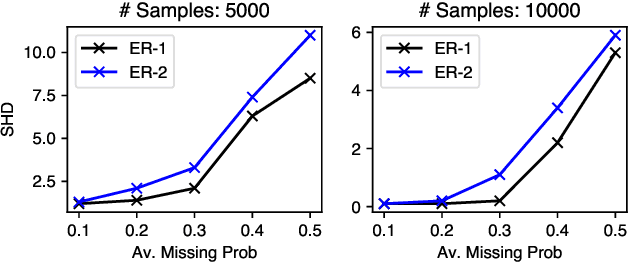
Causal discovery in real-world systems, such as biological networks, is often complicated by feedback loops and incomplete data. Standard algorithms, which assume acyclic structures or fully observed data, struggle with these challenges. To address this gap, we propose MissNODAG, a differentiable framework for learning both the underlying cyclic causal graph and the missingness mechanism from partially observed data, including data missing not at random. Our framework integrates an additive noise model with an expectation-maximization procedure, alternating between imputing missing values and optimizing the observed data likelihood, to uncover both the cyclic structures and the missingness mechanism. We demonstrate the effectiveness of MissNODAG through synthetic experiments and an application to real-world gene perturbation data.
Average Causal Effect Estimation in DAGs with Hidden Variables: Extensions of Back-Door and Front-Door Criteria
Sep 06, 2024
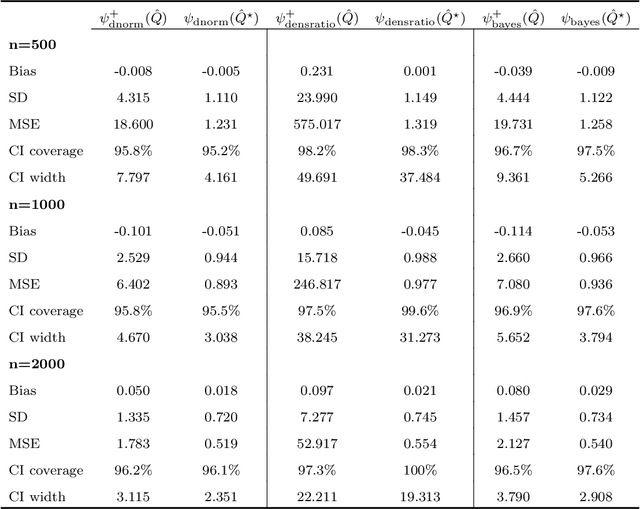

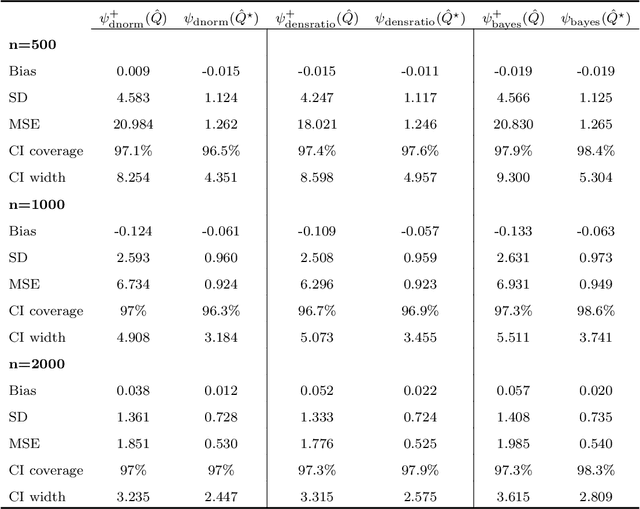
The identification theory for causal effects in directed acyclic graphs (DAGs) with hidden variables is well-developed, but methods for estimating and inferring functionals beyond the g-formula remain limited. Previous studies have proposed semiparametric estimators for identifiable functionals in a broad class of DAGs with hidden variables. While demonstrating double robustness in some models, existing estimators face challenges, particularly with density estimation and numerical integration for continuous variables, and their estimates may fall outside the parameter space of the target estimand. Their asymptotic properties are also underexplored, especially when using flexible statistical and machine learning models for nuisance estimation. This study addresses these challenges by introducing novel one-step corrected plug-in and targeted minimum loss-based estimators of causal effects for a class of DAGs that extend classical back-door and front-door criteria (known as the treatment primal fixability criterion in prior literature). These estimators leverage machine learning to minimize modeling assumptions while ensuring key statistical properties such as asymptotic linearity, double robustness, efficiency, and staying within the bounds of the target parameter space. We establish conditions for nuisance functional estimates in terms of L2(P)-norms to achieve root-n consistent causal effect estimates. To facilitate practical application, we have developed the flexCausal package in R.
Fair Risk Minimization under Causal Path-Specific Effect Constraints
Aug 03, 2024
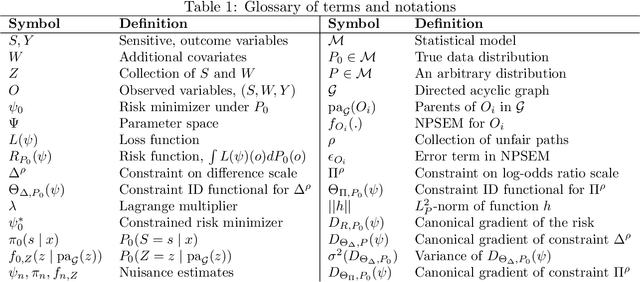
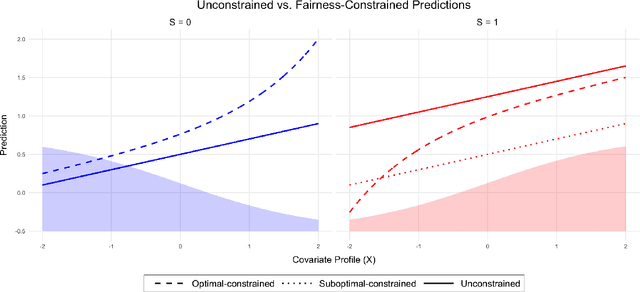
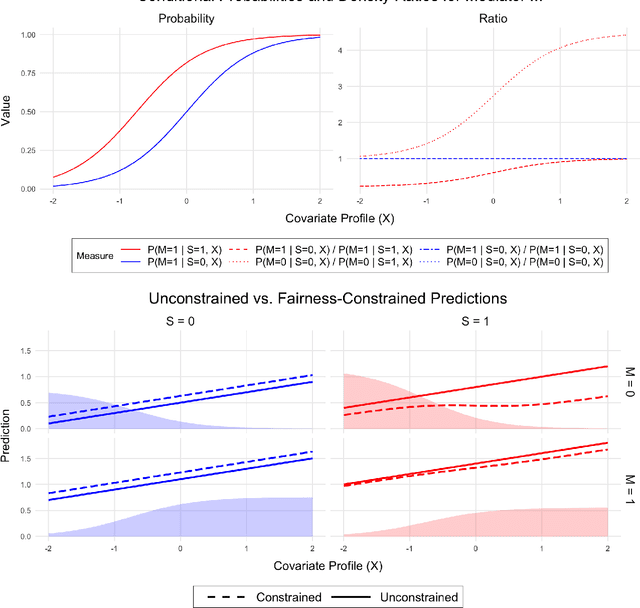
This paper introduces a framework for estimating fair optimal predictions using machine learning where the notion of fairness can be quantified using path-specific causal effects. We use a recently developed approach based on Lagrange multipliers for infinite-dimensional functional estimation to derive closed-form solutions for constrained optimization based on mean squared error and cross-entropy risk criteria. The theoretical forms of the solutions are analyzed in detail and described as nuanced adjustments to the unconstrained minimizer. This analysis highlights important trade-offs between risk minimization and achieving fairnes. The theoretical solutions are also used as the basis for construction of flexible semiparametric estimation strategies for these nuisance components. We describe the robustness properties of our estimators in terms of achieving the optimal constrained risk, as well as in terms of controlling the value of the constraint. We study via simulation the impact of using robust estimators of pathway-specific effects to validate our theory. This work advances the discourse on algorithmic fairness by integrating complex causal considerations into model training, thus providing strategies for implementing fair models in real-world applications.
Statistical learning for constrained functional parameters in infinite-dimensional models with applications in fair machine learning
Apr 15, 2024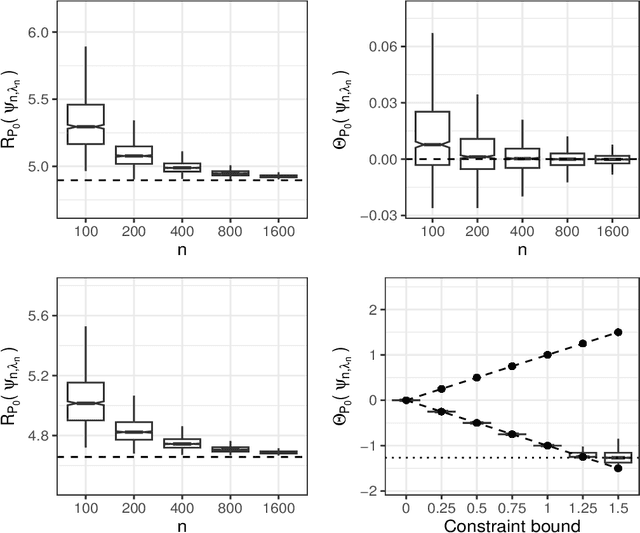
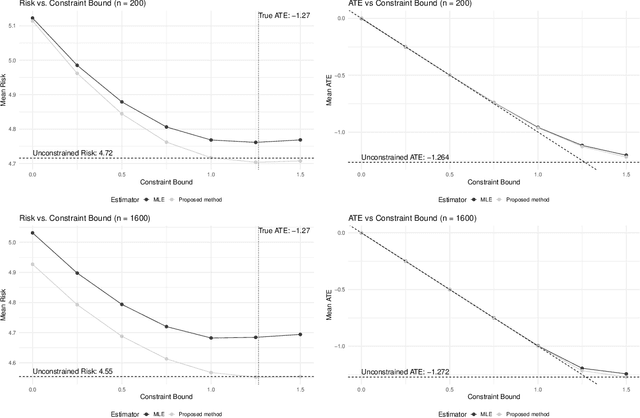
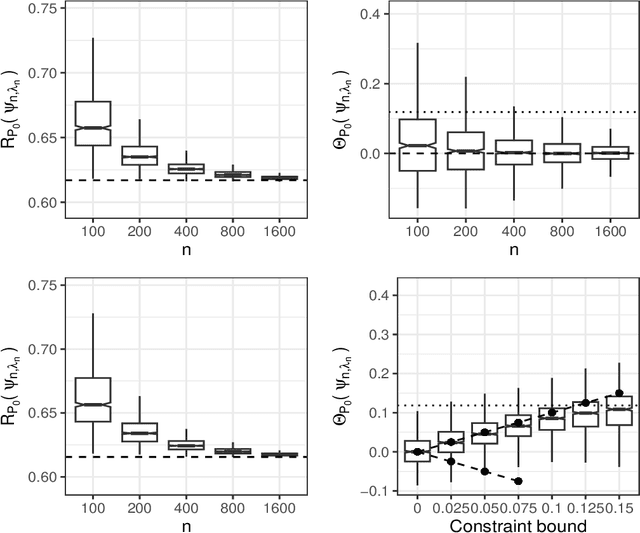

Constrained learning has become increasingly important, especially in the realm of algorithmic fairness and machine learning. In these settings, predictive models are developed specifically to satisfy pre-defined notions of fairness. Here, we study the general problem of constrained statistical machine learning through a statistical functional lens. We consider learning a function-valued parameter of interest under the constraint that one or several pre-specified real-valued functional parameters equal zero or are otherwise bounded. We characterize the constrained functional parameter as the minimizer of a penalized risk criterion using a Lagrange multiplier formulation. We show that closed-form solutions for the optimal constrained parameter are often available, providing insight into mechanisms that drive fairness in predictive models. Our results also suggest natural estimators of the constrained parameter that can be constructed by combining estimates of unconstrained parameters of the data generating distribution. Thus, our estimation procedure for constructing fair machine learning algorithms can be applied in conjunction with any statistical learning approach and off-the-shelf software. We demonstrate the generality of our method by explicitly considering a number of examples of statistical fairness constraints and implementing the approach using several popular learning approaches.