 Add to Chrome
 Add to Firefox
 Add to Edge
Controllable Generative Sandbox for Causal Inference
Mar 03, 2026
Method validation and study design in causal inference rely on synthetic data with known counterfactuals. Existing simulators trade off distributional realism, the ability to capture mixed-type and multimodal tabular data, against causal controllability, including explicit control over overlap, unmeasured confounding, and treatment effect heterogeneity. We introduce CausalMix, a variational generative framework that closes this gap by coupling a mixture of Gaussian latent priors with data-type-specific decoders for continuous, binary, and categorical variables. The model incorporates explicit causal controls: an overlap regularizer shaping propensity-score distributions, alongside direct parameterizations of confounding strength and effect heterogeneity. This unified objective preserves fidelity to the observed data while enabling factorial manipulation of causal mechanisms, allowing overlap, confounding strength, and treatment effect heterogeneity to be varied independently at design time. Across benchmarks, CausalMix achieves state-of-the-art distributional metrics on mixed-type tables while providing stable, fine-grained causal control. We demonstrate practical utility in a comparative safety study of metastatic castration-resistant prostate cancer treatments, using CausalMix to compare estimators under calibrated data-generating processes, tune hyperparameters, and conduct simulation-based power analyses under targeted treatment effect heterogeneity scenarios.

Learning recurrent dynamics in spiking networks
Aug 18, 2018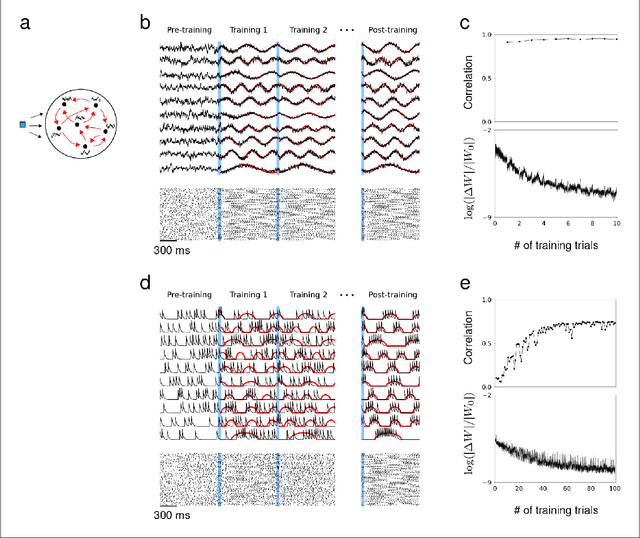
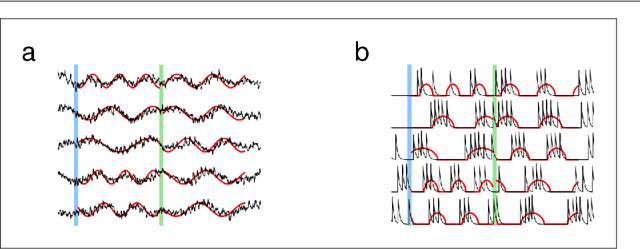
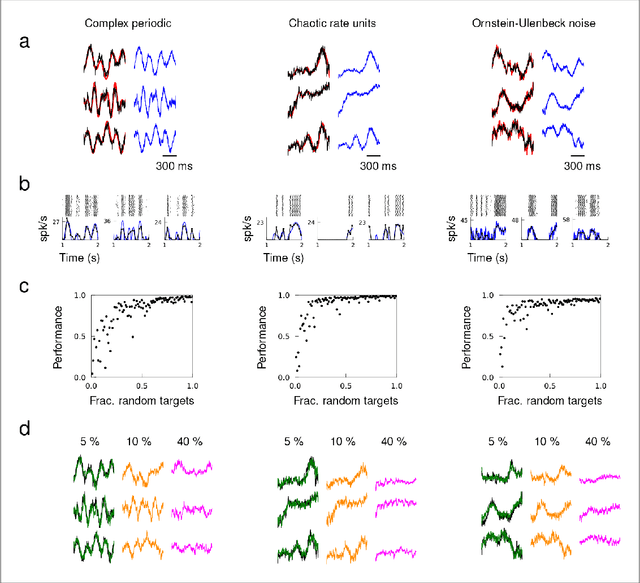
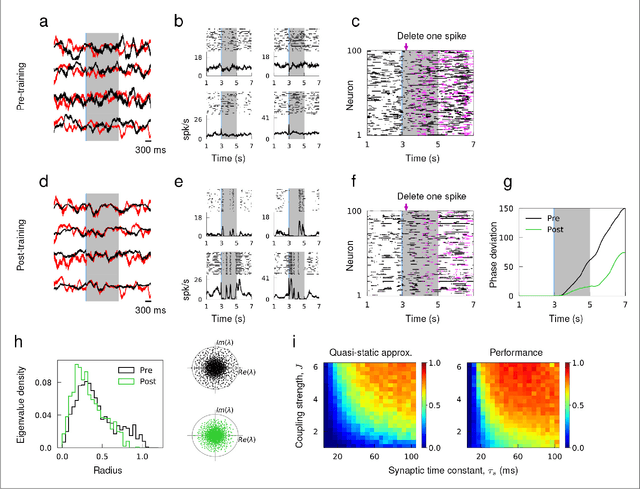
Spiking activity of neurons engaged in learning and performing a task show complex spatiotemporal dynamics. While the output of recurrent network models can learn to perform various tasks, the possible range of recurrent dynamics that emerge after learning remains unknown. Here we show that modifying the recurrent connectivity with a recursive least squares algorithm provides sufficient flexibility for synaptic and spiking rate dynamics of spiking networks to produce a wide range of spatiotemporal activity. We apply the training method to learn arbitrary firing patterns, stabilize irregular spiking activity of a balanced network, and reproduce the heterogeneous spiking rate patterns of cortical neurons engaged in motor planning and movement. We identify sufficient conditions for successful learning, characterize two types of learning errors, and assess the network capacity. Our findings show that synaptically-coupled recurrent spiking networks possess a vast computational capability that can support the diverse activity patterns in the brain.