 Add to Chrome
 Add to Firefox
 Add to Edge
DIVE: Unlocking Self-Improvement in Frozen Language Models Through Diversity-Driven Skill Evolution
Aug 12, 2026
Large language models (LLMs) cannot retain post-deployment experience without parameter updates. We introduce DIVE, a diversity-driven framework that enables frozen LLMs to improve by evolving persistent natural-language skills from task experience and verifier feedback. These skills encode reusable reasoning procedures, verification strategies, common failure modes, and output constraints and are both executed and revised by the same underlying model without access to a teacher model. Since natural-language skill evolution is a stochastic, non-convex search process, optimizing a single skill trajectory can overfit to sampled experience or converge to a suboptimal solution. DIVE mitigates this optimization variance by independently evolving multiple skill populations from bootstrapped experience, adaptively refining them through diverse transformations, and jointly selecting a complementary set of skills. Across six mathematical and logical reasoning tasks and multiple model families, DIVE consistently outperforms existing reasoning methods, prompt-optimization approaches, skill-development frameworks, and memory-based baselines. It achieves rapid self-improvement from accumulated experience, obtaining substantially larger performance gains with fewer rollouts than parameter-based methods such as SFT and GRPO, and prompt optimization with GEPA. Further, the resulting skills transfer across model scales and families, enabling smaller models such as GPT-5-nano to match or outperform larger counterparts, i.e., GPT-5, under conventional prompting. These results establish diversity-driven skill evolution as an effective, interpretable, and parameter-free approach to LLM self-improvement.

NeSyFS: A Neuro-symbolic Fast-Slow Thinking Framework for LLM Agent under Partial Observability
Jul 31, 2026Recently Large Language Models (LLMs) have been increasingly deployed as autonomous agents in applications such as self-reflection, retrieval-augmented generation, and scientific discovery. In these settings, agents must act based on limited observations rather than full environmental states, leading to partial observability. This introduces several key challenges: belief state inference, task objective misalignment, and planning under uncertainty. Prior approaches typically condition actions on full or summarized action-observation histories whose redundant and irrelevant information can mislead the decision making of LLM agent. Inspired by human cognition, we propose a novel neuro-symbolic fast-slow thinking (NeSyFS) framework for LLM agent, addressing the challenges introduced by partial observability in a unified approach. We use a knowledge graph (KG) to represent the belief state, providing triplets as context for every module of NeSyFS. The fast-thinking module performs reactive action, while slow-thinking conducts a new uncertainty-aware planning by following the high-level structure of twisted sequential Monte Carlo (TSMC) algorithm. To mitigate the misalignment of task objective, a reflection module is used to reflect fast-thinking actions, and also switches to the slow-thinking module whenever reactive actions repeatedly fail. Experiments on three representative benchmarks, i.e. ALFWorld, Webshop, and ScienceWorld, demonstrate significant advantages over previous methods.
RECLAIM: Cyclic Causal Discovery Amid Measurement Noise
Mar 21, 2026Uncovering causal relationships is a fundamental problem across science and engineering. However, most existing causal discovery methods assume acyclicity and direct access to the system variables -- assumptions that fail to hold in many real-world settings. For instance, in genomics, cyclic regulatory networks are common, and measurements are often corrupted by instrumental noise. To address these challenges, we propose RECLAIM, a causal discovery framework that natively handles both cycles and measurement noise. RECLAIM learns the causal graph structure by maximizing the likelihood of the observed measurements via expectation-maximization (EM), using residual normalizing flows for tractable likelihood computation. We consider two measurement models: (i) Gaussian additive noise, and (ii) a linear measurement system with additive Gaussian noise. We provide theoretical consistency guarantees for both the settings. Experiments on synthetic data and real-world protein signaling datasets demonstrate the efficacy of the proposed method.
Scaling Search-Augmented LLM Reasoning via Adaptive Information Control
Feb 02, 2026Search-augmented reasoning agents interleave multi-step reasoning with external information retrieval, but uncontrolled retrieval often leads to redundant evidence, context saturation, and unstable learning. Existing approaches rely on outcome-based reinforcement learning (RL), which provides limited guidance for regulating information acquisition. We propose DeepControl, a framework for adaptive information control based on a formal notion of information utility, which measures the marginal value of retrieved evidence under a given reasoning state. Building on this utility, we introduce retrieval continuation and granularity control mechanisms that selectively regulate when to continue and stop retrieval, and how much information to expand. An annealed control strategy enables the agent to internalize effective information acquisition behaviors during training. Extensive experiments across seven benchmarks demonstrate that our method consistently outperforms strong baselines. In particular, our approach achieves average performance improvements of 9.4% and 8.6% on Qwen2.5-7B and Qwen2.5-3B, respectively, over strong outcome-based RL baselines, and consistently outperforms both retrieval-free and retrieval-based reasoning methods without explicit information control. These results highlight the importance of adaptive information control for scaling search-augmented reasoning agents to complex, real-world information environments.
PathWise: Planning through World Model for Automated Heuristic Design via Self-Evolving LLMs
Jan 29, 2026Large Language Models (LLMs) have enabled automated heuristic design (AHD) for combinatorial optimization problems (COPs), but existing frameworks' reliance on fixed evolutionary rules and static prompt templates often leads to myopic heuristic generation, redundant evaluations, and limited reasoning about how new heuristics should be derived. We propose a novel multi-agent reasoning framework, referred to as Planning through World Model for Automated Heuristic Design via Self-Evolving LLMs (PathWise), which formulates heuristic generation as a sequential decision process over an entailment graph serving as a compact, stateful memory of the search trajectory. This approach allows the system to carry forward past decisions and reuse or avoid derivation information across generations. A policy agent plans evolutionary actions, a world model agent generates heuristic rollouts conditioned on those actions, and critic agents provide routed reflections summarizing lessons from prior steps, shifting LLM-based AHD from trial-and-error evolution toward state-aware planning through reasoning. Experiments across diverse COPs show that PathWise converges faster to better heuristics, generalizes across different LLM backbones, and scales to larger problem sizes.
Differentiable Cyclic Causal Discovery Under Unmeasured Confounders
Aug 11, 2025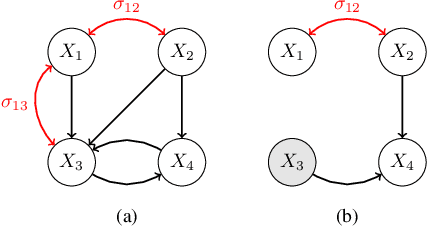
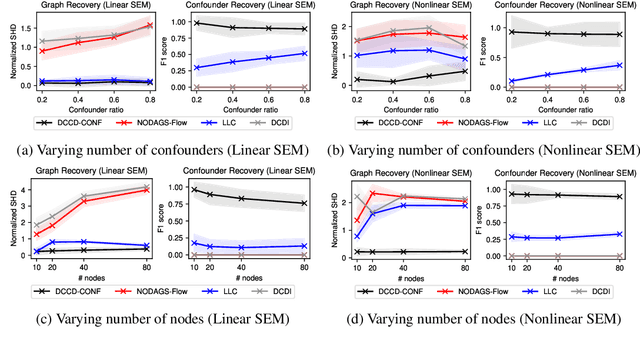
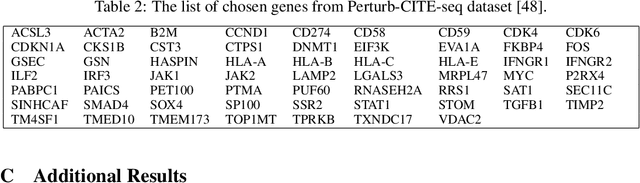
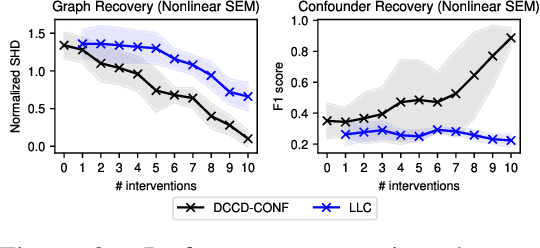
Understanding causal relationships between variables is fundamental across scientific disciplines. Most causal discovery algorithms rely on two key assumptions: (i) all variables are observed, and (ii) the underlying causal graph is acyclic. While these assumptions simplify theoretical analysis, they are often violated in real-world systems, such as biological networks. Existing methods that account for confounders either assume linearity or struggle with scalability. To address these limitations, we propose DCCD-CONF, a novel framework for differentiable learning of nonlinear cyclic causal graphs in the presence of unmeasured confounders using interventional data. Our approach alternates between optimizing the graph structure and estimating the confounder distribution by maximizing the log-likelihood of the data. Through experiments on synthetic data and real-world gene perturbation datasets, we show that DCCD-CONF outperforms state-of-the-art methods in both causal graph recovery and confounder identification. Additionally, we also provide consistency guarantees for our framework, reinforcing its theoretical soundness.
Learning Hidden Subgoals under Temporal Ordering Constraints in Reinforcement Learning
Nov 03, 2024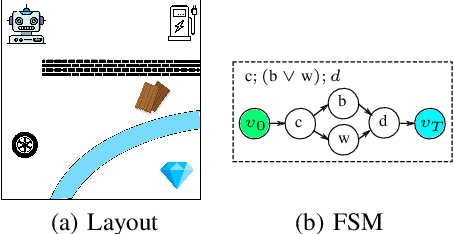
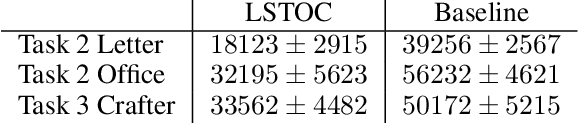
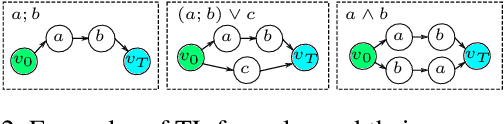
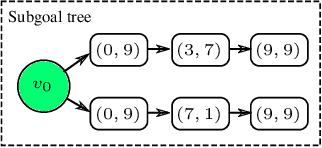
In real-world applications, the success of completing a task is often determined by multiple key steps which are distant in time steps and have to be achieved in a fixed time order. For example, the key steps listed on the cooking recipe should be achieved one-by-one in the right time order. These key steps can be regarded as subgoals of the task and their time orderings are described as temporal ordering constraints. However, in many real-world problems, subgoals or key states are often hidden in the state space and their temporal ordering constraints are also unknown, which make it challenging for previous RL algorithms to solve this kind of tasks. In order to address this issue, in this work we propose a novel RL algorithm for {\bf l}earning hidden {\bf s}ubgoals under {\bf t}emporal {\bf o}rdering {\bf c}onstraints (LSTOC). We propose a new contrastive learning objective which can effectively learn hidden subgoals (key states) and their temporal orderings at the same time, based on first-occupancy representation and temporal geometric sampling. In addition, we propose a sample-efficient learning strategy to discover subgoals one-by-one following their temporal order constraints by building a subgoal tree to represent discovered subgoals and their temporal ordering relationships. Specifically, this tree can be used to improve the sample efficiency of trajectory collection, fasten the task solving and generalize to unseen tasks. The LSTOC framework is evaluated on several environments with image-based observations, showing its significant improvement over baseline methods.
MissNODAG: Differentiable Cyclic Causal Graph Learning from Incomplete Data
Oct 24, 2024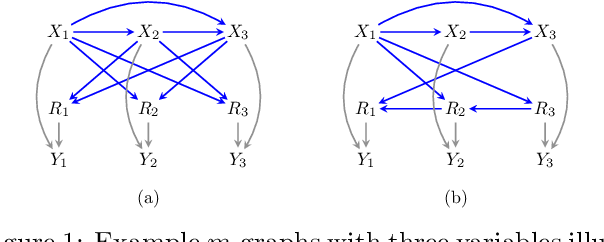
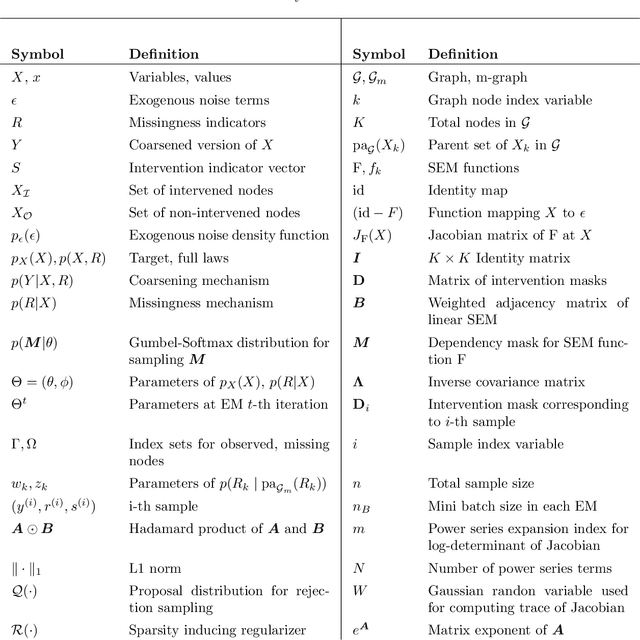
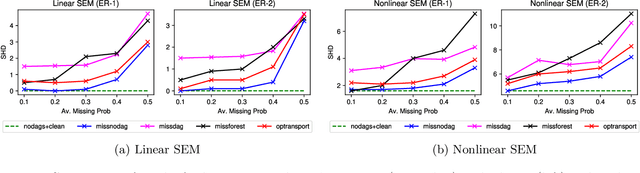
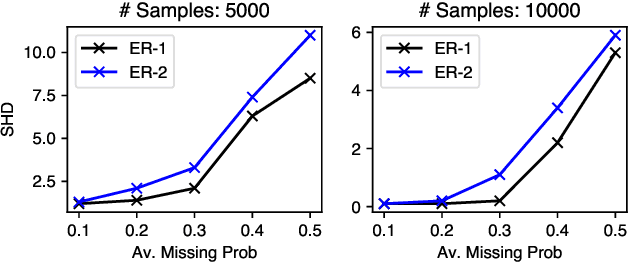
Causal discovery in real-world systems, such as biological networks, is often complicated by feedback loops and incomplete data. Standard algorithms, which assume acyclic structures or fully observed data, struggle with these challenges. To address this gap, we propose MissNODAG, a differentiable framework for learning both the underlying cyclic causal graph and the missingness mechanism from partially observed data, including data missing not at random. Our framework integrates an additive noise model with an expectation-maximization procedure, alternating between imputing missing values and optimizing the observed data likelihood, to uncover both the cyclic structures and the missingness mechanism. We demonstrate the effectiveness of MissNODAG through synthetic experiments and an application to real-world gene perturbation data.
Generalization of Compositional Tasks with Logical Specification via Implicit Planning
Oct 13, 2024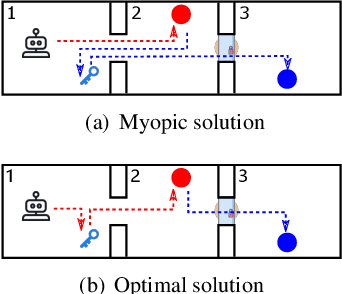
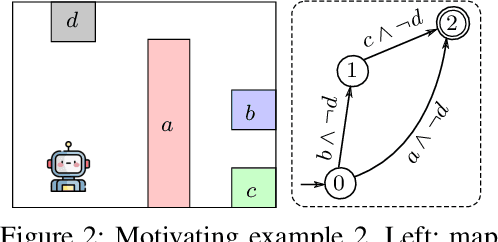
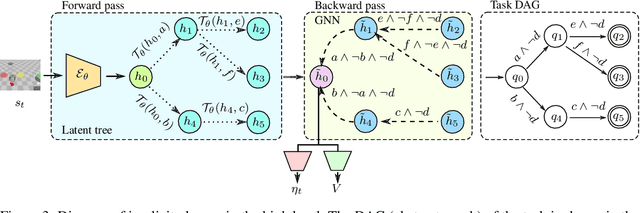
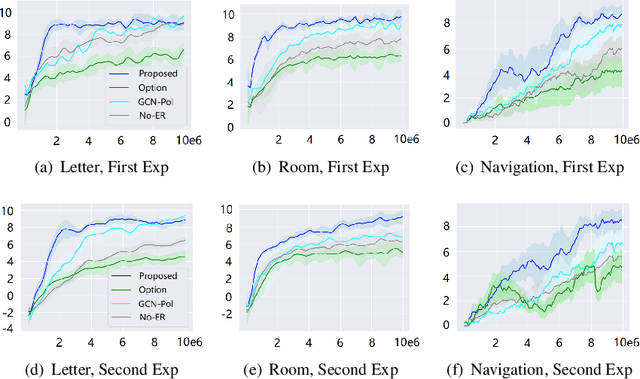
In this work, we study the problem of learning generalizable policies for compositional tasks given by a logic specification. These tasks are composed by temporally extended subgoals. Due to dependencies of subgoals and long task horizon, previous reinforcement learning (RL) algorithms, e.g., task-conditioned and goal-conditioned policies, still suffer from slow convergence and sub-optimality when solving the generalization problem of compositional tasks. In order to tackle these issues, this paper proposes a new hierarchical RL framework for the efficient and optimal generalization of compositional tasks. In the high level, we propose a new implicit planner designed specifically for generalizing compositional tasks. Specifically, the planner produces the selection of next sub-task and estimates the multi-step return of completing the rest of task from current state. It learns a latent transition model and conducts planning in the latent space based on a graph neural network (GNN). Then, the next sub-task selected by the high level guides the low-level agent efficiently to solve long-horizon tasks and the multi-step return makes the low-level policy consider dependencies of future sub-tasks. We conduct comprehensive experiments to show the advantage of proposed framework over previous methods in terms of optimality and efficiency.
Deliberate Reasoning for LLMs as Structure-aware Planning with Accurate World Model
Oct 04, 2024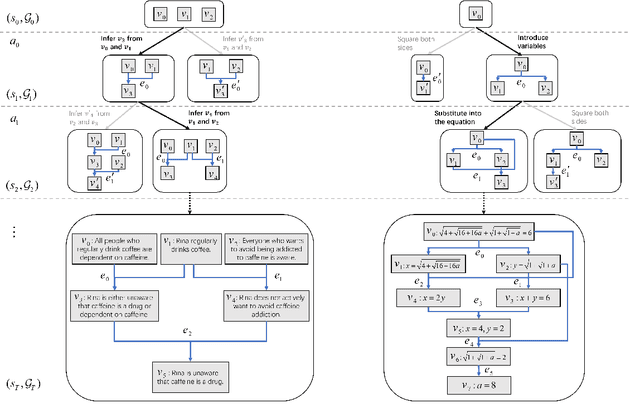
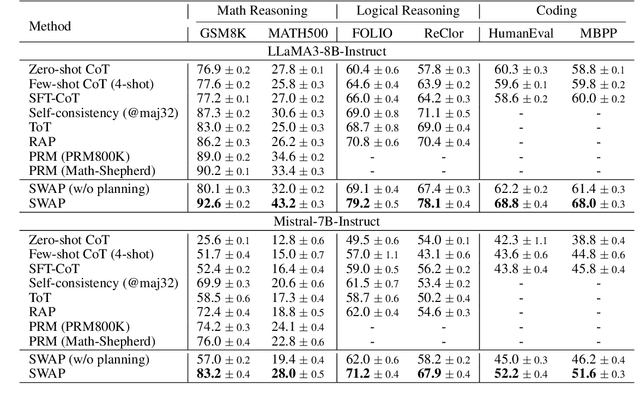
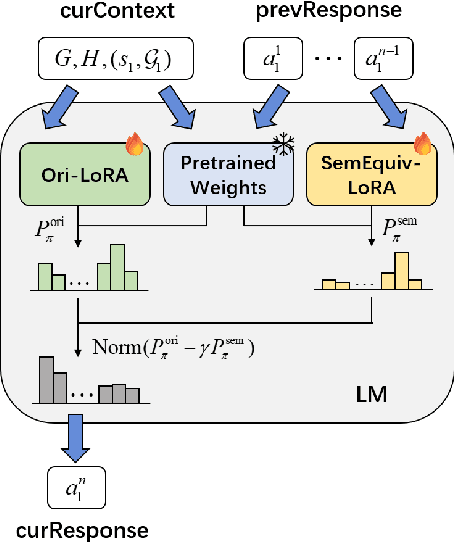
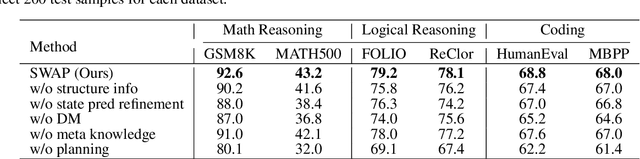
Enhancing the reasoning capabilities of large language models (LLMs) remains a key challenge, especially for tasks that require complex, multi-step decision-making. Humans excel at these tasks by leveraging deliberate planning with an internal world model to simulate the potential outcomes of various actions. Inspired by this, we propose a novel multi-step reasoning framework for LLMs, referred to as Structure-aware Planning with Accurate World Model (SWAP). Unlike previous approaches that rely solely on Chain-of-Thought (CoT) reasoning in natural language, SWAP incorporates structural information to guide the reasoning process via a world model and provides a soft verification mechanism over the steps. Moreover, SWAP overcomes the challenge of accurate world state predictions in complex reasoning tasks by introducing a Generator-Discriminator architecture, which enables more reliable world modeling. Specifically, the generator predicts the next state, and the discriminator ensures alignment with the logical consistency required by the problem context. SWAP also encourages the policy model to explore a broad range of potential actions to prevent premature convergence. By resolving the bottlenecks of generation diversity for both actions and states using diversity-based modeling (DBM) and improving discrimination accuracy through contrastive ranking (CR), SWAP significantly enhances the reasoning performance of LLMs. We evaluate SWAP across diverse reasoning-intensive benchmarks including math reasoning, logical reasoning, and coding tasks. Extensive experiments demonstrate that SWAP achieves substantial improvements over the baselines and consistently outperforms existing LLMs of similar sizes.