 Add to Chrome
 Add to Firefox
 Add to Edge
Multilingual Large Language Models do not comprehend all natural languages to equal degrees
Feb 23, 2026
Large Language Models (LLMs) play a critical role in how humans access information. While their core use relies on comprehending written requests, our understanding of this ability is currently limited, because most benchmarks evaluate LLMs in high-resource languages predominantly spoken by Western, Educated, Industrialised, Rich, and Democratic (WEIRD) communities. The default assumption is that English is the best-performing language for LLMs, while smaller, low-resource languages are linked to less reliable outputs, even in multilingual, state-of-the-art models. To track variation in the comprehension abilities of LLMs, we prompt 3 popular models on a language comprehension task across 12 languages, representing the Indo-European, Afro-Asiatic, Turkic, Sino-Tibetan, and Japonic language families. Our results suggest that the models exhibit remarkable linguistic accuracy across typologically diverse languages, yet they fall behind human baselines in all of them, albeit to different degrees. Contrary to what was expected, English is not the best-performing language, as it was systematically outperformed by several Romance languages, even lower-resource ones. We frame the results by discussing the role of several factors that drive LLM performance, such as tokenization, language distance from Spanish and English, size of training data, and data origin in high- vs. low-resource languages and WEIRD vs. non-WEIRD communities.

Quantification and object perception in Multimodal Large Language Models deviate from human linguistic cognition
Nov 11, 2025
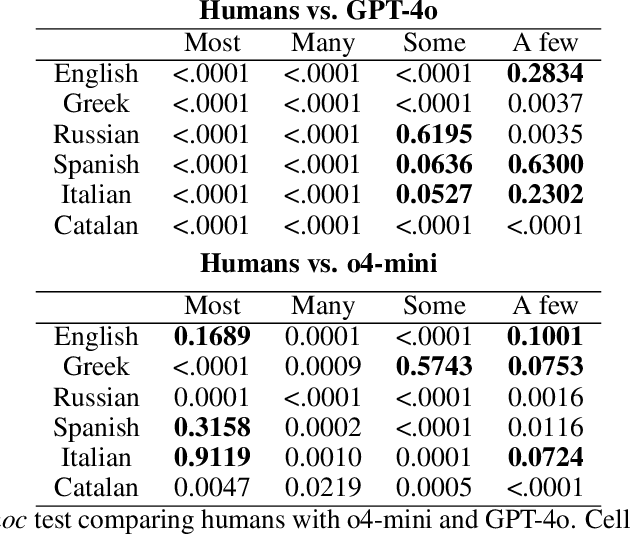
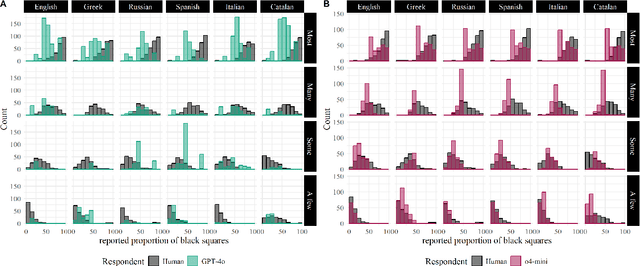
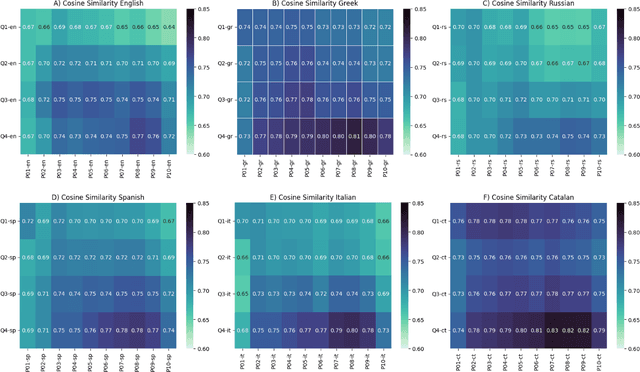
Quantification has been proven to be a particularly difficult linguistic phenomenon for (Multimodal) Large Language Models (MLLMs). However, given that quantification interfaces with the logic, pragmatic, and numerical domains, the exact reasons for the poor performance are still unclear. This papers looks at three key features of human quantification shared cross-linguistically that have remained so far unexplored in the (M)LLM literature: the ordering of quantifiers into scales, the ranges of use and prototypicality, and the biases inherent in the human approximate number system. The aim is to determine how these features are encoded in the models' architecture, how they may differ from humans, and whether the results are affected by the type of model and language under investigation. We find that there are clear differences between humans and MLLMs with respect to these features across various tasks that tap into the representation of quantification in vivo vs. in silico. This work, thus, paves the way for addressing the nature of MLLMs as semantic and pragmatic agents, while the cross-linguistic lens can elucidate whether their abilities are robust and stable across different languages.
Large Language Model probabilities cannot distinguish between possible and impossible language
Sep 18, 2025A controversial test for Large Language Models concerns the ability to discern possible from impossible language. While some evidence attests to the models' sensitivity to what crosses the limits of grammatically impossible language, this evidence has been contested on the grounds of the soundness of the testing material. We use model-internal representations to tap directly into the way Large Language Models represent the 'grammatical-ungrammatical' distinction. In a novel benchmark, we elicit probabilities from 4 models and compute minimal-pair surprisal differences, juxtaposing probabilities assigned to grammatical sentences to probabilities assigned to (i) lower frequency grammatical sentences, (ii) ungrammatical sentences, (iii) semantically odd sentences, and (iv) pragmatically odd sentences. The prediction is that if string-probabilities can function as proxies for the limits of grammar, the ungrammatical condition will stand out among the conditions that involve linguistic violations, showing a spike in the surprisal rates. Our results do not reveal a unique surprisal signature for ungrammatical prompts, as the semantically and pragmatically odd conditions consistently show higher surprisal. We thus demonstrate that probabilities do not constitute reliable proxies for model-internal representations of syntactic knowledge. Consequently, claims about models being able to distinguish possible from impossible language need verification through a different methodology.