 Add to Chrome
 Add to Firefox
 Add to Edge
Tracing the ongoing emergence of human-like reasoning in Large Language Models
May 20, 2026
Humans effortlessly go beyond literal meanings: If you mow the lawn, I will give you fifty dollars, is typically understood as implying that the speaker will pay only if the lawn is mowed, whereas If you are hungry, there is pizza in the oven implies that pizza is available regardless of the hearers hunger. Large Language Models - LLMs - show human-like performance on many tasks, yet it remains unclear whether they reason like humans. To address this, we conducted a population-matching experiment assessing how twentyfive LLMs compute conditional inferences across four languages, compared to an equal number of humans per language. We find that humans enrich logical reasoning through pragmatic inferences across languages. Model behavior is more variable. Some LLMs perfectly follow the truth-table of conditionals but they ignore pragmatic inferences, while others deviate from the truth-table, adhering to a single interpretation across the board, thus reflecting accurate rule-based processing but not human-like reasoning. Overall, LLMs are accurate semantic operators, but fail to capture the pragmatic enrichments characteristic of human reasoning. Crucially, LLM accuracy is neither predicted nor boosted by open vs. closed status, training orientation, or architecture type, suggesting that pragmatic reasoning is still an emerging ability in the cognitive toolkit of artificial systems.

Multilingual Large Language Models do not comprehend all natural languages to equal degrees
Feb 23, 2026Large Language Models (LLMs) play a critical role in how humans access information. While their core use relies on comprehending written requests, our understanding of this ability is currently limited, because most benchmarks evaluate LLMs in high-resource languages predominantly spoken by Western, Educated, Industrialised, Rich, and Democratic (WEIRD) communities. The default assumption is that English is the best-performing language for LLMs, while smaller, low-resource languages are linked to less reliable outputs, even in multilingual, state-of-the-art models. To track variation in the comprehension abilities of LLMs, we prompt 3 popular models on a language comprehension task across 12 languages, representing the Indo-European, Afro-Asiatic, Turkic, Sino-Tibetan, and Japonic language families. Our results suggest that the models exhibit remarkable linguistic accuracy across typologically diverse languages, yet they fall behind human baselines in all of them, albeit to different degrees. Contrary to what was expected, English is not the best-performing language, as it was systematically outperformed by several Romance languages, even lower-resource ones. We frame the results by discussing the role of several factors that drive LLM performance, such as tokenization, language distance from Spanish and English, size of training data, and data origin in high- vs. low-resource languages and WEIRD vs. non-WEIRD communities.
Quantification and object perception in Multimodal Large Language Models deviate from human linguistic cognition
Nov 11, 2025
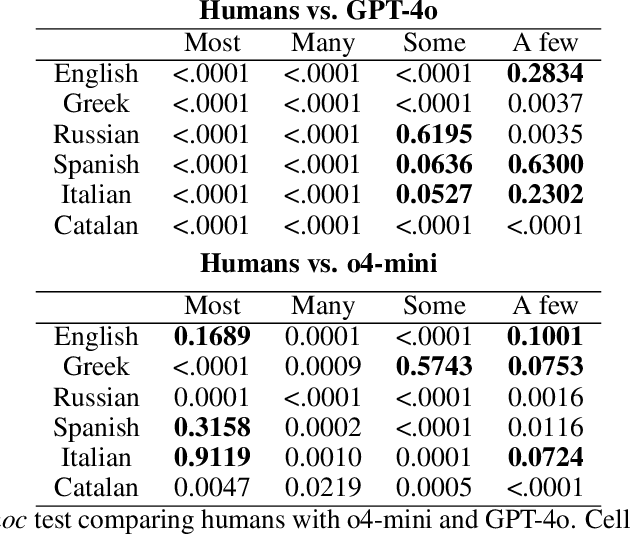
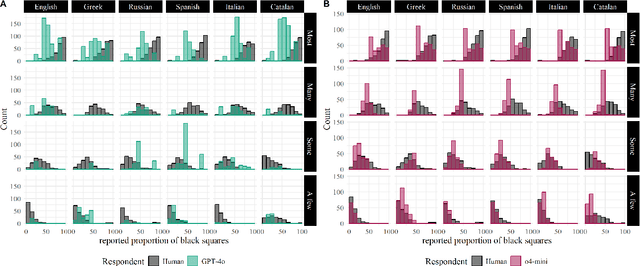
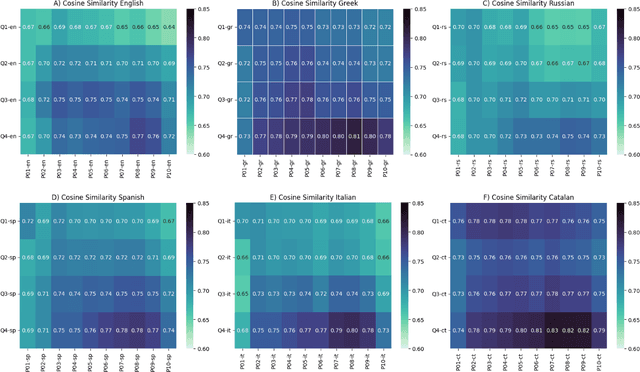
Quantification has been proven to be a particularly difficult linguistic phenomenon for (Multimodal) Large Language Models (MLLMs). However, given that quantification interfaces with the logic, pragmatic, and numerical domains, the exact reasons for the poor performance are still unclear. This papers looks at three key features of human quantification shared cross-linguistically that have remained so far unexplored in the (M)LLM literature: the ordering of quantifiers into scales, the ranges of use and prototypicality, and the biases inherent in the human approximate number system. The aim is to determine how these features are encoded in the models' architecture, how they may differ from humans, and whether the results are affected by the type of model and language under investigation. We find that there are clear differences between humans and MLLMs with respect to these features across various tasks that tap into the representation of quantification in vivo vs. in silico. This work, thus, paves the way for addressing the nature of MLLMs as semantic and pragmatic agents, while the cross-linguistic lens can elucidate whether their abilities are robust and stable across different languages.