 Add to Chrome
 Add to Firefox
 Add to Edge
Every Coin Has Two Sides: On the Dual Nature of Generalization in On-Policy Distillation of Large Language Models
Aug 17, 2026
On-policy distillation (OPD) transfers teacher capabilities by supervising trajectories sampled from the student's own policy, yet its generalization behavior remains poorly understood, as most studies evaluate OPD on a single domain and on benchmarks close to the training data. We present a controlled study that varies one generalization factor at a time, from in-domain distribution shifts to cross-domain transfer and the multi-teacher setting. We find that OPD transfers a teacher's reasoning behavior rather than its answers to particular problems: training difficulty barely matters, and even problems the teacher never solves are useful. Transfer depends strongly on the origin relationship between teacher and student: same-origin pairs bring the student close to the teacher across languages, reasoning horizons, and even other domains, whereas cross-origin pairs mostly fit the trained distribution. This broad reach is a double-edged sword: since routing prompts to domain experts cannot confine each teacher's influence, combining them yields a mixture-dependent seesaw among their capabilities. These results clarify when OPD generalizes and offer a useful perspective for diagnosing multi-teacher OPD.

On the Role of Reasoning Patterns in the Generalization Discrepancy of Long Chain-of-Thought Supervised Fine-Tuning
Apr 02, 2026Supervised Fine-Tuning (SFT) on long Chain-of-Thought (CoT) trajectories has become a pivotal phase in building large reasoning models. However, how CoT trajectories from different sources influence the generalization performance of models remains an open question. In this paper, we conduct a comparative study using two sources of verified CoT trajectories generated by two competing models, \texttt{DeepSeek-R1-0528} and \texttt{gpt-oss-120b}, with their problem sets controlled to be identical. Despite their comparable performance, we uncover a striking paradox: lower training loss does not translate to better generalization. SFT on \texttt{DeepSeek-R1-0528} data achieves remarkably lower training loss, yet exhibits significantly worse generalization performance on reasoning benchmarks compared to those trained on \texttt{gpt-oss-120b}. To understand this paradox, we perform a multi-faceted analysis probing token-level SFT loss and step-level reasoning behaviors. Our analysis reveals a difference in reasoning patterns. \texttt{gpt-oss-120b} exhibits highly convergent and deductive trajectories, whereas \texttt{DeepSeek-R1-0528} favors a divergent and branch-heavy exploration pattern. Consequently, models trained with \texttt{DeepSeek-R1} data inherit inefficient exploration behaviors, often getting trapped in redundant exploratory branches that hinder them from reaching correct solutions. Building upon this insight, we propose a simple yet effective remedy of filtering out frequently branching trajectories to improve the generalization of SFT. Experiments show that training on selected \texttt{DeepSeek-R1-0528} subsets surprisingly improves reasoning performance by up to 5.1% on AIME25, 5.5% on BeyondAIME, and on average 3.6% on five benchmarks.
A Sublinear-Time Spectral Clustering Oracle with Improved Preprocessing Time
Oct 27, 2023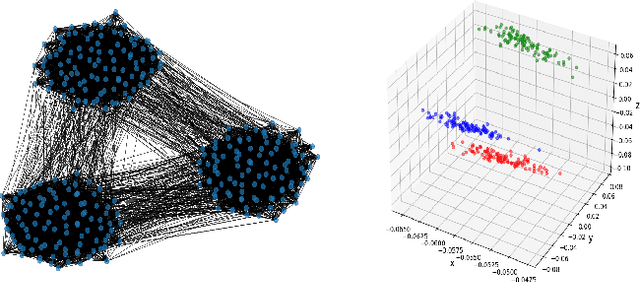
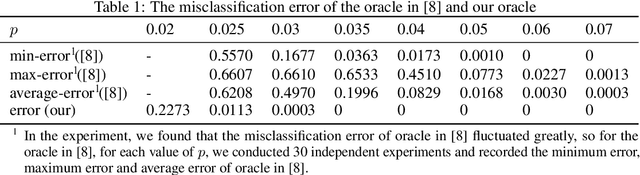
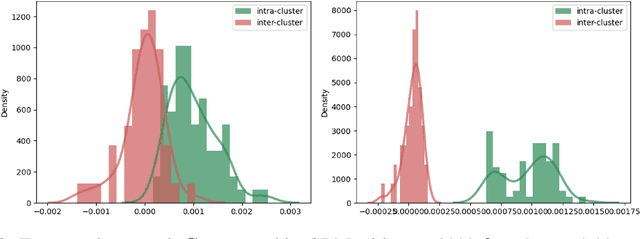

We address the problem of designing a sublinear-time spectral clustering oracle for graphs that exhibit strong clusterability. Such graphs contain $k$ latent clusters, each characterized by a large inner conductance (at least $\varphi$) and a small outer conductance (at most $\varepsilon$). Our aim is to preprocess the graph to enable clustering membership queries, with the key requirement that both preprocessing and query answering should be performed in sublinear time, and the resulting partition should be consistent with a $k$-partition that is close to the ground-truth clustering. Previous oracles have relied on either a $\textrm{poly}(k)\log n$ gap between inner and outer conductances or exponential (in $k/\varepsilon$) preprocessing time. Our algorithm relaxes these assumptions, albeit at the cost of a slightly higher misclassification ratio. We also show that our clustering oracle is robust against a few random edge deletions. To validate our theoretical bounds, we conducted experiments on synthetic networks.