 Add to Chrome
 Add to Firefox
 Add to Edge
CRANE: Constrained Reasoning Injection for Code Agents via Nullspace Editing
May 13, 2026
Code agents must both reason over long-horizon repository state and obey strict tool-use protocols. In paired Instruct/Thinking checkpoints, these capabilities are complementary but misaligned. The Instruct model is concise and tool-disciplined, whereas the Thinking model offers stronger planning and recovery behavior but often over-deliberates and degrades agent performance. We present CRANE (Constrained Reasoning Injection for Code Agents via Nullspace Editing), a training-free parameter-editing method that treats the Thinking-Instruct delta as a directional pool of candidate reasoning edits for the Instruct backbone. CRANE combines magnitude thresholding to denoise the delta, a Conservative Taylor Gate to retain edits that are jointly beneficial for reasoning transfer and tool-use preservation, and Graduated Sigmoidal Projection to suppress format-critical update directions. By merging paired Instruct and Thinking checkpoints, CRANE delivers strong gains over either individual model while preserving Instruct-level efficiency: on Roo-Eval it achieves pass1 of 66.2% (+19.5%) for Qwen3-30B-A3B and 81.5% (+8.7%) for Qwen3-Next-80B-A3B; on SWE-bench-Verified it resolves up to 14 additional instances at both scales (122/500 and 180/500); and on Terminal-Bench v2 it improves pass1/pass5 by up to 2.3%/7.8%, reaching 7.6%/17.9% and 14.8%/30.3%, respectively, consistently outperforming alternative merging strategies across all three benchmarks.

Multi-task Code LLMs: Data Mix or Model Merge?
Jan 28, 2026Recent research advocates deploying smaller, specialized code LLMs in agentic frameworks alongside frontier models, sparking interest in efficient strategies for multi-task learning that balance performance, constraints, and costs. We compare two approaches for creating small, multi-task code LLMs: data mixing versus model merging. We conduct extensive experiments across two model families (Qwen Coder and DeepSeek Coder) at two scales (2B and 7B parameters), fine-tuning them for code generation and code summarization tasks. Our evaluation on HumanEval, MBPP, and CodeXGlue benchmarks reveals that model merging achieves the best overall performance at larger scale across model families, retaining 96% of specialized model performance on code generation tasks while maintaining summarization capabilities. Notably, merged models can even surpass individually fine-tuned models, with our best configuration of Qwen Coder 2.5 7B model achieving 92.7% Pass@1 on HumanEval compared to 90.9% for its task-specific fine-tuned equivalent. At a smaller scale we find instead data mixing to be a preferred strategy. We further introduce a weight analysis technique to understand how different tasks affect model parameters and their implications for merging strategies. The results suggest that careful merging and mixing strategies can effectively combine task-specific capabilities without significant performance degradation, making them ideal for resource-constrained deployment scenarios.
Granite Code Models: A Family of Open Foundation Models for Code Intelligence
May 07, 2024

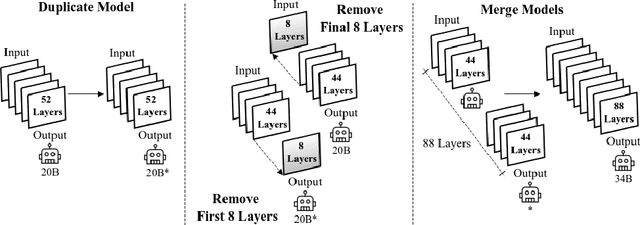

Large Language Models (LLMs) trained on code are revolutionizing the software development process. Increasingly, code LLMs are being integrated into software development environments to improve the productivity of human programmers, and LLM-based agents are beginning to show promise for handling complex tasks autonomously. Realizing the full potential of code LLMs requires a wide range of capabilities, including code generation, fixing bugs, explaining and documenting code, maintaining repositories, and more. In this work, we introduce the Granite series of decoder-only code models for code generative tasks, trained with code written in 116 programming languages. The Granite Code models family consists of models ranging in size from 3 to 34 billion parameters, suitable for applications ranging from complex application modernization tasks to on-device memory-constrained use cases. Evaluation on a comprehensive set of tasks demonstrates that Granite Code models consistently reaches state-of-the-art performance among available open-source code LLMs. The Granite Code model family was optimized for enterprise software development workflows and performs well across a range of coding tasks (e.g. code generation, fixing and explanation), making it a versatile all around code model. We release all our Granite Code models under an Apache 2.0 license for both research and commercial use.
CoSiNES: Contrastive Siamese Network for Entity Standardization
Jun 05, 2023Entity standardization maps noisy mentions from free-form text to standard entities in a knowledge base. The unique challenge of this task relative to other entity-related tasks is the lack of surrounding context and numerous variations in the surface form of the mentions, especially when it comes to generalization across domains where labeled data is scarce. Previous research mostly focuses on developing models either heavily relying on context, or dedicated solely to a specific domain. In contrast, we propose CoSiNES, a generic and adaptable framework with Contrastive Siamese Network for Entity Standardization that effectively adapts a pretrained language model to capture the syntax and semantics of the entities in a new domain. We construct a new dataset in the technology domain, which contains 640 technical stack entities and 6,412 mentions collected from industrial content management systems. We demonstrate that CoSiNES yields higher accuracy and faster runtime than baselines derived from leading methods in this domain. CoSiNES also achieves competitive performance in four standard datasets from the chemistry, medicine, and biomedical domains, demonstrating its cross-domain applicability.