 Add to Chrome
 Add to Firefox
 Add to Edge
Vision Non-Causal Trapezoidal Mamba: Eliminating Directional Scanning in Vision SSMs with Second-Order Dynamics
Jul 03, 2026
State Space Models (SSMs) have emerged as an alternative to Vision Transformers, yet most vision SSMs inherit directional token scanning from causal sequence modeling. While effective for sequential data, directional scanning introduces spatial bias and orientation-sensitive representations. We present Vision Non-Causal Trapezoidal Mamba (VNCT), a second-order non-causal vision SSM that enables all image tokens to interact in a single pass, eliminating direSctional scanning and achieving low single-image inference latency. VNCT exhibits more orientation-robust representations, showing reduced performance degradation under image rotations and flips, while improving Boundary IoU by up to 3.7 points, leading to more accurate boundary preservation and object localization. Across ImageNet-1K classification, COCO object detection and instance segmentation, and ADE20K semantic segmentation, VNCT consistently outperforms both directional-scanning vision SSMs and first-order non-causal SSMs. These results show that directional scanning is unnecessary for high-performance vision SSMs and that second-order non-causal state-space modeling offers a simple, efficient, and robust alternative for visual recognition.

Accurate and Resource-Efficient Federated Continual Learning
Jun 09, 2026Federated continual learning (FCL) must learn from distributed task streams under limited resources, such as communication, computation, memory, and label availability. Existing FCL methods often rely on repeated local optimization, replay, and full supervision. Analytic alternatives avoid iterative training and replay, but using high-dimensional random features to improve accuracy requires a second-order feature statistic, the Gram matrix, which has a quadratic communication cost in the random feature size $M$. We propose FedRAN, a resource-aware analytic FCL framework that replaces gradient-based updates with compact random feature statistics. Each client transmits a truncated-SVD summary of its Gram matrix, reducing the dominant second-order upload from quadratic to linear in $M$ for fixed rank. The server performs a two-level QR-SVD subspace merge, spatially across clients and temporally across tasks, and solves a ridge classifier in closed form. FedRAN further supports label scarcity through prototype-based pseudo-labeling. Across CIFAR-100, ImageNet-R, and VTAB datasets, FedRAN improves average accuracy by up to 4.8 percentage points over the strongest baseline, uses 30.6-121.8$\times$ less per-client communication than optimization-based FCL, and is 190.3$\times$ faster on average than gradient-based baselines; with only 20% labels, pseudo-labeling improves average accuracy by up to 6.61 points. These results show that FedRAN enables accurate and resource-efficient FCL under communication, computation, and label constraints. The source code is available at https://github.com/JebacyrilArockiaraj/Fed-RAN-SSL.
Rethinking RL for LLM Reasoning: It's Sparse Policy Selection, Not Capability Learning
May 07, 2026Reinforcement learning has become the standard for improving reasoning in large language models, yet evidence increasingly suggests that RL does not teach new strategies; it redistributes probability mass over solutions the base model already contains. In this work, we ask: if RL merely steers the model toward paths it already knows, is the RL optimization loop itself necessary? Through token-level analysis across multiple model families and RL algorithms, we find that RL's beneficial footprint is a sparse, predictable correction concentrated at high-entropy decision points where the model is uncertain which branch to take. Only 1--3\% of token positions are affected, the promoted token always lies within the base model's top-5 alternatives, and targeted corrections at those few positions causally recover a large fraction of RL's accuracy gain, while random corrections fail. The base model's own entropy identifies these positions without any RL-trained model, and the entire correction is low-dimensional, representable in a tiny fraction of model parameters. These findings reframe reasoning improvement as sparse policy selection, not capability acquisition. We translate this insight into ReasonMaxxer, a minimal RL-free method that applies contrastive loss only at entropy-gated decision points, using a few hundred base-model rollouts and no online generation. Across three model families, six scales, and six math reasoning benchmarks, ReasonMaxxer matches or exceeds full RL performance while requiring only tens of problems and minutes of single-GPU training, a reduction in training cost of roughly three orders of magnitude.
Latent Denoising Improves Visual Alignment in Large Multimodal Models
Apr 23, 2026Large Multimodal Models (LMMs) such as LLaVA are typically trained with an autoregressive language modeling objective, providing only indirect supervision to visual tokens. This often yields weak internal visual representations and brittle behavior under distribution shift. Inspired by recent progress on latent denoising for learning high-quality visual tokenizers, we show that the same principle provides an effective form of visual supervision for improving internal visual feature alignment and multimodal understanding in LMMs. We propose a latent denoising framework that corrupts projected visual tokens using a saliency-aware mixture of masking and Gaussian noising. The LMM is trained to denoise these corrupted tokens by recovering clean teacher patch features from hidden states at a selected intermediate LLM layer using a decoder. To prevent representation collapse, our framework also preserves the teacher's intra-image similarity structure and applies intra-image contrastive patch distillation. During inference, corruption and auxiliary heads are disabled, introducing no additional inference-time overhead. Across a broad suite of standard multimodal benchmarks, our method consistently improves visual understanding and reasoning over strong baselines, and yields clear gains on compositional robustness benchmarks (e.g., NaturalBench). Moreover, under ImageNet-C-style non-adversarial common corruptions applied to benchmark images, our method maintains higher accuracy and exhibits reduced degradation at both moderate and severe corruption levels. Our code is available at https://github.com/dhruvashp/latent-denoising-for-lmms.
EvoClaw: Evaluating AI Agents on Continuous Software Evolution
Mar 13, 2026With AI agents increasingly deployed as long-running systems, it becomes essential to autonomously construct and continuously evolve customized software to enable interaction within dynamic environments. Yet, existing benchmarks evaluate agents on isolated, one-off coding tasks, neglecting the temporal dependencies and technical debt inherent in real-world software evolution. To bridge this gap, we introduce DeepCommit, an agentic pipeline that reconstructs verifiable Milestone DAGs from noisy commit logs, where milestones are defined as semantically cohesive development goals. These executable sequences enable EvoClaw, a novel benchmark that requires agents to sustain system integrity and limit error accumulation, dimensions of long-term software evolution largely missing from current benchmarks. Our evaluation of 12 frontier models across 4 agent frameworks reveals a critical vulnerability: overall performance scores drop significantly from $>$80% on isolated tasks to at most 38% in continuous settings, exposing agents' profound struggle with long-term maintenance and error propagation.
Action-Graph Policies: Learning Action Co-dependencies in Multi-Agent Reinforcement Learning
Feb 19, 2026Coordinating actions is the most fundamental form of cooperation in multi-agent reinforcement learning (MARL). Successful decentralized decision-making often depends not only on good individual actions, but on selecting compatible actions across agents to synchronize behavior, avoid conflicts, and satisfy global constraints. In this paper, we propose Action Graph Policies (AGP), that model dependencies among agents' available action choices. It constructs, what we call, \textit{coordination contexts}, that enable agents to condition their decisions on global action dependencies. Theoretically, we show that AGPs induce a strictly more expressive joint policy compared to fully independent policies and can realize coordinated joint actions that are provably more optimal than greedy execution even from centralized value-decomposition methods. Empirically, we show that AGP achieves 80-95\% success on canonical coordination tasks with partial observability and anti-coordination penalties, where other MARL methods reach only 10-25\%. We further demonstrate that AGP consistently outperforms these baselines in diverse multi-agent environments.
ConsensusDrop: Fusing Visual and Cross-Modal Saliency for Efficient Vision Language Models
Feb 01, 2026Vision-Language Models (VLMs) are expensive because the LLM processes hundreds of largely redundant visual tokens. Existing token reduction methods typically exploit \textit{either} vision-encoder saliency (broad but query-agnostic) \textit{or} LLM cross-attention (query-aware but sparse and costly). We show that neither signal alone is sufficient: fusing them consistently improves performance compared to unimodal visual token selection (ranking). However, making such fusion practical is non-trivial: cross-modal saliency is usually only available \emph{inside} the LLM (too late for efficient pre-LLM pruning), and the two signals are inherently asymmetric, so naive fusion underutilizes their complementary strengths. We propose \textbf{ConsensusDrop}, a training-free framework that derives a \emph{consensus} ranking by reconciling vision encoder saliency with query-aware cross-attention, retaining the most informative tokens while compressing the remainder via encoder-guided token merging. Across LLaVA-1.5/NeXT, Video-LLaVA, and other open-source VLMs, ConsensusDrop consistently outperforms prior pruning methods under identical token budgets and delivers a stronger accuracy-efficiency Pareto frontier -- preserving near-baseline accuracy even at aggressive token reductions while reducing TTFT and KV cache footprint. Our code will be open-sourced.
HierRouter: Coordinated Routing of Specialized Large Language Models via Reinforcement Learning
Nov 13, 2025Large Language Models (LLMs) deliver state-of-the-art performance across many tasks but impose high computational and memory costs, limiting their deployment in resource-constrained or real-time settings. To address this, we propose HierRouter, a hierarchical routing approach that dynamically assembles inference pipelines from a pool of specialized, lightweight language models. Formulated as a finite-horizon Markov Decision Process (MDP), our approach trains a Proximal Policy Optimization (PPO)-based reinforcement learning agent to iteratively select which models to invoke at each stage of multi-hop inference. The agent conditions on the evolving context and accumulated cost to make context-aware routing decisions. Experiments with three open-source candidate LLMs across six benchmarks, including QA, code generation, and mathematical reasoning, show that HierRouter improves response quality by up to 2.4x compared to using individual models independently, while incurring only a minimal additional inference cost on average. These results highlight the promise of hierarchical routing for cost-efficient, high-performance LLM inference. All codes can be found here https://github.com/ Nikunj-Gupta/hierouter.
TIGER-MARL: Enhancing Multi-Agent Reinforcement Learning with Temporal Information through Graph-based Embeddings and Representations
Nov 11, 2025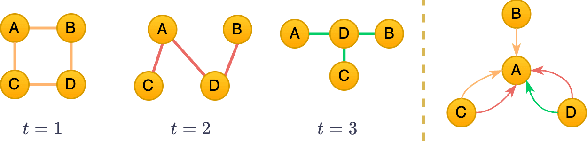
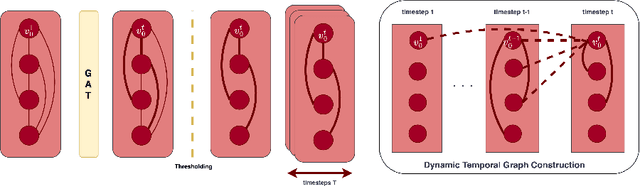


In this paper, we propose capturing and utilizing \textit{Temporal Information through Graph-based Embeddings and Representations} or \textbf{TIGER} to enhance multi-agent reinforcement learning (MARL). We explicitly model how inter-agent coordination structures evolve over time. While most MARL approaches rely on static or per-step relational graphs, they overlook the temporal evolution of interactions that naturally arise as agents adapt, move, or reorganize cooperation strategies. Capturing such evolving dependencies is key to achieving robust and adaptive coordination. To this end, TIGER constructs dynamic temporal graphs of MARL agents, connecting their current and historical interactions. It then employs a temporal attention-based encoder to aggregate information across these structural and temporal neighborhoods, yielding time-aware agent embeddings that guide cooperative policy learning. Through extensive experiments on two coordination-intensive benchmarks, we show that TIGER consistently outperforms diverse value-decomposition and graph-based MARL baselines in task performance and sample efficiency. Furthermore, we conduct comprehensive ablation studies to isolate the impact of key design parameters in TIGER, revealing how structural and temporal factors can jointly shape effective policy learning in MARL. All codes can be found here: https://github.com/Nikunj-Gupta/tiger-marl.
RECIPE-TKG: From Sparse History to Structured Reasoning for LLM-based Temporal Knowledge Graph Completion
May 23, 2025Temporal Knowledge Graphs (TKGs) represent dynamic facts as timestamped relations between entities. TKG completion involves forecasting missing or future links, requiring models to reason over time-evolving structure. While LLMs show promise for this task, existing approaches often overemphasize supervised fine-tuning and struggle particularly when historical evidence is limited or missing. We introduce RECIPE-TKG, a lightweight and data-efficient framework designed to improve accuracy and generalization in settings with sparse historical context. It combines (1) rule-based multi-hop retrieval for structurally diverse history, (2) contrastive fine-tuning of lightweight adapters to encode relational semantics, and (3) test-time semantic filtering to iteratively refine generations based on embedding similarity. Experiments on four TKG benchmarks show that RECIPE-TKG outperforms previous LLM-based approaches, achieving up to 30.6\% relative improvement in Hits@10. Moreover, our proposed framework produces more semantically coherent predictions, even for the samples with limited historical context.