 Add to Chrome
 Add to Firefox
 Add to Edge
GLARE: A Natural Language Interface for Querying Global Explanations
Jun 18, 2026
While global explanations are crucial for understanding vision models across datasets, classes, and decision contexts, their complex and monolithic nature often hinders practical exploration. Because users typically seek targeted answers to specific questions rather than static artifacts, we present an LLM-based interactive interface that provides natural language access to global explanations for black-box image classifiers. The system's core LLM acts as a mediator, translating natural language questions into structured SQL queries over local explanation data. This enables flexible aggregation without exposing users to low-level representations. For each query, the interface outputs statistics-augmented natural language responses, supporting local explanations, and intent-aligned visualizations. We evaluate the system on intent interpretation, query mapping accuracy, generalization to novel queries and datasets, and robustness to linguistic errors. Our results demonstrate that LLM-mediated querying substantially improves the accessibility and usability of global explanations for human-centered XAI.

Local-to-Global Logical Explanations for Deep Vision Models
Jan 19, 2026While deep neural networks are extremely effective at classifying images, they remain opaque and hard to interpret. We introduce local and global explanation methods for black-box models that generate explanations in terms of human-recognizable primitive concepts. Both the local explanations for a single image and the global explanations for a set of images are cast as logical formulas in monotone disjunctive-normal-form (MDNF), whose satisfaction guarantees that the model yields a high score on a given class. We also present an algorithm for explaining the classification of examples into multiple classes in the form of a monotone explanation list over primitive concepts. Despite their simplicity and interpretability we show that the explanations maintain high fidelity and coverage with respect to the blackbox models they seek to explain in challenging vision datasets.
* 15 pages, 5 figures, 5th International Joint Conference on Learning & Reasoning 2025
Iterative and Adaptive Sampling with Spatial Attention for Black-Box Model Explanations
Dec 18, 2019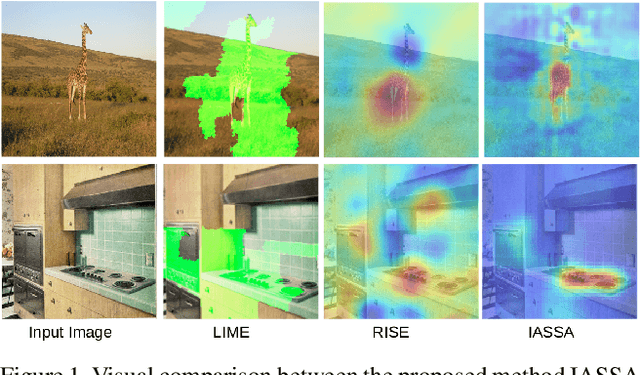
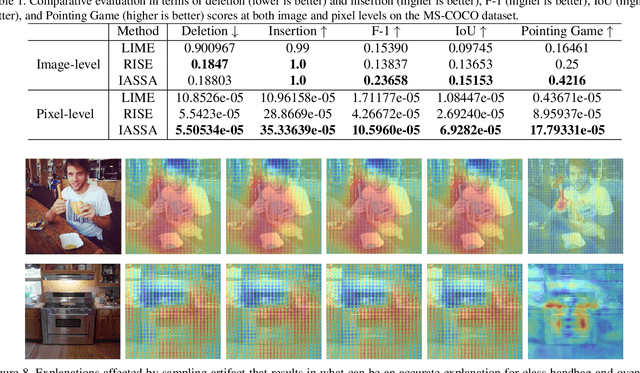
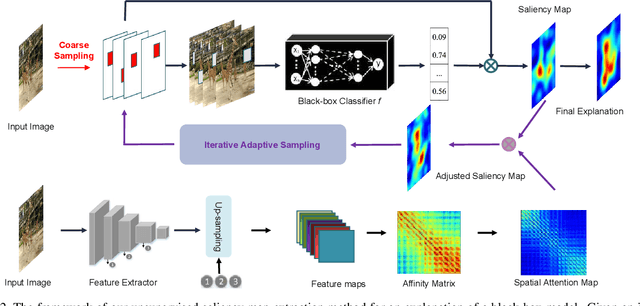
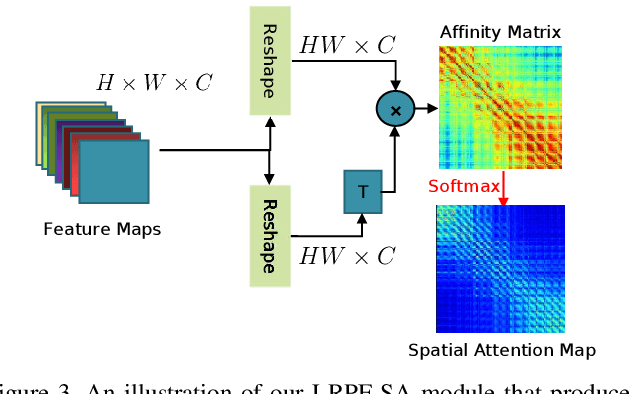
Deep neural networks have achieved great success in many real-world applications, yet it remains unclear and difficult to explain their decision-making process to an end-user. In this paper, we address the explainable AI problem for deep neural networks with our proposed framework, named IASSA, which generates an importance map indicating how salient each pixel is for the model's prediction with an iterative and adaptive sampling module. We employ an affinity matrix calculated on multi-level deep learning features to explore long-range pixel-to-pixel correlation, which can shift the saliency values guided by our long-range and parameter-free spatial attention. Extensive experiments on the MS-COCO dataset show that our proposed approach matches or exceeds the performance of state-of-the-art black-box explanation methods.