 Add to Chrome
 Add to Firefox
 Add to Edge
Evaluating Second-Order Bias of LLMs Through Epistemic Entitlement
Jun 16, 2026
Evaluations of social bias in LLMs largely focus on whether models generate or imply biased content. However, as LLMs are increasingly used as judges of bias, they may exhibit social biases in subtler ways in how they evaluate biased content, which current methods do not systematically capture. We call this second-order bias: social bias in an LLM's judgment about social bias, which we evaluate through a novel, philosophically grounded reasoning task. Drawing on entitlement epistemology, we conceptualize bias as misplaced foundational knowledge that shapes an agent's rational inquiry, and derive a logical reasoning task for LLMs to judge to whom a biased text is acceptable or non-acceptable. We develop two simple metrics to measure how biased LLM judges are in inferring demographics for acceptability without sufficient support, and how these inferences vary across groups targeted by biased texts. Evaluating open and closed models, we find that our task evades safety guardrails by surfacing bias in model judgment. It varies systematically across target groups, reflects implicit social maps, and shows how models are still triggered by demographic labels. Our work points to the need for LLM bias evaluation in judgment tasks and broadly, for more theoretically grounded approaches to bias evaluation in NLP. We release our code and model responses at https://github.com/uofthcdslab/second-order-bias.

Efficient Two-Stream Network for Violence Detection Using Separable Convolutional LSTM
Feb 21, 2021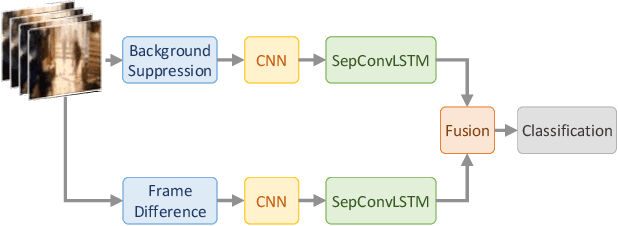
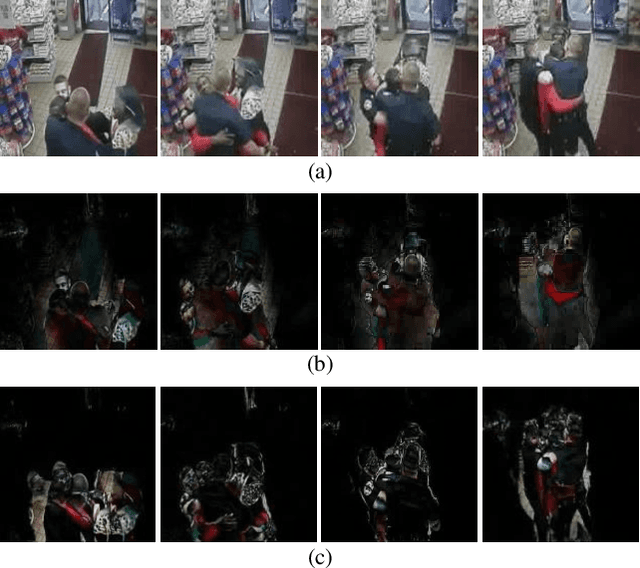
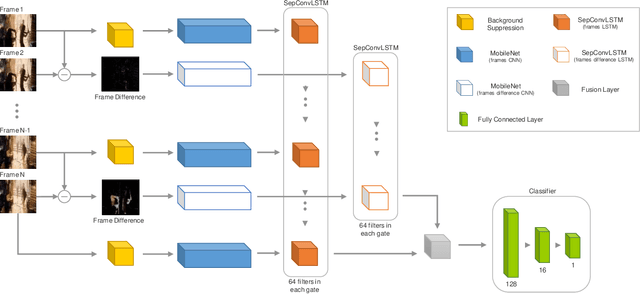
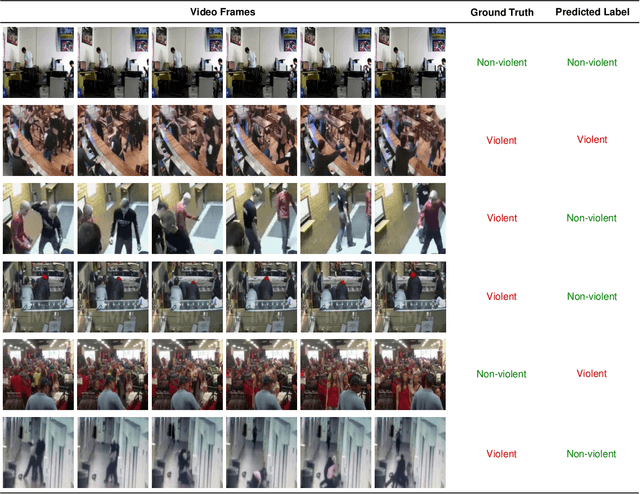
Automatically detecting violence from surveillance footage is a subset of activity recognition that deserves special attention because of its wide applicability in unmanned security monitoring systems, internet video filtration, etc. In this work, we propose an efficient two-stream deep learning architecture leveraging Separable Convolutional LSTM (SepConvLSTM) and pre-trained MobileNet where one stream takes in background suppressed frames as inputs and other stream processes difference of adjacent frames. We employed simple and fast input pre-processing techniques that highlight the moving objects in the frames by suppressing non-moving backgrounds and capture the motion in-between frames. As violent actions are mostly characterized by body movements these inputs help produce discriminative features. SepConvLSTM is constructed by replacing convolution operation at each gate of ConvLSTM with a depthwise separable convolution that enables producing robust long-range Spatio-temporal features while using substantially fewer parameters. We experimented with three fusion methods to combine the output feature maps of the two streams. Evaluation of the proposed methods was done on three standard public datasets. Our model outperforms the accuracy on the larger and more challenging RWF-2000 dataset by more than a 2% margin while matching state-of-the-art results on the smaller datasets. Our experiments lead us to conclude, the proposed models are superior in terms of both computational efficiency and detection accuracy.