 Add to Chrome
 Add to Firefox
 Add to Edge
CenSynCMB: Centre Maps and Physics-Guided Synthesis for Microbleed Detection
Jul 06, 2026
Cerebral microbleeds (CMBs) are MRI markers of small vessel disease and the microbleed component of amyloid related imaging abnormalities (ARIA-H), but their small size, sparsity, and similarity to vessels, calcification-like foci, and artefacts make automated detection difficult. We propose CenSynCMB, a centre-guided and mimic-aware framework combining a 3D Attention U-Net, auxiliary centre-map supervision, false-negative-driven reweighting, and fold-wise physics-guided synthesis of positive CMBs and labelled hard negatives. Synthetic data expose the detector to compact lesions and common mimics without validation or test leakage. On VALDO Task 2, CenSynCMB achieved the best local-comparison lesion-level F1 (74.3%, p = 0.020); on external AIBL SWI, it achieved the highest local-comparison recall (88.5%, p = 0.0058) and F1 (65.0%, p = 0.0016). Together, these results support scalable CMB candidate extraction in large, unlabelled MRI cohorts, while highlighting cohort-specific calibration as the next step toward reliable burden estimation.

Where is VALDO? VAscular Lesions Detection and segmentatiOn challenge at MICCAI 2021
Aug 15, 2022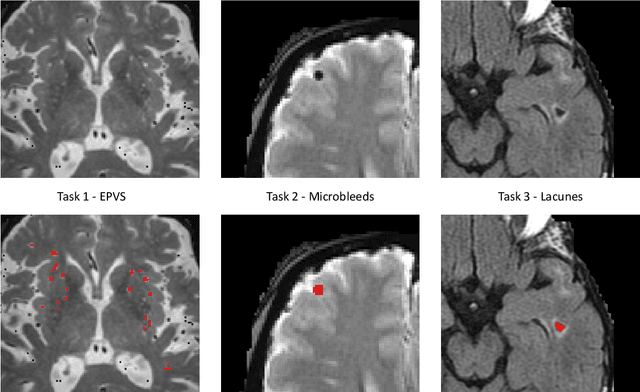
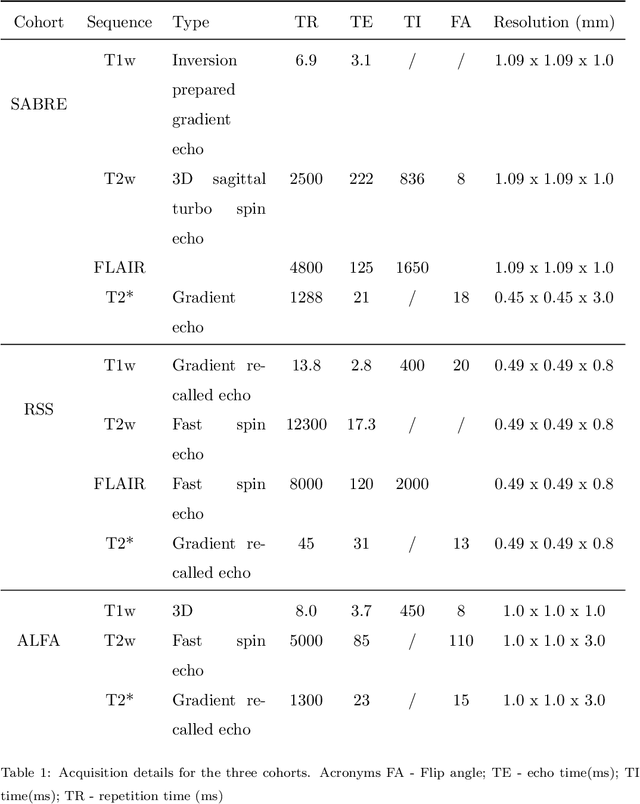
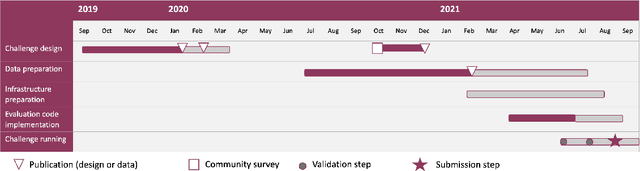
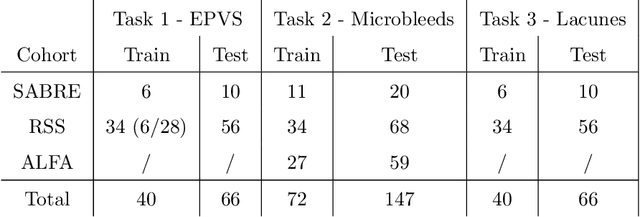
Imaging markers of cerebral small vessel disease provide valuable information on brain health, but their manual assessment is time-consuming and hampered by substantial intra- and interrater variability. Automated rating may benefit biomedical research, as well as clinical assessment, but diagnostic reliability of existing algorithms is unknown. Here, we present the results of the \textit{VAscular Lesions DetectiOn and Segmentation} (\textit{Where is VALDO?}) challenge that was run as a satellite event at the international conference on Medical Image Computing and Computer Aided Intervention (MICCAI) 2021. This challenge aimed to promote the development of methods for automated detection and segmentation of small and sparse imaging markers of cerebral small vessel disease, namely enlarged perivascular spaces (EPVS) (Task 1), cerebral microbleeds (Task 2) and lacunes of presumed vascular origin (Task 3) while leveraging weak and noisy labels. Overall, 12 teams participated in the challenge proposing solutions for one or more tasks (4 for Task 1 - EPVS, 9 for Task 2 - Microbleeds and 6 for Task 3 - Lacunes). Multi-cohort data was used in both training and evaluation. Results showed a large variability in performance both across teams and across tasks, with promising results notably for Task 1 - EPVS and Task 2 - Microbleeds and not practically useful results yet for Task 3 - Lacunes. It also highlighted the performance inconsistency across cases that may deter use at an individual level, while still proving useful at a population level.