 Add to Chrome
 Add to Firefox
 Add to Edge
Neural Network-Assisted RIS Weight Optimization for Spatial Nulling in Distorted Reflector Antenna Systems
Paper and Code
Dec 24, 2025
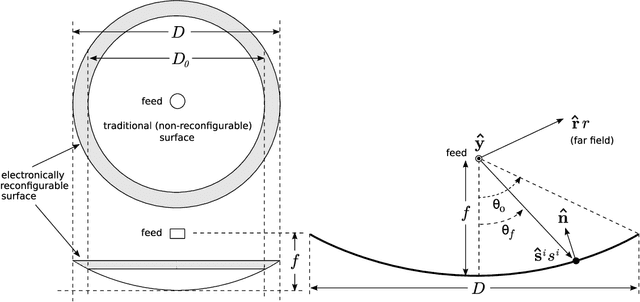
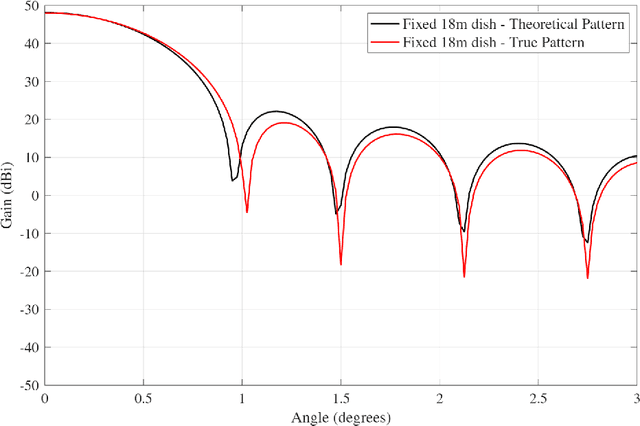
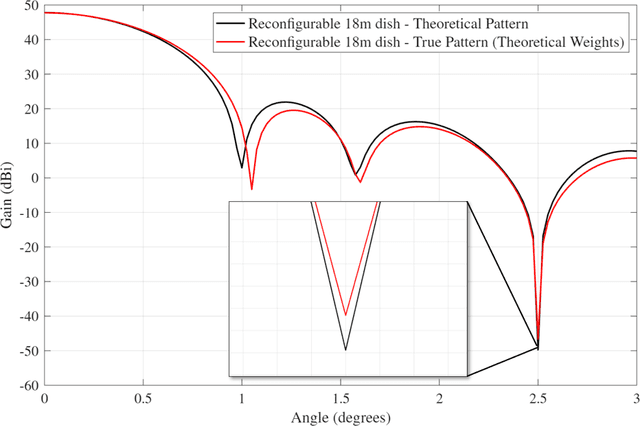
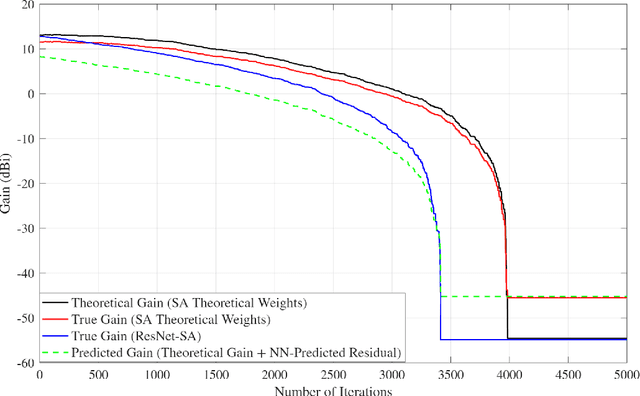
Reconfigurable intelligent surfaces (RIS) have recently been proposed as an effective means for spatial interference suppression in large reflector antenna systems. Existing RIS weight optimization algorithms typically rely on accurate theoretical radiation models. However, in practice, distortions on the reflector antenna may cause mismatches between the theoretical and true antenna patterns, leading to degraded interference cancellation performance when these weights are directly applied. In this report, a residual learning network-assisted simulated annealing (ResNet-SA) framework is proposed to address this mismatch without requiring explicit knowledge of the distorted electric field. By learning the residual difference between the theoretical and true antenna gains, a neural network (NN) is embedded in a heuristic optimization algorithm to find the optimal weight vector. Simulation results demonstrate that the proposed approach achieves improved null depth in the true radiation pattern as compared with conventional methods that optimize weights based solely on the theoretical model, validating the effectiveness of the ResNet-SA algorithm for reflector antenna systems with approximate knowledge of the pattern.
