 Add to Chrome
 Add to Firefox
 Add to Edge
Weakly-Supervised Alignment of Video With Text
Dec 21, 2015
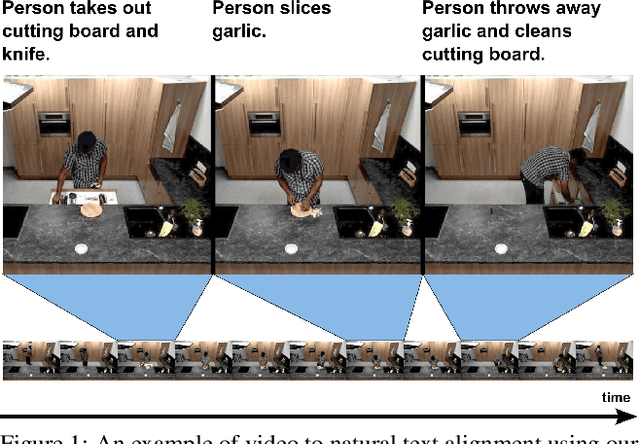
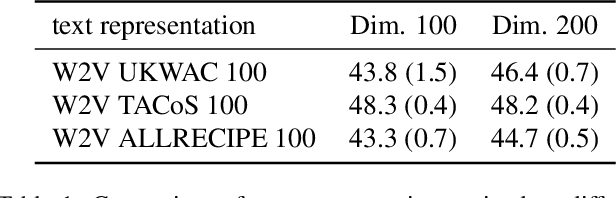
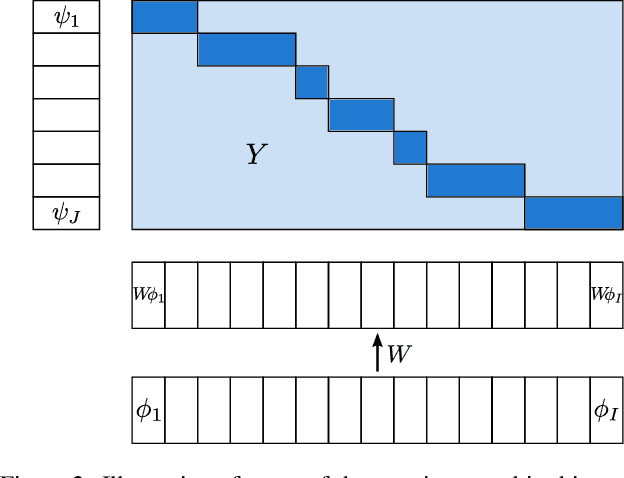
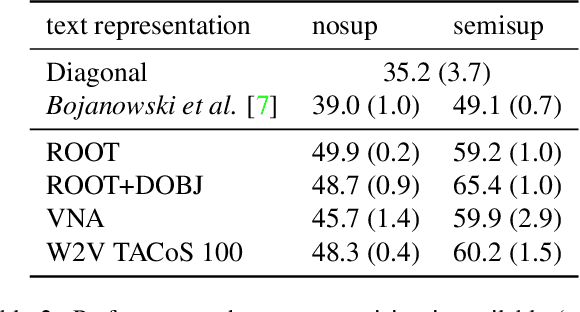
Suppose that we are given a set of videos, along with natural language descriptions in the form of multiple sentences (e.g., manual annotations, movie scripts, sport summaries etc.), and that these sentences appear in the same temporal order as their visual counterparts. We propose in this paper a method for aligning the two modalities, i.e., automatically providing a time stamp for every sentence. Given vectorial features for both video and text, we propose to cast this task as a temporal assignment problem, with an implicit linear mapping between the two feature modalities. We formulate this problem as an integer quadratic program, and solve its continuous convex relaxation using an efficient conditional gradient algorithm. Several rounding procedures are proposed to construct the final integer solution. After demonstrating significant improvements over the state of the art on the related task of aligning video with symbolic labels [7], we evaluate our method on a challenging dataset of videos with associated textual descriptions [36], using both bag-of-words and continuous representations for text.

Semidefinite and Spectral Relaxations for Multi-Label Classification
Jun 05, 2015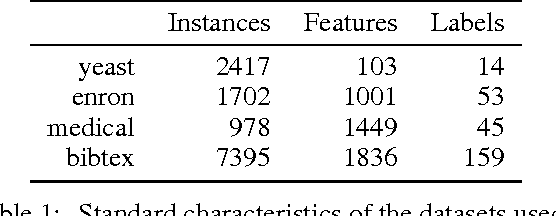
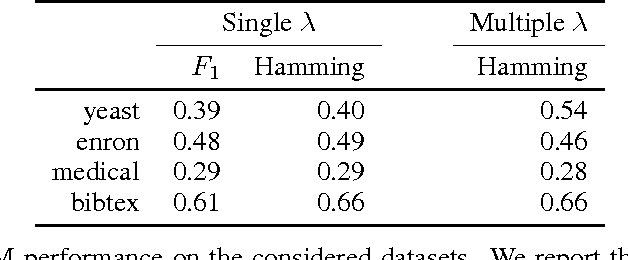
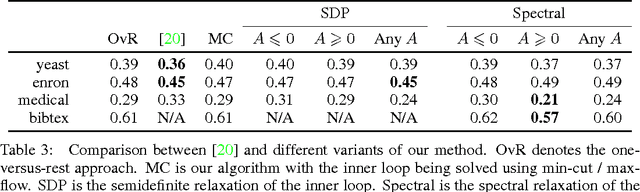
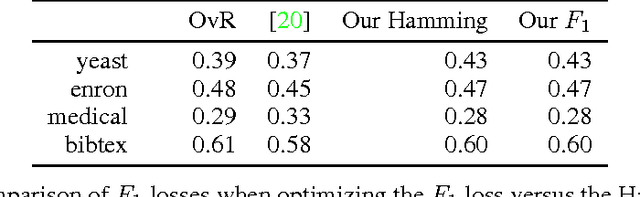
In this paper, we address the problem of multi-label classification. We consider linear classifiers and propose to learn a prior over the space of labels to directly leverage the performance of such methods. This prior takes the form of a quadratic function of the labels and permits to encode both attractive and repulsive relations between labels. We cast this problem as a structured prediction one aiming at optimizing either the accuracies of the predictors or the F 1-score. This leads to an optimization problem closely related to the max-cut problem, which naturally leads to semidefinite and spectral relaxations. We show on standard datasets how such a general prior can improve the performances of multi-label techniques.
Metric Learning for Temporal Sequence Alignment
Sep 10, 2014
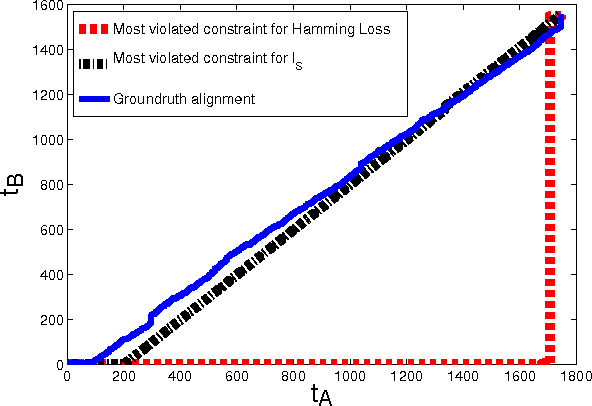


In this paper, we propose to learn a Mahalanobis distance to perform alignment of multivariate time series. The learning examples for this task are time series for which the true alignment is known. We cast the alignment problem as a structured prediction task, and propose realistic losses between alignments for which the optimization is tractable. We provide experiments on real data in the audio to audio context, where we show that the learning of a similarity measure leads to improvements in the performance of the alignment task. We also propose to use this metric learning framework to perform feature selection and, from basic audio features, build a combination of these with better performance for the alignment.
Weakly Supervised Action Labeling in Videos Under Ordering Constraints
Jul 04, 2014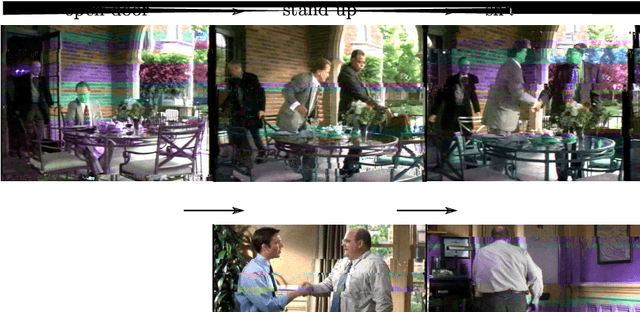
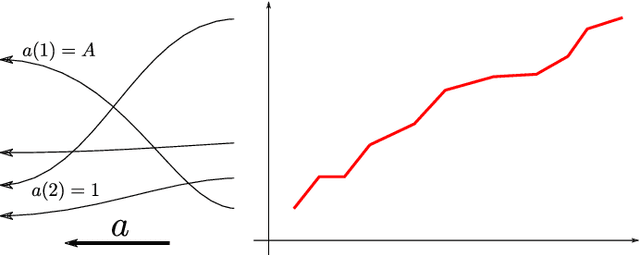
We are given a set of video clips, each one annotated with an {\em ordered} list of actions, such as "walk" then "sit" then "answer phone" extracted from, for example, the associated text script. We seek to temporally localize the individual actions in each clip as well as to learn a discriminative classifier for each action. We formulate the problem as a weakly supervised temporal assignment with ordering constraints. Each video clip is divided into small time intervals and each time interval of each video clip is assigned one action label, while respecting the order in which the action labels appear in the given annotations. We show that the action label assignment can be determined together with learning a classifier for each action in a discriminative manner. We evaluate the proposed model on a new and challenging dataset of 937 video clips with a total of 787720 frames containing sequences of 16 different actions from 69 Hollywood movies.
Large-Margin Metric Learning for Partitioning Problems
Mar 06, 2013


In this paper, we consider unsupervised partitioning problems, such as clustering, image segmentation, video segmentation and other change-point detection problems. We focus on partitioning problems based explicitly or implicitly on the minimization of Euclidean distortions, which include mean-based change-point detection, K-means, spectral clustering and normalized cuts. Our main goal is to learn a Mahalanobis metric for these unsupervised problems, leading to feature weighting and/or selection. This is done in a supervised way by assuming the availability of several potentially partially labelled datasets that share the same metric. We cast the metric learning problem as a large-margin structured prediction problem, with proper definition of regularizers and losses, leading to a convex optimization problem which can be solved efficiently with iterative techniques. We provide experiments where we show how learning the metric may significantly improve the partitioning performance in synthetic examples, bioinformatics, video segmentation and image segmentation problems.