 Add to Chrome
 Add to Firefox
 Add to Edge
GS-Quant: Granular Semantic and Generative Structural Quantization for Knowledge Graph Completion
Apr 23, 2026
Large Language Models (LLMs) have shown immense potential in Knowledge Graph Completion (KGC), yet bridging the modality gap between continuous graph embeddings and discrete LLM tokens remains a critical challenge. While recent quantization-based approaches attempt to align these modalities, they typically treat quantization as flat numerical compression, resulting in semantically entangled codes that fail to mirror the hierarchical nature of human reasoning. In this paper, we propose GS-Quant, a novel framework that generates semantically coherent and structurally stratified discrete codes for KG entities. Unlike prior methods, GS-Quant is grounded in the insight that entity representations should follow a linguistic coarse-to-fine logic. We introduce a Granular Semantic Enhancement module that injects hierarchical knowledge into the codebook, ensuring that earlier codes capture global semantic categories while later codes refine specific attributes. Furthermore, a Generative Structural Reconstruction module imposes causal dependencies on the code sequence, transforming independent discrete units into structured semantic descriptors. By expanding the LLM vocabulary with these learned codes, we enable the model to reason over graph structures isomorphically to natural language generation. Experimental results demonstrate that GS-Quant significantly outperforms existing text-based and embedding-based baselines. Our code is publicly available at https://github.com/mikumifa/GS-Quant.

Mitigating Homophily Disparity in Graph Anomaly Detection: A Scalable and Adaptive Approach
Mar 09, 2026Graph anomaly detection (GAD) aims to identify nodes that deviate from normal patterns in structure or features. While recent GNN-based approaches have advanced this task, they struggle with two major challenges: 1) homophily disparity, where nodes exhibit varying homophily at both class and node levels; and 2) limited scalability, as many methods rely on costly whole-graph operations. To address them, we propose SAGAD, a Scalable and Adaptive framework for GAD. SAGAD precomputes multi-hop embeddings and applies reparameterized Chebyshev filters to extract low- and high-frequency information, enabling efficient training and capturing both homophilic and heterophilic patterns. To mitigate node-level homophily disparity, we introduce an Anomaly Context-Aware Adaptive Fusion, which adaptively fuses low- and high-pass embeddings using fusion coefficients conditioned on Rayleigh Quotient-guided anomalous subgraph structures for each node. To alleviate class-level disparity, we design a Frequency Preference Guidance Loss, which encourages anomalies to preserve more high-frequency information than normal nodes. SAGAD supports mini-batch training, achieves linear time and space complexity, and drastically reduces memory usage on large-scale graphs. Theoretically, SAGAD ensures asymptotic linear separability between normal and abnormal nodes under mild conditions. Extensive experiments on 10 benchmarks confirm SAGAD's superior accuracy and scalability over state-of-the-art methods.
Multi-Scale Heterogeneous Text-Attributed Graph Datasets From Diverse Domains
Dec 12, 2024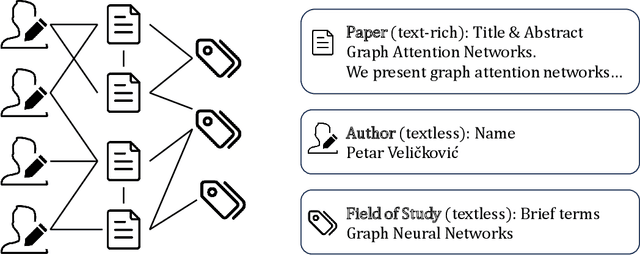
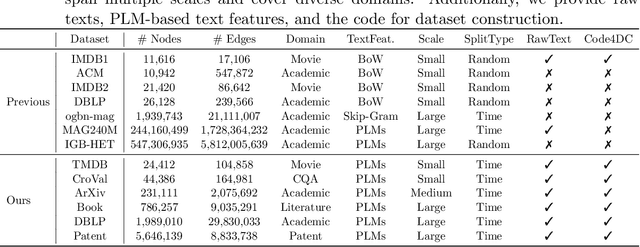
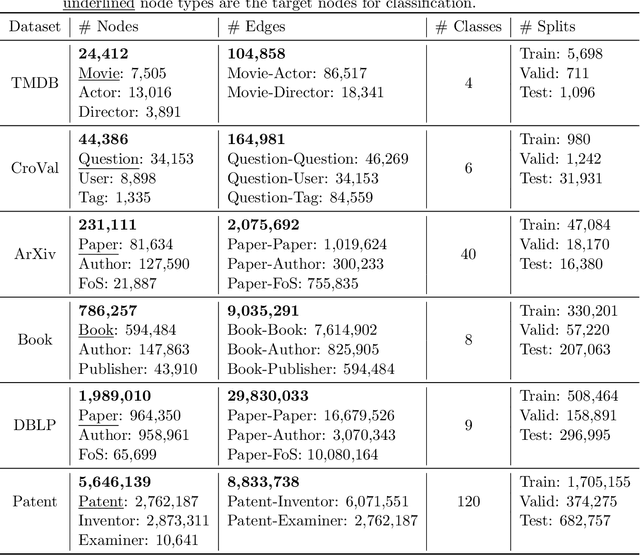
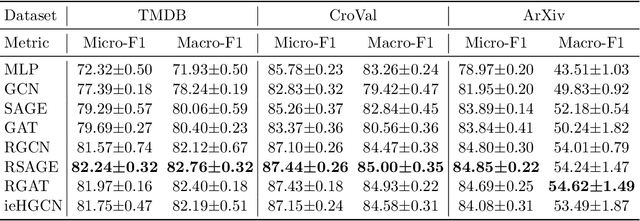
Heterogeneous Text-Attributed Graphs (HTAGs), where different types of entities are not only associated with texts but also connected by diverse relationships, have gained widespread popularity and application across various domains. However, current research on text-attributed graph learning predominantly focuses on homogeneous graphs, which feature a single node and edge type, thus leaving a gap in understanding how methods perform on HTAGs. One crucial reason is the lack of comprehensive HTAG datasets that offer original textual content and span multiple domains of varying sizes. To this end, we introduce a collection of challenging and diverse benchmark datasets for realistic and reproducible evaluation of machine learning models on HTAGs. Our HTAG datasets are multi-scale, span years in duration, and cover a wide range of domains, including movie, community question answering, academic, literature, and patent networks. We further conduct benchmark experiments on these datasets with various graph neural networks. All source data, dataset construction codes, processed HTAGs, data loaders, benchmark codes, and evaluation setup are publicly available at GitHub and Hugging Face.