 Add to Chrome
 Add to Firefox
 Add to Edge
Grounded Continuation: A Linear-Time Runtime Verifier for LLM Conversations
May 13, 2026
In long conversations, an LLM can produce a next utterance that sounds plausible but rests on premises the conversation has already abandoned. Context-manipulation attacks against deployed agents now actively exploit this gap. We close it with a runtime verifier that maintains an explicit dependency graph: an LLM classifies each turn into one of 8 update operations drawn from four formalisms (dynamic epistemic logic, abductive reasoning, awareness logic, argumentation), and a symbolic engine records which claims depend on which evidence. Checking whether a continuation is supported reduces to a graph walk; retraction propagates through the same graph to flag exactly the conclusions that lose support, with linear per-turn cost and a formal conflict-free guarantee. On LongMemEval-KU oracle (n=78), the verifier reaches 89.7% accuracy vs. 88.5% for the LLM-only baseline (+1.3pp) and 87.2% for a transcript-RAG baseline matched on retrieval budget (+2.6pp); wins among disagreements are correct abstentions where the baseline confabulates. On LoCoMo's 60 official QA items the verifier is competitive with retrieval-augmented baselines. Beyond external benchmarks, we construct two multi-agent scenarios and a 50-item grounding test: on the 15-item stale-premise subset, the verifier reaches 100% accuracy vs. 93.3% (+6.7pp). These instantiate a soundness-faithfulness decomposition: the structural check is sound by construction, and per-deployment LLM extraction faithfulness is the empirical question we measure across four LLM families. The retraction check plateaus at microseconds while history-replay grows linearly with conversation length.

Safety-Constrained Reinforcement Learning with Post-Training Reachability Verification for Robot Navigation
May 13, 2026Safe navigation for mobile robots demands policies that remain reliable under the high-consequence perception uncertainty of cluttered environments. Yet most existing safe reinforcement learning (RL) methods assess safety through average cumulative cost. Such metrics can mask dangerous tail-risk behaviors. To address this, we propose a framework that trains risk-sensitive policies through Conditional Value-at-Risk (CVaR) constrained optimization on an off-policy TD3 backbone and evaluates their safety margins post-training through neural network reachability verification. During training, the policy is optimized under CVaR constraints on cumulative costs, promoting sensitivity to high-cost tail outcomes rather than average behavior alone. After training, we compute action reachable sets under bounded observation uncertainty using Taylor Model analysis, yielding a safety rate metric that quantifies the proportion of evaluated states at which the policy's reachable action set remains within prescribed safety margins. A key finding is that policies trained with CVaR constraints maintain larger safety margins from obstacles across evaluated states. This makes them significantly more amenable to formal reachability verification. Experiments across ten navigation scenarios and six baselines show that our method achieves a 98.3\% success rate, the highest safety verification rate among all compared methods, while revealing that average cost rankings and reachability-based safety rankings can diverge. This indicates that reachability verification captures risks which are missed by empirical cost metrics alone. We further validate our approach on a physical Clearpath Jackal robot, demonstrating successful sim-to-real transfer.
Eidos: Efficient, Imperceptible Adversarial 3D Point Clouds
May 23, 2024
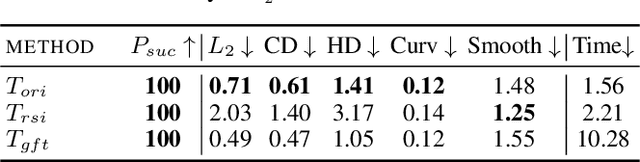
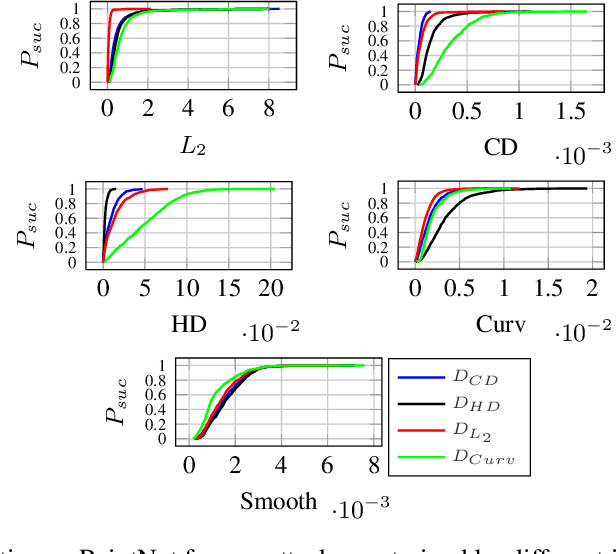
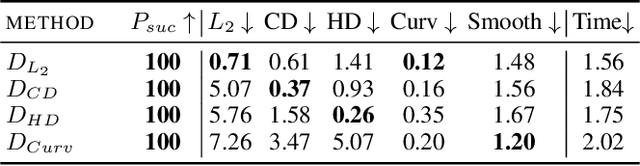
Classification of 3D point clouds is a challenging machine learning (ML) task with important real-world applications in a spectrum from autonomous driving and robot-assisted surgery to earth observation from low orbit. As with other ML tasks, classification models are notoriously brittle in the presence of adversarial attacks. These are rooted in imperceptible changes to inputs with the effect that a seemingly well-trained model ends up misclassifying the input. This paper adds to the understanding of adversarial attacks by presenting Eidos, a framework providing Efficient Imperceptible aDversarial attacks on 3D pOint cloudS. Eidos supports a diverse set of imperceptibility metrics. It employs an iterative, two-step procedure to identify optimal adversarial examples, thereby enabling a runtime-imperceptibility trade-off. We provide empirical evidence relative to several popular 3D point cloud classification models and several established 3D attack methods, showing Eidos' superiority with respect to efficiency as well as imperceptibility.