 Add to Chrome
 Add to Firefox
 Add to Edge
Collaborative Reconstruction and Repair for Multi-class Industrial Anomaly Detection
Dec 12, 2025
Industrial anomaly detection is a challenging open-set task that aims to identify unknown anomalous patterns deviating from normal data distribution. To avoid the significant memory consumption and limited generalizability brought by building separate models per class, we focus on developing a unified framework for multi-class anomaly detection. However, under this challenging setting, conventional reconstruction-based networks often suffer from an identity mapping problem, where they directly replicate input features regardless of whether they are normal or anomalous, resulting in detection failures. To address this issue, this study proposes a novel framework termed Collaborative Reconstruction and Repair (CRR), which transforms the reconstruction to repairation. First, we optimize the decoder to reconstruct normal samples while repairing synthesized anomalies. Consequently, it generates distinct representations for anomalous regions and similar representations for normal areas compared to the encoder's output. Second, we implement feature-level random masking to ensure that the representations from decoder contain sufficient local information. Finally, to minimize detection errors arising from the discrepancies between feature representations from the encoder and decoder, we train a segmentation network supervised by synthetic anomaly masks, thereby enhancing localization performance. Extensive experiments on industrial datasets that CRR effectively mitigates the identity mapping issue and achieves state-of-the-art performance in multi-class industrial anomaly detection.

HSS-IAD: A Heterogeneous Same-Sort Industrial Anomaly Detection Dataset
Apr 17, 2025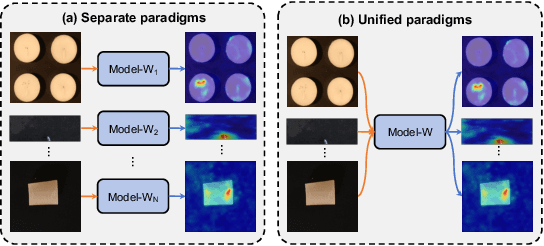
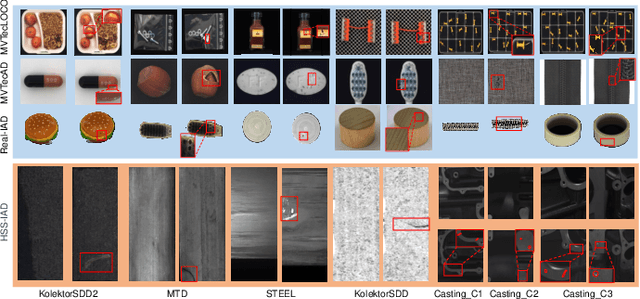
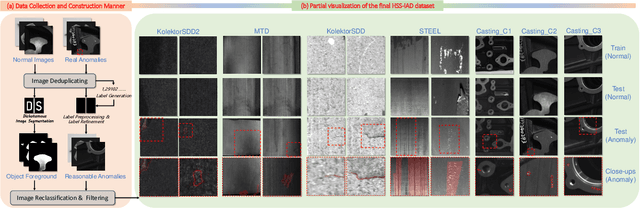
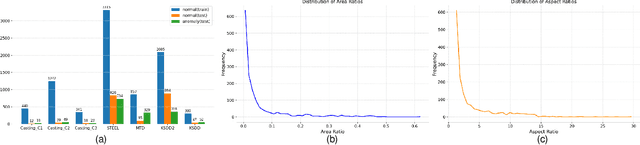
Multi-class Unsupervised Anomaly Detection algorithms (MUAD) are receiving increasing attention due to their relatively low deployment costs and improved training efficiency. However, the real-world effectiveness of MUAD methods is questioned due to limitations in current Industrial Anomaly Detection (IAD) datasets. These datasets contain numerous classes that are unlikely to be produced by the same factory and fail to cover multiple structures or appearances. Additionally, the defects do not reflect real-world characteristics. Therefore, we introduce the Heterogeneous Same-Sort Industrial Anomaly Detection (HSS-IAD) dataset, which contains 8,580 images of metallic-like industrial parts and precise anomaly annotations. These parts exhibit variations in structure and appearance, with subtle defects that closely resemble the base materials. We also provide foreground images for synthetic anomaly generation. Finally, we evaluate popular IAD methods on this dataset under multi-class and class-separated settings, demonstrating its potential to bridge the gap between existing datasets and real factory conditions. The dataset is available at https://github.com/Qiqigeww/HSS-IAD-Dataset.
Search is All You Need for Few-shot Anomaly Detection
Apr 16, 2025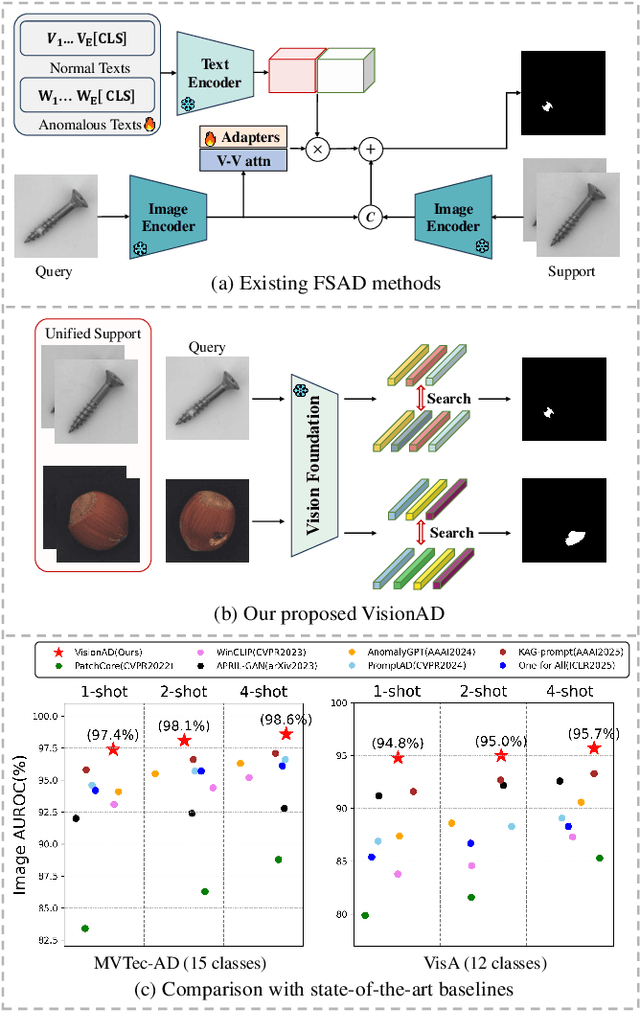
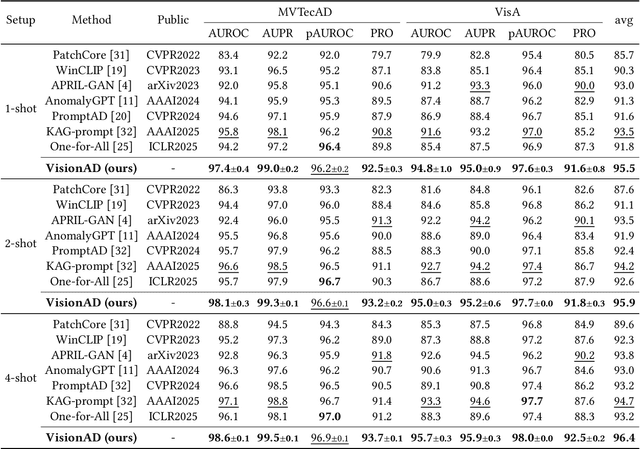
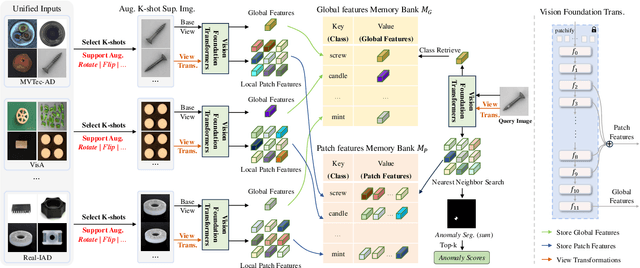
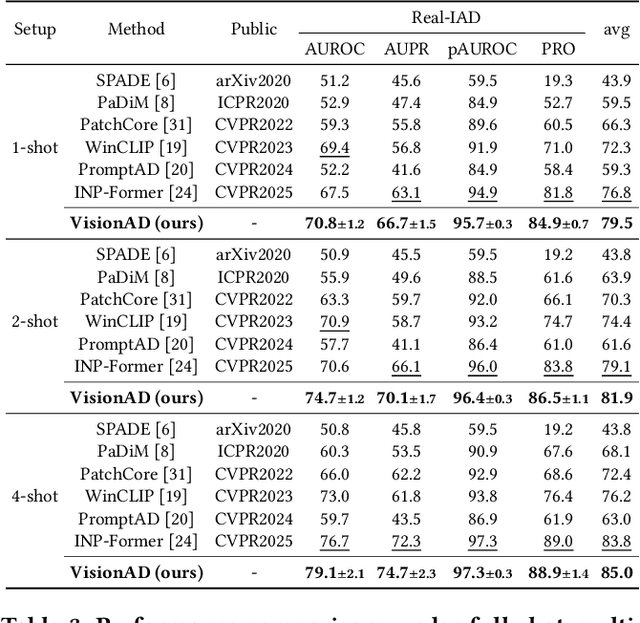
Few-shot anomaly detection (FSAD) has emerged as a crucial yet challenging task in industrial inspection, where normal distribution modeling must be accomplished with only a few normal images. While existing approaches typically employ multi-modal foundation models combining language and vision modalities for prompt-guided anomaly detection, these methods often demand sophisticated prompt engineering and extensive manual tuning. In this paper, we demonstrate that a straightforward nearest-neighbor search framework can surpass state-of-the-art performance in both single-class and multi-class FSAD scenarios. Our proposed method, VisionAD, consists of four simple yet essential components: (1) scalable vision foundation models that extract universal and discriminative features; (2) dual augmentation strategies - support augmentation to enhance feature matching adaptability and query augmentation to address the oversights of single-view prediction; (3) multi-layer feature integration that captures both low-frequency global context and high-frequency local details with minimal computational overhead; and (4) a class-aware visual memory bank enabling efficient one-for-all multi-class detection. Extensive evaluations across MVTec-AD, VisA, and Real-IAD benchmarks demonstrate VisionAD's exceptional performance. Using only 1 normal images as support, our method achieves remarkable image-level AUROC scores of 97.4%, 94.8%, and 70.8% respectively, outperforming current state-of-the-art approaches by significant margins (+1.6%, +3.2%, and +1.4%). The training-free nature and superior few-shot capabilities of VisionAD make it particularly appealing for real-world applications where samples are scarce or expensive to obtain. Code is available at https://github.com/Qiqigeww/VisionAD.
MSVCOD:A Large-Scale Multi-Scene Dataset for Video Camouflage Object Detection
Feb 19, 2025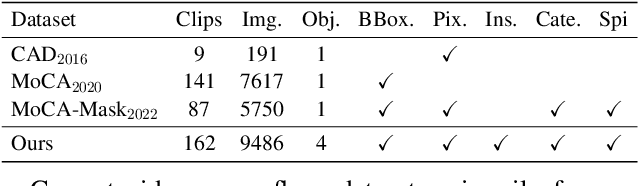
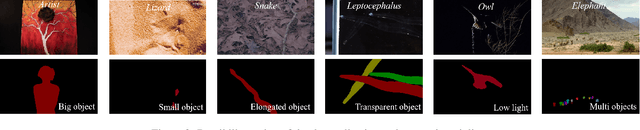
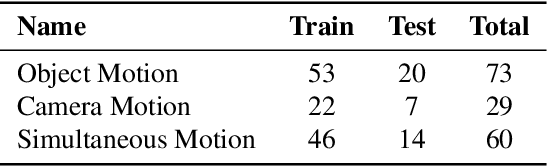
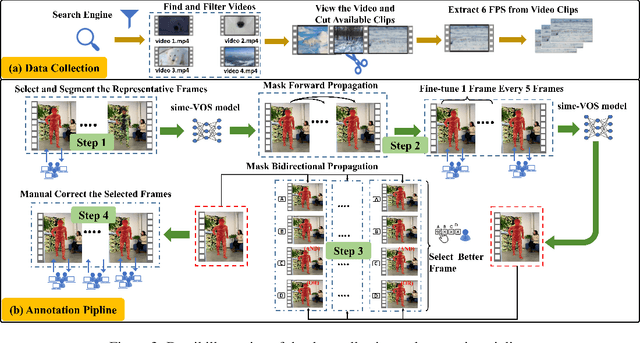
Video Camouflaged Object Detection (VCOD) is a challenging task which aims to identify objects that seamlessly concealed within the background in videos. The dynamic properties of video enable detection of camouflaged objects through motion cues or varied perspectives. Previous VCOD datasets primarily contain animal objects, limiting the scope of research to wildlife scenarios. However, the applications of VCOD extend beyond wildlife and have significant implications in security, art, and medical fields. Addressing this problem, we construct a new large-scale multi-domain VCOD dataset MSVCOD. To achieve high-quality annotations, we design a semi-automatic iterative annotation pipeline that reduces costs while maintaining annotation accuracy. Our MSVCOD is the largest VCOD dataset to date, introducing multiple object categories including human, animal, medical, and vehicle objects for the first time, while also expanding background diversity across various environments. This expanded scope increases the practical applicability of the VCOD task in camouflaged object detection. Alongside this dataset, we introduce a one-steam video camouflage object detection model that performs both feature extraction and information fusion without additional motion feature fusion modules. Our framework achieves state-of-the-art results on the existing VCOD animal dataset and the proposed MSVCOD. The dataset and code will be made publicly available.
P3S-Diffusion:A Selective Subject-driven Generation Framework via Point Supervision
Dec 27, 2024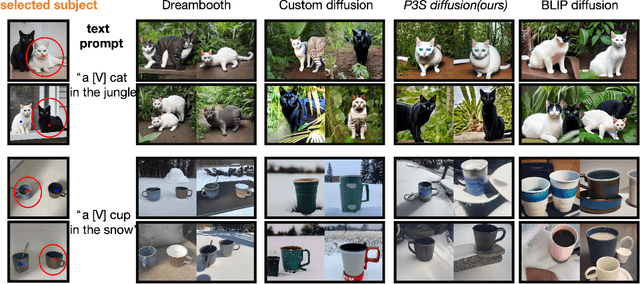
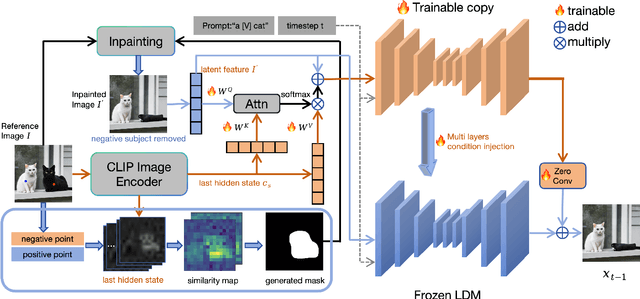
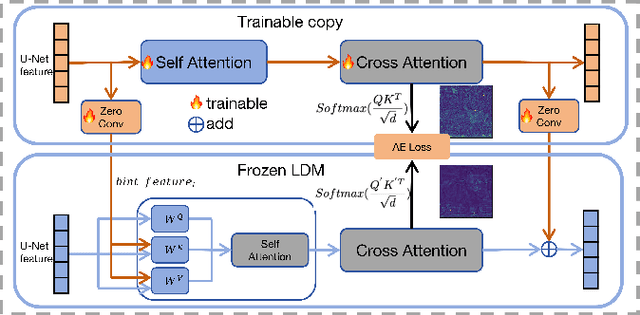
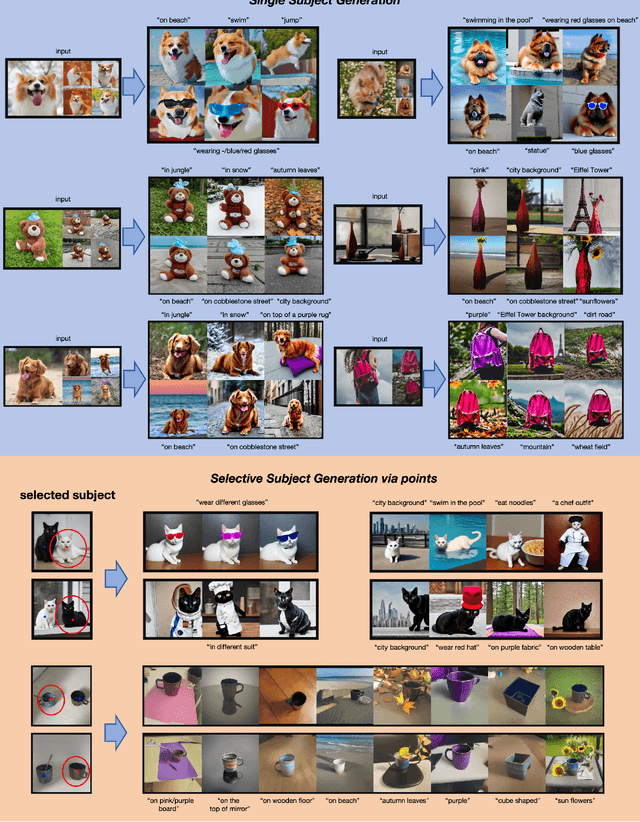
Recent research in subject-driven generation increasingly emphasizes the importance of selective subject features. Nevertheless, accurately selecting the content in a given reference image still poses challenges, especially when selecting the similar subjects in an image (e.g., two different dogs). Some methods attempt to use text prompts or pixel masks to isolate specific elements. However, text prompts often fall short in precisely describing specific content, and pixel masks are often expensive. To address this, we introduce P3S-Diffusion, a novel architecture designed for context-selected subject-driven generation via point supervision. P3S-Diffusion leverages minimal cost label (e.g., points) to generate subject-driven images. During fine-tuning, it can generate an expanded base mask from these points, obviating the need for additional segmentation models. The mask is employed for inpainting and aligning with subject representation. The P3S-Diffusion preserves fine features of the subjects through Multi-layers Condition Injection. Enhanced by the Attention Consistency Loss for improved training, extensive experiments demonstrate its excellent feature preservation and image generation capabilities.