 Add to Chrome
 Add to Firefox
 Add to Edge
From Recoverability to Functional Use: Certifying Temporal Reports in Time-Series Forecasting
Aug 14, 2026
Models increasingly accompany time-series forecasts with temporal reports---delays, leading indicators, or selected history---yet a correct report need not describe the computation that produced the forecast. We formalize this as a three-stage certification problem: \emph{recoverability} of the target from the realized trajectory, \emph{correctness} of the model's report, and \emph{functional use} of the reported history. For Gaussian point delays, we derive an exact finite-sample recovery--substitutability identity: the same realized shift geometry yields structural evidence at scale $nη_n$ but normalized proxy-prediction cost at scale $η_n$. Thus a delay can be decisively identifiable while a correlated alternative remains near-oracle. We then audit intentionally unconstrained TCN and N-HiTS forecasters only on trajectories that are recoverable, correctly reported, and near-oracle. Even there, Jacobian and in-distribution conditional-replacement response peaks lie $9.3$--$13.5$ time steps from the reported delay. Finally, a report-conditioned no-bypass factorization provides a sufficient access certificate; architecture-matched post-hoc routing and gate-destruction controls show that the alignment change is attributable to report-coordinate access. The framework distinguishes evidence that a temporal statement is identifiable and correct from evidence that the forecast computation actually depends on it.

Do Time-Series Forecasters Use the Right History: Recoverability, Recovery, and Functional Use of Temporal Delays
Aug 11, 2026Forecast accuracy does not tell us which past inputs produced a prediction. We separate three questions for time-series models with known delay structure: can the true delay be recovered from the observed data, does the model report it, and does the forecast actually use the same history? We first derive input-conditioned recoverability measures that separate intrinsic ambiguity from model error. We then prove that a delay report can become arbitrarily reliable while forecast risk approaches the oracle even though the predictor still uses the wrong lag. This failure also appears in finite samples on the point-delay task: among forecasts with a correct delay report and normalized excess risk within 10\% of the oracle, the reported history is functionally unused under our matched masking test in 55.4\% of N-HiTS cases and 92.7\% of TCN cases. Finally, we show that routing the prediction through the reported history removes off-report bypass paths; a hard one-hot control achieves exact fixed-report alignment. The main conclusion is simple: a good forecast, even with a correct delay report, does not show that the model used the right history.
An Hybrid Quantum-Classical Diffusion Model for Image Generation
Jul 08, 2026Quantum diffusion models provide a physics-consistent route to generative learning by formulating noising and denoising directly on quantum states. However, applying such models to classical high-dimensional data is constrained by the qubit cost of state encoding and the computational burden of simulating large density operators. We propose a scalable hybrid generative pipeline that combines a classical autoencoder for dimensionality reduction with a mixed-state quantum denoising diffusion probabilistic model (MSQuDDPM) operating in the learned latent space. The autoencoder compresses data into compact latent codes that can be embedded into a small-qubit Hilbert space, after which the quantum diffusion model learns a generative distribution over latent density operators and decodes samples back to the original domain. Algorithmically, we simplify the reverse dynamics by predicting an estimate of the clean state $ρ_0$ at timestep $t$ and computing the one-step reverse update via an analytic backward propagation rule, rather than learning an explicit predictor for $ρ_{t-1}$. We demonstrate the proposed approach on MNIST image generation and discuss how mixed-state quantum diffusion can serve as a practical backbone for hybrid quantum--classical generative modeling under realistic qubit budgets.
Learning Heat-based Equations in Self-similar variables
Feb 03, 2026We study solution learning for heat-based equations in self-similar variables (SSV). We develop an SSV training framework compatible with standard neural-operator training. We instantiate this framework on the two-dimensional incompressible Navier-Stokes equations and the one-dimensional viscous Burgers equation, and perform controlled comparisons between models trained in physical coordinates and in the corresponding self-similar coordinates using two simple fully connected architectures (standard multilayer perceptrons and a factorized fully connected network). Across both systems and both architectures, SSV-trained networks consistently deliver substantially more accurate and stable extrapolation beyond the training window and better capture qualitative long-time trends. These results suggest that self-similar coordinates provide a mathematically motivated inductive bias for learning the long-time dynamics of heat-based equations.
Wavelet-Inspired Multiscale Graph Convolutional Recurrent Network for Traffic Forecasting
Jan 11, 2024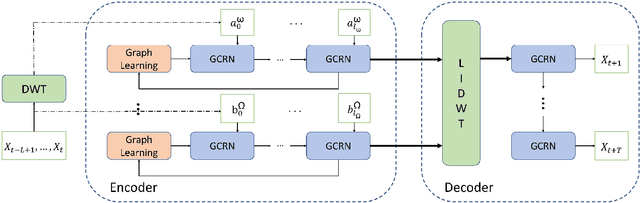
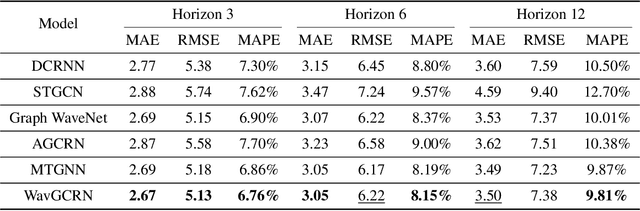
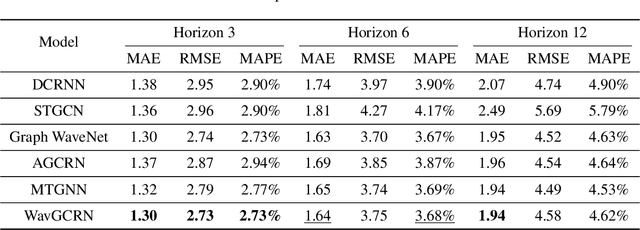
Traffic forecasting is the foundation for intelligent transportation systems. Spatiotemporal graph neural networks have demonstrated state-of-the-art performance in traffic forecasting. However, these methods do not explicitly model some of the natural characteristics in traffic data, such as the multiscale structure that encompasses spatial and temporal variations at different levels of granularity or scale. To that end, we propose a Wavelet-Inspired Graph Convolutional Recurrent Network (WavGCRN) which combines multiscale analysis (MSA)-based method with Deep Learning (DL)-based method. In WavGCRN, the traffic data is decomposed into time-frequency components with Discrete Wavelet Transformation (DWT), constructing a multi-stream input structure; then Graph Convolutional Recurrent networks (GCRNs) are employed as encoders for each stream, extracting spatiotemporal features in different scales; and finally the learnable Inversed DWT and GCRN are combined as the decoder, fusing the information from all streams for traffic metrics reconstruction and prediction. Furthermore, road-network-informed graphs and data-driven graph learning are combined to accurately capture spatial correlation. The proposed method can offer well-defined interpretability, powerful learning capability, and competitive forecasting performance on real-world traffic data sets.