 Add to Chrome
 Add to Firefox
 Add to Edge
An Hybrid Quantum-Classical Diffusion Model for Image Generation
Jul 08, 2026
Quantum diffusion models provide a physics-consistent route to generative learning by formulating noising and denoising directly on quantum states. However, applying such models to classical high-dimensional data is constrained by the qubit cost of state encoding and the computational burden of simulating large density operators. We propose a scalable hybrid generative pipeline that combines a classical autoencoder for dimensionality reduction with a mixed-state quantum denoising diffusion probabilistic model (MSQuDDPM) operating in the learned latent space. The autoencoder compresses data into compact latent codes that can be embedded into a small-qubit Hilbert space, after which the quantum diffusion model learns a generative distribution over latent density operators and decodes samples back to the original domain. Algorithmically, we simplify the reverse dynamics by predicting an estimate of the clean state $ρ_0$ at timestep $t$ and computing the one-step reverse update via an analytic backward propagation rule, rather than learning an explicit predictor for $ρ_{t-1}$. We demonstrate the proposed approach on MNIST image generation and discuss how mixed-state quantum diffusion can serve as a practical backbone for hybrid quantum--classical generative modeling under realistic qubit budgets.

RGB Pre-Training Enhanced Unobservable Feature Latent Diffusion Model for Spectral Reconstruction
Jul 17, 2025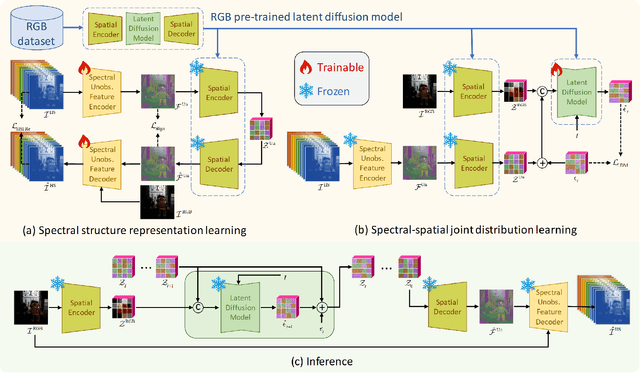
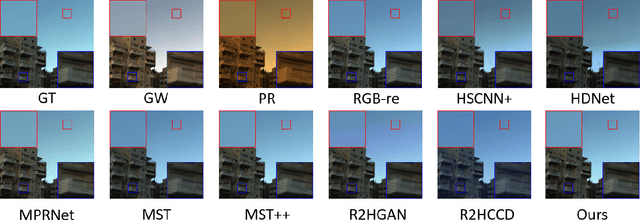
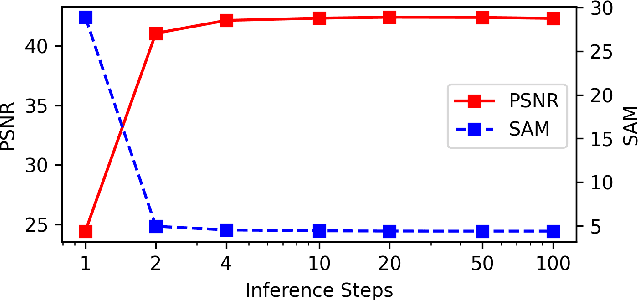
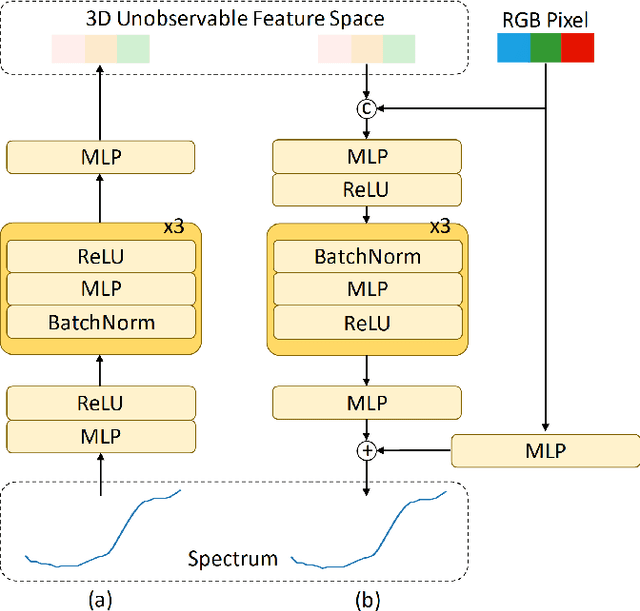
Spectral reconstruction (SR) is a crucial problem in image processing that requires reconstructing hyperspectral images (HSIs) from the corresponding RGB images. A key difficulty in SR is estimating the unobservable feature, which encapsulates significant spectral information not captured by RGB imaging sensors. The solution lies in effectively constructing the spectral-spatial joint distribution conditioned on the RGB image to complement the unobservable feature. Since HSIs share a similar spatial structure with the corresponding RGB images, it is rational to capitalize on the rich spatial knowledge in RGB pre-trained models for spectral-spatial joint distribution learning. To this end, we extend the RGB pre-trained latent diffusion model (RGB-LDM) to an unobservable feature LDM (ULDM) for SR. As the RGB-LDM and its corresponding spatial autoencoder (SpaAE) already excel in spatial knowledge, the ULDM can focus on modeling spectral structure. Moreover, separating the unobservable feature from the HSI reduces the redundant spectral information and empowers the ULDM to learn the joint distribution in a compact latent space. Specifically, we propose a two-stage pipeline consisting of spectral structure representation learning and spectral-spatial joint distribution learning to transform the RGB-LDM into the ULDM. In the first stage, a spectral unobservable feature autoencoder (SpeUAE) is trained to extract and compress the unobservable feature into a 3D manifold aligned with RGB space. In the second stage, the spectral and spatial structures are sequentially encoded by the SpeUAE and the SpaAE, respectively. The ULDM is then acquired to model the distribution of the coded unobservable feature with guidance from the corresponding RGB images. Experimental results on SR and downstream relighting tasks demonstrate that our proposed method achieves state-of-the-art performance.