 Add to Chrome
 Add to Firefox
 Add to Edge
Image-to-Image Translation Framework Embedded with Rotation Symmetry Priors
Apr 14, 2026
Image-to-image translation (I2I) is a fundamental task in computer vision, focused on mapping an input image from a source domain to a corresponding image in a target domain while preserving domain-invariant features and adapting domain-specific attributes. Despite the remarkable success of deep learning-based I2I approaches, the lack of paired data and unsupervised learning framework still hinder their effectiveness. In this work, we address the challenge by incorporating transformation symmetry priors into image-to-image translation networks. Specifically, we introduce rotation group equivariant convolutions to achieve rotation equivariant I2I framework, a novel contribution, to the best of our knowledge, along this research direction. This design ensures the preservation of rotation symmetry, one of the most intrinsic and domain-invariant properties of natural and scientific images, throughout the network. Furthermore, we conduct a systematic study on image symmetry priors on real dataset and propose a novel transformation learnable equivariant convolutions (TL-Conv) that adaptively learns transformation groups, enhancing symmetry preservation across diverse datasets. We also provide a theoretical analysis of the equivariance error of TL-Conv, proving that it maintains exact equivariance in continuous domains and provide a bound for the error in discrete cases. Through extensive experiments across a range of I2I tasks, we validate the effectiveness and superior performance of our approach, highlighting the potential of equivariant networks in enhancing generation quality and its broad applicability. Our code is available at https://github.com/tanfy929/Equivariant-I2I

An Accelerated Mixed Weighted-Unweighted MMSE Approach for MU-MIMO Beamforming
Oct 23, 2025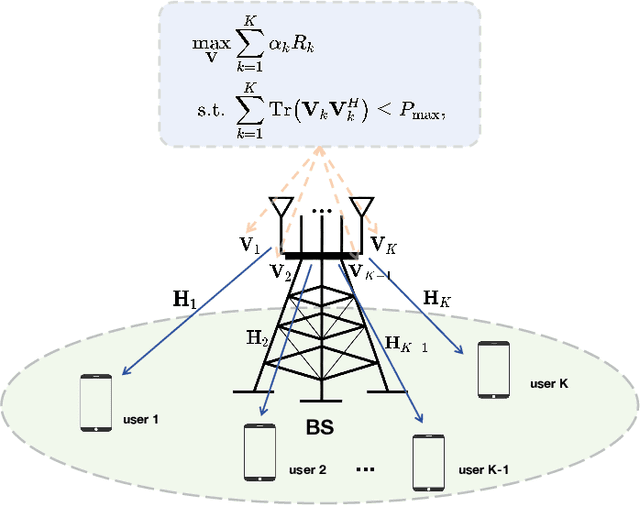
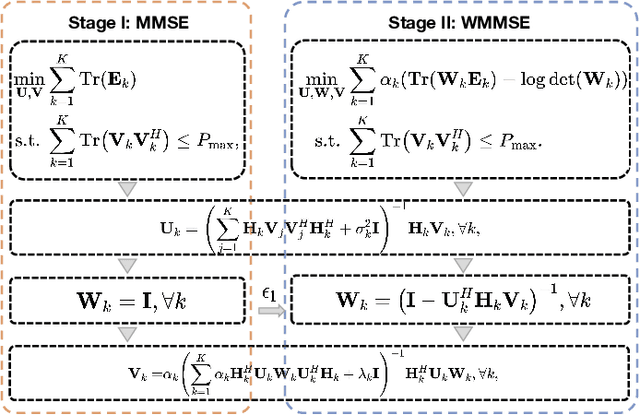
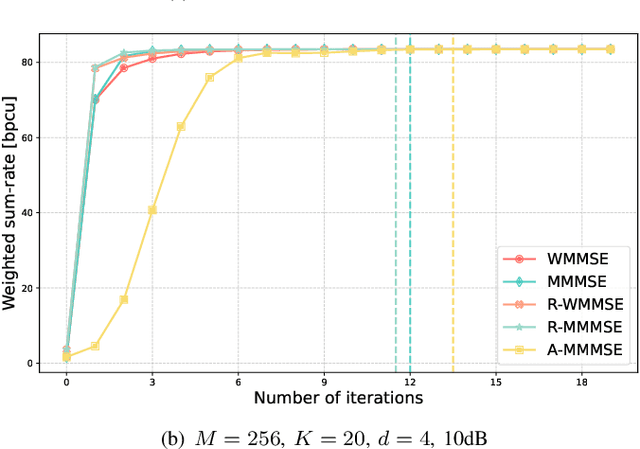
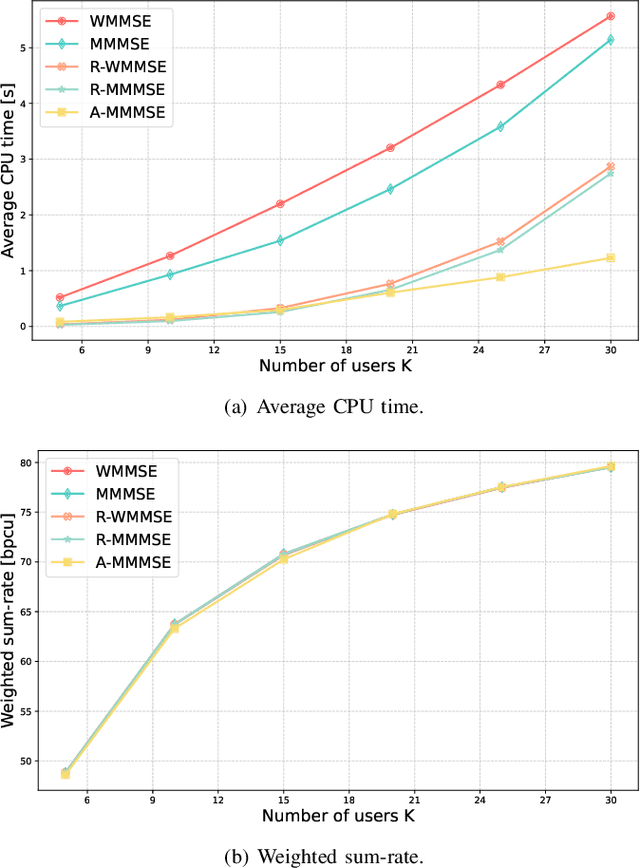
Precoding design based on weighted sum-rate (WSR) maximization is a fundamental problem in downlink multi-user multiple-input multiple-output (MU-MIMO) systems. While the weighted minimum mean-square error (WMMSE) algorithm is a standard solution, its high computational complexity--cubic in the number of base station antennas due to matrix inversions--hinders its application in latency-sensitive scenarios. To address this limitation, we propose a highly parallel algorithm based on a block coordinate descent framework. Our key innovation lies in updating the precoding matrix via block coordinate gradient descent, which avoids matrix inversions and relies solely on matrix multiplications, making it exceptionally amenable to GPU acceleration. We prove that the proposed algorithm converges to a stationary point of the WSR maximization problem. Furthermore, we introduce a two-stage warm-start strategy grounded in the sum mean-square error (MSE) minimization problem to accelerate convergence. We refer to our method as the Accelerated Mixed weighted-unweighted sum-MSE minimization (A-MMMSE) algorithm. Simulation results demonstrate that A-MMMSE matches the WSR performance of both conventional WMMSE and its enhanced variant, reduced-WMMSE, while achieving a substantial reduction in computational time across diverse system configurations.