 Add to Chrome
 Add to Firefox
 Add to Edge
QED: An Open-Source Multi-Agent System for Generating Mathematical Proofs on Open Problems
Apr 27, 2026
We explore a central question in AI for mathematics: can AI systems produce original, nontrivial proofs for open research problems? Despite strong benchmark performance, producing genuinely novel proofs remains an outstanding challenge for LLMs. Through systematic experiments with frontier LLMs on research-level proof tasks, we identify seven failure modes that prevent reliable proof generation, including context contamination, citation hallucination, hand-waving on key steps and misallocation of proof effort, unstable proof plans, unfocused verification, problem modification and single-model bottleneck. We argue that the gap between benchmark success and research-level proving is primarily one of system design, due to those failure modes. We present QED, an open-source multi-agent proof system in which each architectural decision directly addresses a specific failure mode. Evaluated on five open problems in applied analysis and PDEs contributed by domain experts, QED produces correct proofs for three problems, each verified by the contributing experts as original and nontrivial. QED is released as open-source software at https://github.com/proofQED/QED.

A Robust Model-Based Approach for Continuous-Time Policy Evaluation with Unknown Lévy Process Dynamics
Apr 02, 2025This paper develops a model-based framework for continuous-time policy evaluation (CTPE) in reinforcement learning, incorporating both Brownian and L\'evy noise to model stochastic dynamics influenced by rare and extreme events. Our approach formulates the policy evaluation problem as solving a partial integro-differential equation (PIDE) for the value function with unknown coefficients. A key challenge in this setting is accurately recovering the unknown coefficients in the stochastic dynamics, particularly when driven by L\'evy processes with heavy tail effects. To address this, we propose a robust numerical approach that effectively handles both unbiased and censored trajectory datasets. This method combines maximum likelihood estimation with an iterative tail correction mechanism, improving the stability and accuracy of coefficient recovery. Additionally, we establish a theoretical bound for the policy evaluation error based on coefficient recovery error. Through numerical experiments, we demonstrate the effectiveness and robustness of our method in recovering heavy-tailed L\'evy dynamics and verify the theoretical error analysis in policy evaluation.
Learn from Failure: Fine-Tuning LLMs with Trial-and-Error Data for Intuitionistic Propositional Logic Proving
Apr 10, 2024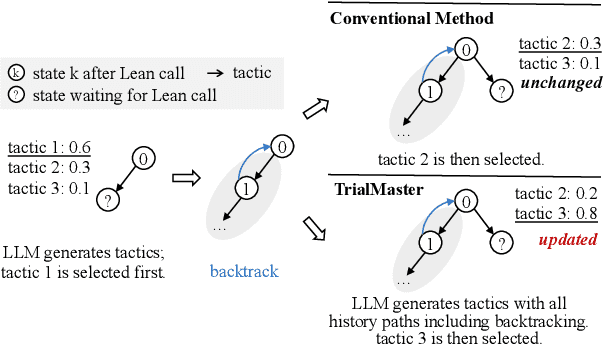
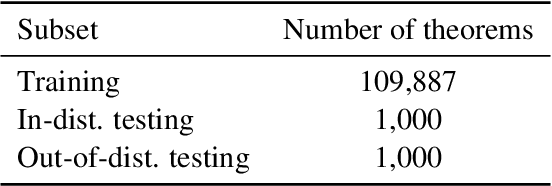
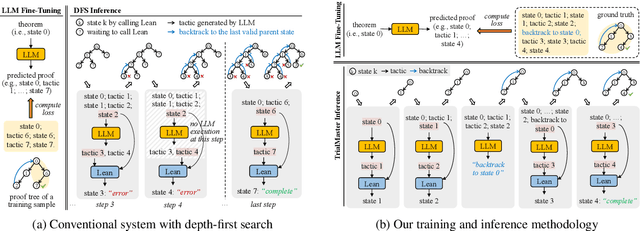
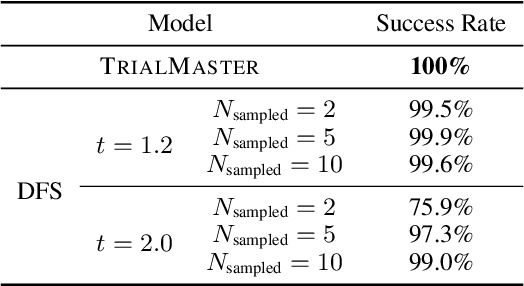
Recent advances in Automated Theorem Proving have shown the effectiveness of leveraging a (large) language model that generates tactics (i.e. proof steps) to search through proof states. The current model, while trained solely on successful proof paths, faces a discrepancy at the inference stage, as it must sample and try various tactics at each proof state until finding success, unlike its training which does not incorporate learning from failed attempts. Intuitively, a tactic that leads to a failed search path would indicate that similar tactics should receive less attention during the following trials. In this paper, we demonstrate the benefit of training models that additionally learn from failed search paths. Facing the lack of such trial-and-error data in existing open-source theorem-proving datasets, we curate a dataset on intuitionistic propositional logic theorems and formalize it in Lean, such that we can reliably check the correctness of proofs. We compare our model trained on relatively short trial-and-error information (TrialMaster) with models trained only on the correct paths and discover that the former solves more unseen theorems with lower trial searches.