 Add to Chrome
 Add to Firefox
 Add to Edge
DD-INR: Dynamics-Driven Implicit Neural Representation for Accelerated Whole-Brain Functional MRI Reconstruction
Jun 09, 2026
Accelerated acquisition of fMRI enables enhanced detection of neurovascular (BOLD) activity in the brain, but image reconstruction becomes challenging with high k-space undersampling: Task-evoked BOLD signals are small in magnitude, which traditional anatomical MRI reconstruction methods fail to recover, as they favor spatial accuracy over temporal fidelity. We present DD-INR, a Dynamics-Driven Implicit Neural Representation framework tailored for accelerated fMRI that benefits from incoherent time-varying sampling and a tailored spatiotemporal prior, outperforming traditional methods, demonstrated in simulation and in-vivo acquisition, both in terms of image quality and retrieval of activation patterns. DD-INR achieves this by splitting the fMRI data into a static background and a temporally varying dynamic component, representing only the dynamics with a dedicated INR, thereby focusing the model's capacity on activation-relevant changes while remaining compact. In general, DD-INR provides a promising framework for accelerated fMRI reconstruction, with the potential to improve the sensitivity and robustness of fMRI studies within practical scan time limits. The source code is available at https://github.com/JoosenLi/DD-INR.

Efficient temporal prediction of compressible flows in irregular domains using Fourier neural operators
Jan 05, 2026This paper investigates the temporal evolution of high-speed compressible fluids in irregular flow fields using the Fourier Neural Operator (FNO). We reconstruct the irregular flow field point set into sequential format compatible with FNO input requirements, and then embed temporal bundling technique within a recurrent neural network (RNN) for multi-step prediction. We further employ a composite loss function to balance errors across different physical quantities. Experiments are conducted on three different types of irregular flow fields, including orthogonal and non-orthogonal grid configurations. Then we comprehensively analyze the physical component loss curves, flow field visualizations, and physical profiles. Results demonstrate that our approach significantly surpasses traditional numerical methods in computational efficiency while achieving high accuracy, with maximum relative $L_2$ errors of (0.78, 0.57, 0.35)% for ($p$, $T$, $\mathbf{u}$) respectively. This verifies that the method can efficiently and accurately simulate the temporal evolution of high-speed compressible flows in irregular domains.
Sequential-Scanning Dual-Energy CT Imaging Using High Temporal Resolution Image Reconstruction and Error-Compensated Material Basis Image Generation
Aug 27, 2024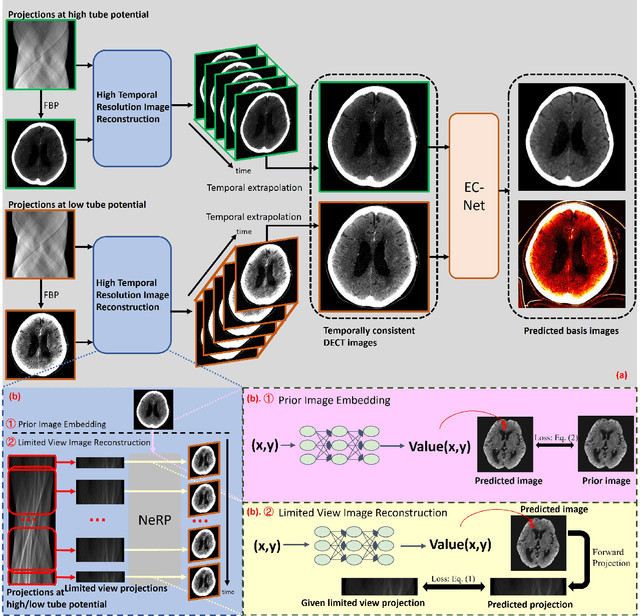
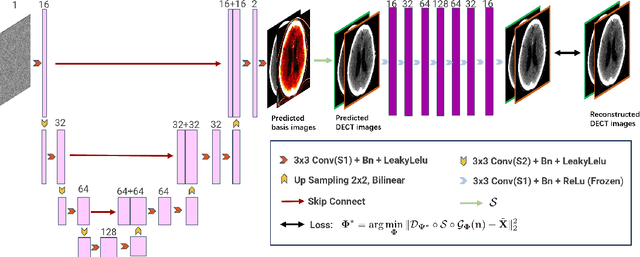
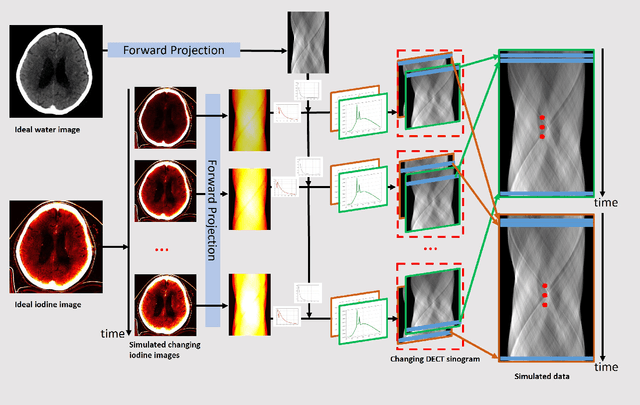
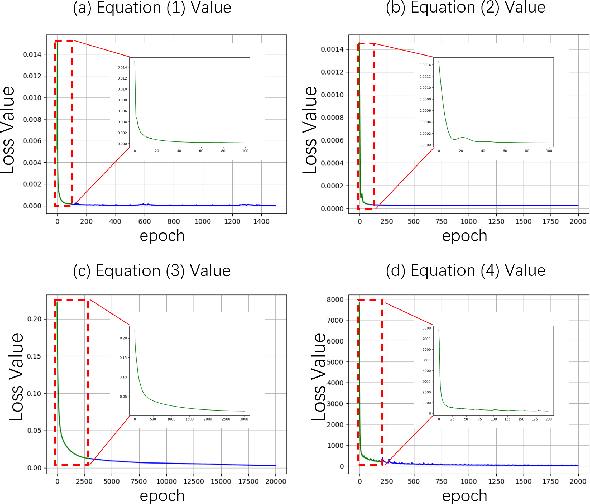
Dual-energy computed tomography (DECT) has been widely used to obtain quantitative elemental composition of imaged subjects for personalized and precise medical diagnosis. Compared with DECT leveraging advanced X-ray source and/or detector technologies, the use of the sequential-scanning data acquisition scheme to implement DECT may make a broader impact on clinical practice because this scheme requires no specialized hardware designs and can be directly implemented into conventional CT systems. However, since the concentration of iodinated contrast agent in the imaged subject varies over time, sequentially scanned data sets acquired at two tube potentials are temporally inconsistent. As existing material basis image reconstruction approaches assume that the data sets acquired at two tube potentials are temporally consistent, the violation of this assumption results in inaccurate quantification of material concentration. In this work, we developed sequential-scanning DECT imaging using high temporal resolution image reconstruction and error-compensated material basis image generation, ACCELERATION in short, to address the technical challenge induced by temporal inconsistency of sequentially scanned data sets and improve quantification accuracy of material concentration in sequential-scanning DECT. ACCELERATION has been validated and evaluated using numerical simulation data sets generated from clinical human subject exams and experimental human subject studies. Results demonstrated the improvement of quantification accuracy and image quality using ACCELERATION.
ACCELERATION: Sequentially-scanning DECT Imaging Using High Temporal Resolution Image Reconstruction And Temporal Extrapolation
Aug 12, 2024Dual-energy computed tomography (DECT) has been widely used to obtain quantitative elemental composition of imaged subjects for personalized and precise medical diagnosis. Compared with existing high-end DECT leveraging advanced X-ray source and/or detector technologies, the use of the sequentially-scanning data acquisition scheme to implement DECT may make broader impact on clinical practice because this scheme requires no specialized hardware designs. However, since the concentration of iodinated contrast agent in the imaged subject varies over time, sequentially-scanned data sets acquired at two tube potentials are temporally inconsistent. As existing material decomposition approaches for DECT assume that the data sets acquired at two tube potentials are temporally consistent, the violation of this assumption results in inaccurate quantification accuracy of iodine concentration. In this work, we developed a technique to achieve sequentially-scanning DECT imaging using high temporal resolution image reconstruction and temporal extrapolation, ACCELERATION in short, to address the technical challenge induced by temporal inconsistency of sequentially-scanned data sets and improve iodine quantification accuracy in sequentially-scanning DECT. ACCELERATION has been validated and evaluated using numerical simulation data sets generated from clinical human subject exams. Results demonstrated the improvement of iodine quantification accuracy using ACCELERATION.