 Add to Chrome
 Add to Firefox
 Add to Edge
Efficient temporal prediction of compressible flows in irregular domains using Fourier neural operators
Jan 05, 2026
This paper investigates the temporal evolution of high-speed compressible fluids in irregular flow fields using the Fourier Neural Operator (FNO). We reconstruct the irregular flow field point set into sequential format compatible with FNO input requirements, and then embed temporal bundling technique within a recurrent neural network (RNN) for multi-step prediction. We further employ a composite loss function to balance errors across different physical quantities. Experiments are conducted on three different types of irregular flow fields, including orthogonal and non-orthogonal grid configurations. Then we comprehensively analyze the physical component loss curves, flow field visualizations, and physical profiles. Results demonstrate that our approach significantly surpasses traditional numerical methods in computational efficiency while achieving high accuracy, with maximum relative $L_2$ errors of (0.78, 0.57, 0.35)% for ($p$, $T$, $\mathbf{u}$) respectively. This verifies that the method can efficiently and accurately simulate the temporal evolution of high-speed compressible flows in irregular domains.

On the Comprehensibility of Multi-structured Financial Documents using LLMs and Pre-processing Tools
Jun 05, 2025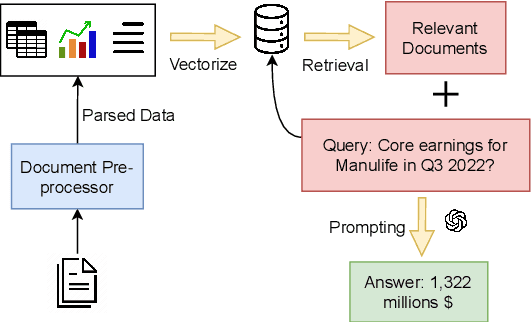
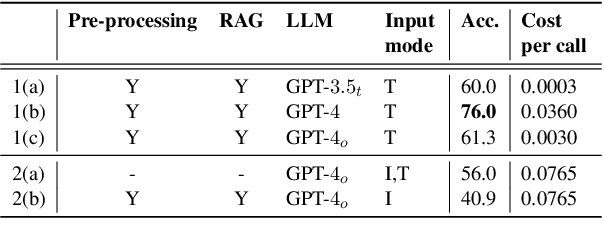
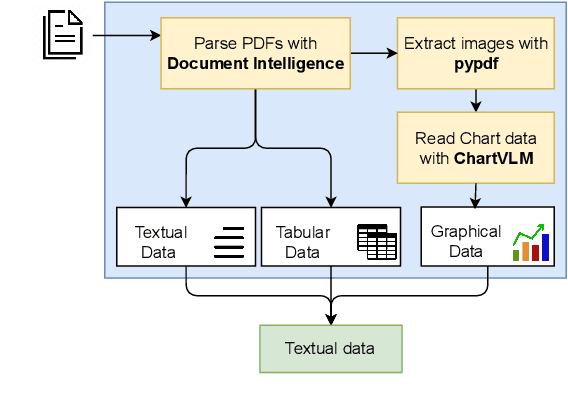
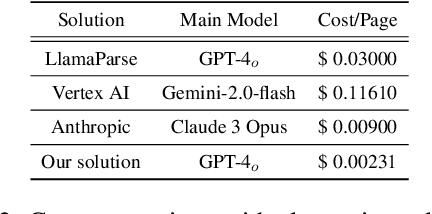
The proliferation of complex structured data in hybrid sources, such as PDF documents and web pages, presents unique challenges for current Large Language Models (LLMs) and Multi-modal Large Language Models (MLLMs) in providing accurate answers. Despite the recent advancements of MLLMs, they still often falter when interpreting intricately structured information, such as nested tables and multi-dimensional plots, leading to hallucinations and erroneous outputs. This paper explores the capabilities of LLMs and MLLMs in understanding and answering questions from complex data structures found in PDF documents by leveraging industrial and open-source tools as part of a pre-processing pipeline. Our findings indicate that GPT-4o, a popular MLLM, achieves an accuracy of 56% on multi-structured documents when fed documents directly, and that integrating pre-processing tools raises the accuracy of LLMs to 61.3% for GPT-4o and 76% for GPT-4, and with lower overall cost. The code is publicly available at https://github.com/OGCDS/FinancialQA.