 Add to Chrome
 Add to Firefox
 Add to Edge
Lyapunov-Based Sample Complexity Analysis for Weakly-Coupled MDPs
Jun 12, 2026
We study the sample complexity of learning in average-reward weakly-coupled Markov decision processes (WCMDPs) and Restless Bandits (RBs) under a generative model. Naive reduction to a tabular MDP leads to high complexity bounds as the state-action space is exponentially large in the number of arms $N$. By exploiting the weakly coupled structure, we show that near-optimal policies can be learned with sample and computational complexities that are polynomial in $N$. Specifically, we analyze the plug-in approach, which applies an efficient planning algorithm to an empirical model estimated from data. For fully heterogeneous WCMDPs, we establish the first finite-sample PAC guarantee with polynomial complexity and an $O(1/\sqrt{N})$ optimality gap. For homogeneous RBs, we further prove that a smaller optimality gap is achievable under mild structural assumptions. A primary technical contribution of our work is a novel Lyapunov-based analysis framework. Unlike classical approaches that rely on the difficult-to-control bias function, our framework uses an explicitly constructed Lyapunov function along with a drift transfer technique between the true and empirical models. A key step of independent interest in our framework is a fine-grained perturbation analysis for the underlying linear programming (LP) relaxation, which provides a general tool for analyzing LP-based policies and weakly-coupled systems.

On the Peril of (Even a Little) Nonstationarity in Satisficing Regret Minimization
Mar 19, 2026Motivated by the principle of satisficing in decision-making, we study satisficing regret guarantees for nonstationary $K$-armed bandits. We show that in the general realizable, piecewise-stationary setting with $L$ stationary segments, the optimal regret is $Θ(L\log T)$ as long as $L\geq 2$. This stands in sharp contrast to the case of $L=1$ (i.e., the stationary setting), where a $T$-independent $Θ(1)$ satisficing regret is achievable under realizability. In other words, the optimal regret has to scale with $T$ even if just a little nonstationarity presents. A key ingredient in our analysis is a novel Fano-based framework tailored to nonstationary bandits via a \emph{post-interaction reference} construction. This framework strictly extends the classical Fano method for passive estimation as well as recent interactive Fano techniques for stationary bandits. As a complement, we also discuss a special regime in which constant satisficing regret is again possible.
LLM-Augmented Computational Phenotyping of Long Covid
Mar 18, 2026Phenotypic characterization is essential for understanding heterogeneity in chronic diseases and for guiding personalized interventions. Long COVID, a complex and persistent condition, yet its clinical subphenotypes remain poorly understood. In this work, we propose an LLM-augmented computational phenotyping framework ``Grace Cycle'' that iteratively integrates hypothesis generation, evidence extraction, and feature refinement to discover clinically meaningful subgroups from longitudinal patient data. The framework identifies three distinct clinical phenotypes, Protected, Responder, and Refractory, based on 13,511 Long Covid participants. These phenotypes exhibit pronounced separation in peak symptom severity, baseline disease burden, and longitudinal dose-response patterns, with strong statistical support across multiple independent dimensions. This study illustrates how large language models can be integrated into a principled, statistically grounded pipeline for phenotypic screening from complex longitudinal data. Note that the proposed framework is disease-agnostic and offers a general approach for discovering clinically interpretable subphenotypes.
Predicting Trajectories of Long COVID in Adult Women: The Critical Role of Causal Disentanglement
Mar 18, 2026Early prediction of Post-Acute Sequelae of SARS-CoV-2 severity is a critical challenge for women's health, particularly given the diagnostic overlap between PASC and common hormonal transitions such as menopause. Identifying and accounting for these confounding factors is essential for accurate long-term trajectory prediction. We conducted a retrospective study of 1,155 women (mean age 61) from the NIH RECOVER dataset. By integrating static clinical profiles with four weeks of longitudinal wearable data (monitoring cardiac activity and sleep), we developed a causal network based on a Large Language Model to predict future PASC scores. Our framework achieved a precision of 86.7\% in clinical severity prediction. Our causal attribution analysis demonstrate the model's ability to differentiate between active pathology and baseline noise: direct indicators such as breathlessness and malaise reached maximum saliency (1.00), while confounding factors like menopause and diabetes were successfully suppressed with saliency scores below 0.27.
C-kNN-LSH: A Nearest-Neighbor Algorithm for Sequential Counterfactual Inference
Feb 02, 2026Estimating causal effects from longitudinal trajectories is central to understanding the progression of complex conditions and optimizing clinical decision-making, such as comorbidities and long COVID recovery. We introduce \emph{C-kNN--LSH}, a nearest-neighbor framework for sequential causal inference designed to handle such high-dimensional, confounded situations. By utilizing locality-sensitive hashing, we efficiently identify ``clinical twins'' with similar covariate histories, enabling local estimation of conditional treatment effects across evolving disease states. To mitigate bias from irregular sampling and shifting patient recovery profiles, we integrate neighborhood estimator with a doubly-robust correction. Theoretical analysis guarantees our estimator is consistent and second-order robust to nuisance error. Evaluated on a real-world Long COVID cohort with 13,511 participants, \emph{C-kNN-LSH} demonstrates superior performance in capturing recovery heterogeneity and estimating policy values compared to existing baselines.
Wasserstein-p Central Limit Theorem Rates: From Local Dependence to Markov Chains
Jan 13, 2026Finite-time central limit theorem (CLT) rates play a central role in modern machine learning (ML). In this paper, we study CLT rates for multivariate dependent data in Wasserstein-$p$ ($\mathcal W_p$) distance, for general $p\ge 1$. We focus on two fundamental dependence structures that commonly arise in ML: locally dependent sequences and geometrically ergodic Markov chains. In both settings, we establish the \textit{first optimal} $\mathcal O(n^{-1/2})$ rate in $\mathcal W_1$, as well as the first $\mathcal W_p$ ($p\ge 2$) CLT rates under mild moment assumptions, substantially improving the best previously known bounds in these dependent-data regimes. As an application of our optimal $\mathcal W_1$ rate for locally dependent sequences, we further obtain the first optimal $\mathcal W_1$--CLT rate for multivariate $U$-statistics. On the technical side, we derive a tractable auxiliary bound for $\mathcal W_1$ Gaussian approximation errors that is well suited to studying dependent data. For Markov chains, we further prove that the regeneration time of the split chain associated with a geometrically ergodic chain has a geometric tail without assuming strong aperiodicity or other restrictive conditions. These tools may be of independent interests and enable our optimal $\mathcal W_1$ rates and underpin our $\mathcal W_p$ ($p\ge 2$) results.
Contextual Online Pricing with (Biased) Offline Data
Jul 03, 2025We study contextual online pricing with biased offline data. For the scalar price elasticity case, we identify the instance-dependent quantity $\delta^2$ that measures how far the offline data lies from the (unknown) online optimum. We show that the time length $T$, bias bound $V$, size $N$ and dispersion $\lambda_{\min}(\hat{\Sigma})$ of the offline data, and $\delta^2$ jointly determine the statistical complexity. An Optimism-in-the-Face-of-Uncertainty (OFU) policy achieves a minimax-optimal, instance-dependent regret bound $\tilde{\mathcal{O}}\big(d\sqrt{T} \wedge (V^2T + \frac{dT}{\lambda_{\min}(\hat{\Sigma}) + (N \wedge T) \delta^2})\big)$. For general price elasticity, we establish a worst-case, minimax-optimal rate $\tilde{\mathcal{O}}\big(d\sqrt{T} \wedge (V^2T + \frac{dT }{\lambda_{\min}(\hat{\Sigma})})\big)$ and provide a generalized OFU algorithm that attains it. When the bias bound $V$ is unknown, we design a robust variant that always guarantees sub-linear regret and strictly improves on purely online methods whenever the exact bias is small. These results deliver the first tight regret guarantees for contextual pricing in the presence of biased offline data. Our techniques also transfer verbatim to stochastic linear bandits with biased offline data, yielding analogous bounds.
A Piecewise Lyapunov Analysis of Sub-quadratic SGD: Applications to Robust and Quantile Regression
Apr 15, 2025Motivated by robust and quantile regression problems, we investigate the stochastic gradient descent (SGD) algorithm for minimizing an objective function $f$ that is locally strongly convex with a sub--quadratic tail. This setting covers many widely used online statistical methods. We introduce a novel piecewise Lyapunov function that enables us to handle functions $f$ with only first-order differentiability, which includes a wide range of popular loss functions such as Huber loss. Leveraging our proposed Lyapunov function, we derive finite-time moment bounds under general diminishing stepsizes, as well as constant stepsizes. We further establish the weak convergence, central limit theorem and bias characterization under constant stepsize, providing the first geometrical convergence result for sub--quadratic SGD. Our results have wide applications, especially in online statistical methods. In particular, we discuss two applications of our results. 1) Online robust regression: We consider a corrupted linear model with sub--exponential covariates and heavy--tailed noise. Our analysis provides convergence rates comparable to those for corrupted models with Gaussian covariates and noise. 2) Online quantile regression: Importantly, our results relax the common assumption in prior work that the conditional density is continuous and provide a more fine-grained analysis for the moment bounds.
Optimally Installing Strict Equilibria
Mar 05, 2025In this work, we develop a reward design framework for installing a desired behavior as a strict equilibrium across standard solution concepts: dominant strategy equilibrium, Nash equilibrium, correlated equilibrium, and coarse correlated equilibrium. We also extend our framework to capture the Markov-perfect equivalents of each solution concept. Central to our framework is a comprehensive mathematical characterization of strictly installable, based on the desired solution concept and the behavior's structure. These characterizations lead to efficient iterative algorithms, which we generalize to handle optimization objectives through linear programming. Finally, we explore how our results generalize to bounded rational agents.
Coupling-based Convergence Diagnostic and Stepsize Scheme for Stochastic Gradient Descent
Dec 15, 2024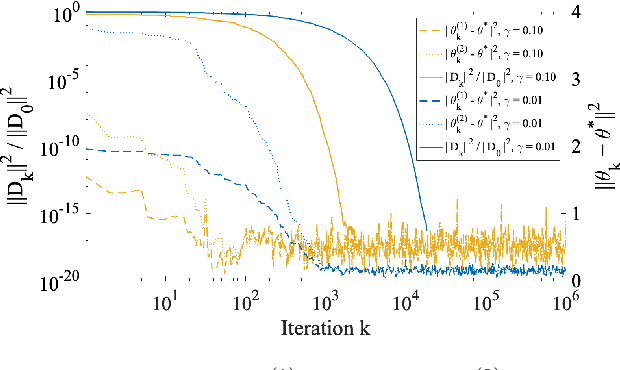
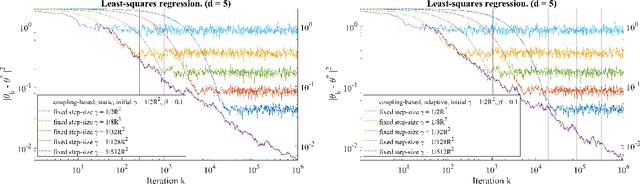
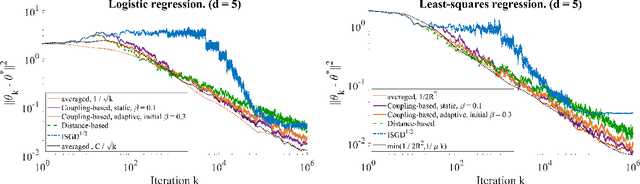
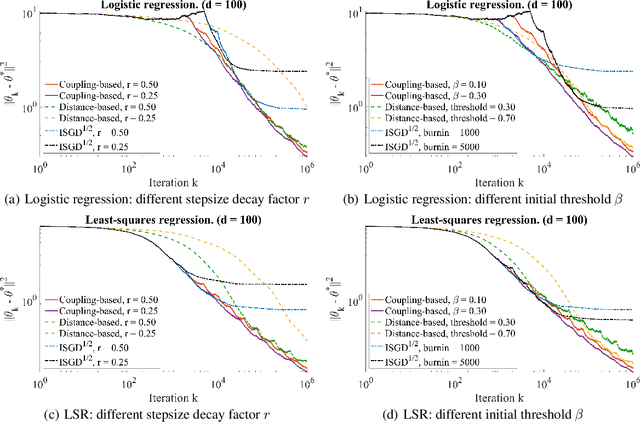
The convergence behavior of Stochastic Gradient Descent (SGD) crucially depends on the stepsize configuration. When using a constant stepsize, the SGD iterates form a Markov chain, enjoying fast convergence during the initial transient phase. However, when reaching stationarity, the iterates oscillate around the optimum without making further progress. In this paper, we study the convergence diagnostics for SGD with constant stepsize, aiming to develop an effective dynamic stepsize scheme. We propose a novel coupling-based convergence diagnostic procedure, which monitors the distance of two coupled SGD iterates for stationarity detection. Our diagnostic statistic is simple and is shown to track the transition from transience stationarity theoretically. We conduct extensive numerical experiments and compare our method against various existing approaches. Our proposed coupling-based stepsize scheme is observed to achieve superior performance across a diverse set of convex and non-convex problems. Moreover, our results demonstrate the robustness of our approach to a wide range of hyperparameters.