 Add to Chrome
 Add to Firefox
 Add to Edge
Generation as Auxiliary Supervision: Enhancing Visual Understanding at Zero Inference Overhead via Decoupled Embedding Prediction
Aug 12, 2026
While Multimodal Large Language Models (MLLMs) have achieved remarkable progress, visual understanding and generation are typically treated as divergent objectives. Existing unified frameworks often rely on discrete visual tokenization or diffusion objectives whose generative targets differ from the continuous representations consumed by visual understanding models, making direct transfer to enhance existing pretrained MLLMs non-trivial. In this work, we present GAS, a generation-guided training framework that reinterprets visual generation as auxiliary supervision for representation learning. Concretely, GAS adapts Next Embedding Prediction (NEP) as a cross-modal generation paradigm within a decoupled Mixture-of-Transformers (MoT) architecture. By maintaining a shared lower trunk and parallel upper layers, GAS lets generation losses enrich the shared visual pathway with finer spatial precision and stronger visual retention while shielding the upper understanding layers from direct generation gradients. To maximize this synergy, we further construct highly correlated generation tasks that demand deep cognitive grounding rather than generic synthesis alone. Across model scales and training stages, GAS improves aggregate multimodal understanding, with its most reliable gains on perception and spatial comprehension. Crucially, because the auxiliary generation branch is discarded after training, these gains incur zero inference overhead. Extensive controlled comparisons and representation-level analyses further clarify when and why generation-guided training benefits understanding, and demonstrate the feasibility of generation-guided training as a practical route to stronger multimodal understanding.

PRISM: Priority-aware Rubric Internalization via Structured Multimodal Data Synthesis
Aug 07, 2026Real-world multimodal instructions often bundle multiple requirements with unequal importance, yet most multimodal training data still reduce instruction following to answering one self-contained question. We study this gap through rubric comprehension, which casts the model not as a generator measured against rubrics but as an executor that follows them: given an image and a typed, prioritized rubric, the model must verify each rule before producing an overall judgment. To support this setting, we propose PRISM, a four-stage data synthesis framework that produces persona--task pairs, prefix-guided rule sets, quality-filtered rubrics, and structured verification traces. We further introduce PRISM-Eval, whose Loose and Strict metrics use deterministic matching against fixed labels and therefore require no inference-time judge model. With only 10K synthesized samples, PRISM lifts Qwen3-VL-4B from 9.5% to 30.1% Strict accuracy on PRISM-Eval while preserving average performance on general benchmarks, and the gains transfer to four additional open-source MLLMs across dense and MoE architectures, suggesting that structured rubric supervision is a scalable path toward multi-rule, priority-aware multimodal instruction following.
DecoupleMix: Decoupled Ratio Search and Convex Allocation for Scalable VLM Data Recipes
Jul 27, 2026While data curation for Vision Language Models (VLMs) is increasingly active, public practice for constructing pretraining mixtures remains largely heuristic: practitioners stack datasets that pass quality filters, set cross-domain ratios by intuition, and lack a principled, attributable criterion for admitting new data, while frontier recipes remain undisclosed. We formulate data construction as a systematic mixture-optimization problem and turn it into a reproducible engineering discipline by decoupling the mixture into two orthogonal sub-problems: inter-class ratios across capabilities and intra-class ratios within a category. For inter-class allocation, we use a single-variable iterative search; for intra-class composition, we apply a multidimensional, dataset-level assessment scoring Quality and Difficulty, and formulate selection as a constrained convex optimization with a diversity objective. The DecoupleMix framework delivers two critical capabilities: guiding what data to collect next and rendering dataset validation a controlled, attributable experiment. Experiments show our approach consistently surpasses heuristic baselines. Moreover, optimal ratios discovered on small-scale proxies transfer seamlessly to larger scales without retuning. Using 80B additional multimodal continue-pretraining tokens, our VLM is competitive with strong open-source models trained with substantially larger multimodal budgets.
Cherry on Top: Parameter Heterogeneity and Quantization in Large Language Models
Apr 03, 2024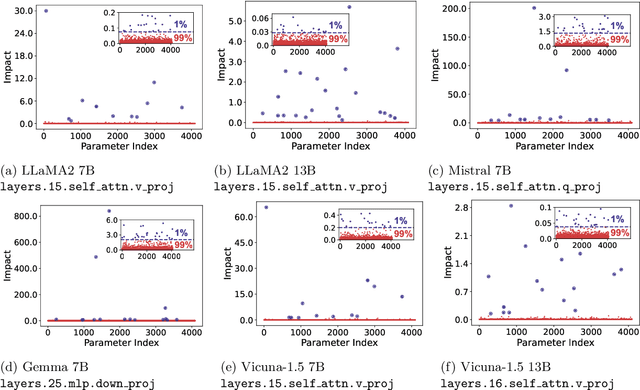
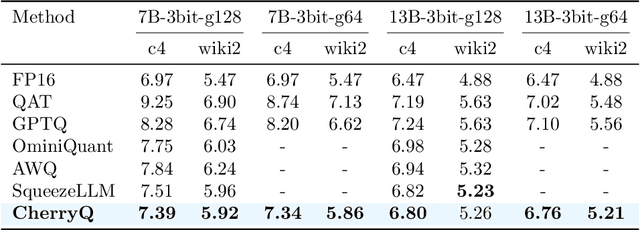

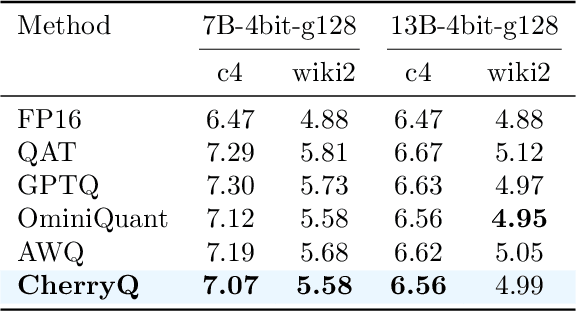
This paper reveals the phenomenon of parameter heterogeneity in large language models (LLMs). We find that a small subset of ``cherry'' parameters exhibit a disproportionately large influence on model performance, while the vast majority of parameters have minimal impact. This heterogeneity is found to be prevalent across different model families, scales, and types. Motivated by this observation, we propose CherryQ, a novel quantization method that unifies the optimization of mixed-precision parameters. CherryQ identifies and preserves the critical cherry parameters in high precision while aggressively quantizing the remaining parameters to low precision. Extensive experiments demonstrate the effectiveness of CherryQ. CherryQ outperforms existing quantization approaches in terms of perplexity and downstream task performance. Notably, our 3-bit quantized Vicuna-1.5 exhibits competitive performance compared to their 16-bit counterparts. These findings highlight the potential of CherryQ for enabling efficient deployment of LLMs by taking advantage of parameter heterogeneity.
Who Said That? Benchmarking Social Media AI Detection
Oct 12, 2023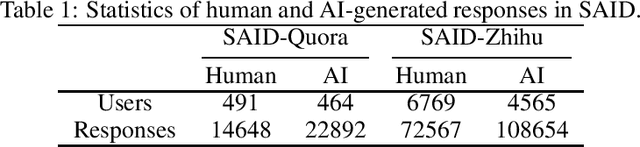
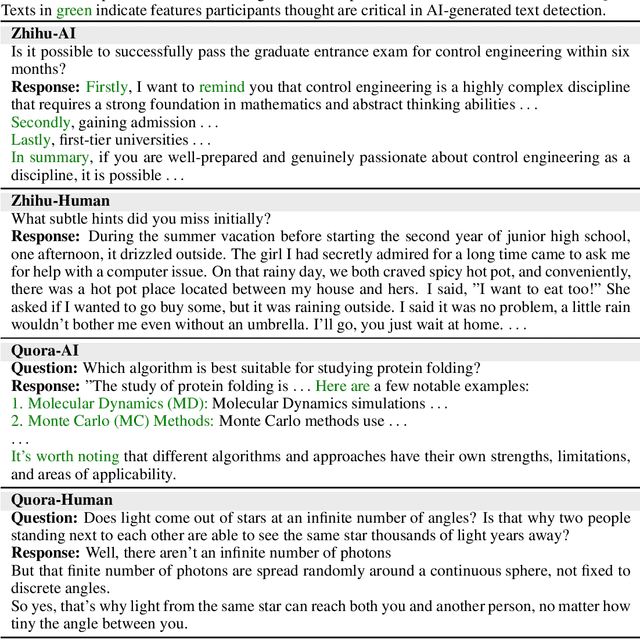

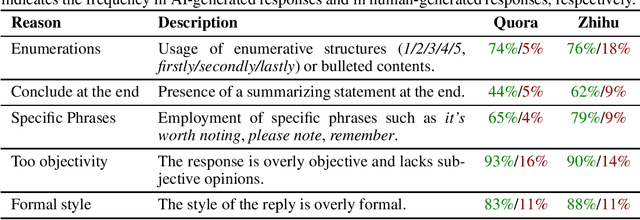
AI-generated text has proliferated across various online platforms, offering both transformative prospects and posing significant risks related to misinformation and manipulation. Addressing these challenges, this paper introduces SAID (Social media AI Detection), a novel benchmark developed to assess AI-text detection models' capabilities in real social media platforms. It incorporates real AI-generate text from popular social media platforms like Zhihu and Quora. Unlike existing benchmarks, SAID deals with content that reflects the sophisticated strategies employed by real AI users on the Internet which may evade detection or gain visibility, providing a more realistic and challenging evaluation landscape. A notable finding of our study, based on the Zhihu dataset, reveals that annotators can distinguish between AI-generated and human-generated texts with an average accuracy rate of 96.5%. This finding necessitates a re-evaluation of human capability in recognizing AI-generated text in today's widely AI-influenced environment. Furthermore, we present a new user-oriented AI-text detection challenge focusing on the practicality and effectiveness of identifying AI-generated text based on user information and multiple responses. The experimental results demonstrate that conducting detection tasks on actual social media platforms proves to be more challenging compared to traditional simulated AI-text detection, resulting in a decreased accuracy. On the other hand, user-oriented AI-generated text detection significantly improve the accuracy of detection.
Ada-Instruct: Adapting Instruction Generators for Complex Reasoning
Oct 10, 2023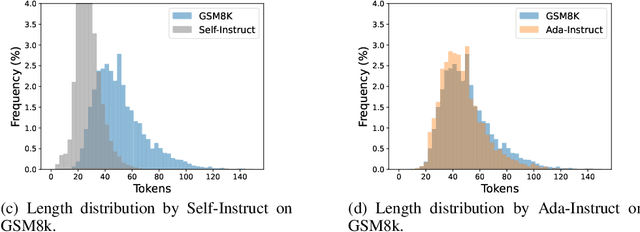
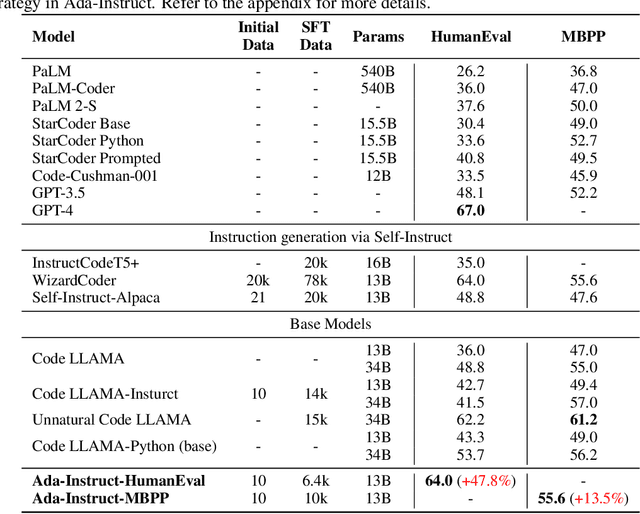

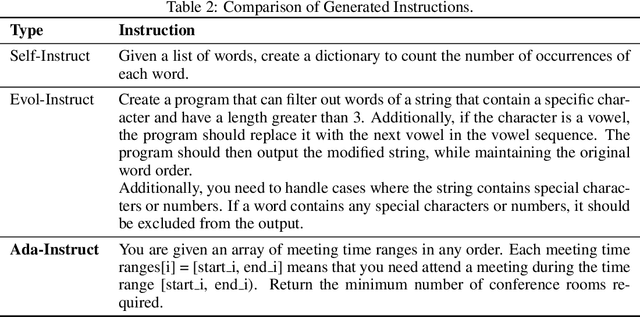
Generating diverse and sophisticated instructions for downstream tasks by Large Language Models (LLMs) is pivotal for advancing the effect. Current approaches leverage closed-source LLMs, employing in-context prompting for instruction generation. However, in this paper, we found that in-context prompting cannot generate complex instructions with length $\ge 100$ for tasks like code completion. To solve this problem, we introduce Ada-Instruct, an adaptive instruction generator developed by fine-tuning open-source LLMs. Our pivotal finding illustrates that fine-tuning open-source LLMs with a mere ten samples generates long instructions that maintain distributional consistency for complex reasoning tasks. We empirically validated Ada-Instruct's efficacy across different applications, including code completion, mathematical reasoning, and commonsense reasoning. The results underscore Ada-Instruct's superiority, evidencing its improvements over its base models, current self-instruct methods, and other state-of-the-art models.