 Add to Chrome
 Add to Firefox
 Add to Edge
LithoDreamer: A Physics-Informed World Model for Multi-Stage Computational Lithography
Jun 25, 2026
As semiconductor technology nodes scale, computational lithography is essential for ensuring yield and performance. However, lithography is a continuous physical process involving mask optimization, optical imaging, resist exposure, and development, which existing models fail to capture. To overcome this limitation, we present LithoDreamer, the first physics-informed World Model (WM) framework for computational lithography, which formulates the ``Layout-Mask-Resist Image-After Development Image (ADI)'' pipeline as a decision-driven multi-step evolution system. LithoDreamer captures feature changes between adjacent states to model stage-specific physics-informed latent spaces, in which it controls process intervention exploration and drives subsequent state transitions. To achieve interpretable intervention optimization without continuous supervision, we propose a contrastive variational optimization paradigm that contrasts the latent differences between intervention paths with variational evolution constraints, guiding the model to generate evolutions consistent with real lithography physics. Experiments show LithoDreamer achieves state-of-the-art performance in forward evolution and inverse planning. Our lithography dataset is publicly available at GitHub (https://github.com/7jiangyq/lithodreamer.git).
* Correspondence to: Qi Sun <qisunchn \at zju \dot edu \dot cn>

Unitho: A Unified Multi-Task Framework for Computational Lithography
Nov 14, 2025Reliable, generalizable data foundations are critical for enabling large-scale models in computational lithography. However, essential tasks-mask generation, rule violation detection, and layout optimization-are often handled in isolation, hindered by scarce datasets and limited modeling approaches. To address these challenges, we introduce Unitho, a unified multi-task large vision model built upon the Transformer architecture. Trained on a large-scale industrial lithography simulation dataset with hundreds of thousands of cases, Unitho supports end-to-end mask generation, lithography simulation, and rule violation detection. By enabling agile and high-fidelity lithography simulation, Unitho further facilitates the construction of robust data foundations for intelligent EDA. Experimental results validate its effectiveness and generalizability, with performance substantially surpassing academic baselines.
FabGPT: An Efficient Large Multimodal Model for Complex Wafer Defect Knowledge Queries
Jul 15, 2024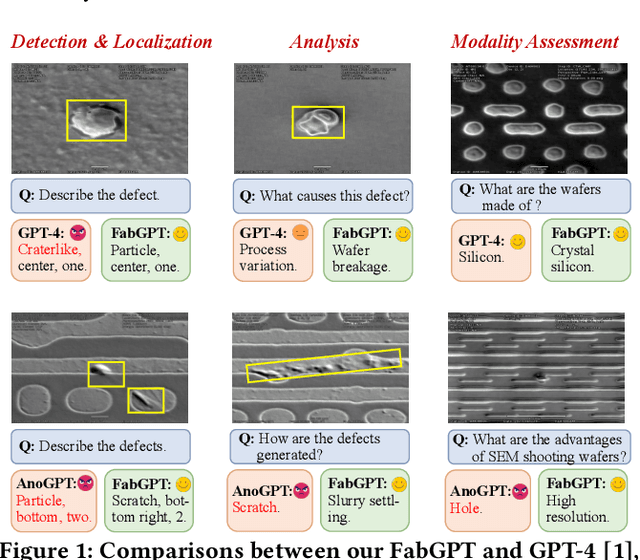

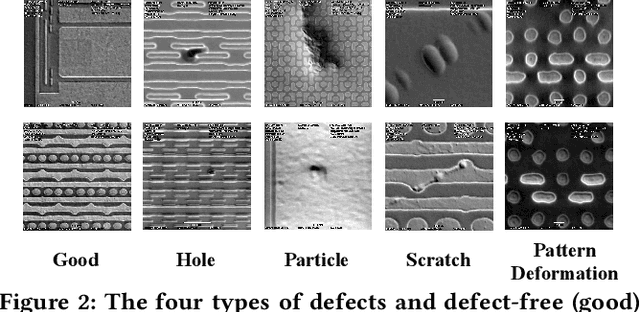

Intelligence is key to advancing integrated circuit (IC) fabrication. Recent breakthroughs in Large Multimodal Models (LMMs) have unlocked unparalleled abilities in understanding images and text, fostering intelligent fabrication. Leveraging the power of LMMs, we introduce FabGPT, a customized IC fabrication large multimodal model for wafer defect knowledge query. FabGPT manifests expertise in conducting defect detection in Scanning Electron Microscope (SEM) images, performing root cause analysis, and providing expert question-answering (Q&A) on fabrication processes. FabGPT matches enhanced multimodal features to automatically detect minute defects under complex wafer backgrounds and reduce the subjectivity of manual threshold settings. Besides, the proposed modulation module and interactive corpus training strategy embed wafer defect knowledge into the pre-trained model, effectively balancing Q&A queries related to defect knowledge and original knowledge and mitigating the modality bias issues. Experiments on in-house fab data (SEM-WaD) show that our FabGPT achieves significant performance improvement in wafer defect detection and knowledge querying.