 Add to Chrome
 Add to Firefox
 Add to Edge
HEXAR: a Hierarchical Explainability Architecture for Robots
Jan 06, 2026
As robotic systems become increasingly complex, the need for explainable decision-making becomes critical. Existing explainability approaches in robotics typically either focus on individual modules, which can be difficult to query from the perspective of high-level behaviour, or employ monolithic approaches, which do not exploit the modularity of robotic architectures. We present HEXAR (Hierarchical EXplainability Architecture for Robots), a novel framework that provides a plug-in, hierarchical approach to generate explanations about robotic systems. HEXAR consists of specialised component explainers using diverse explanation techniques (e.g., LLM-based reasoning, causal models, feature importance, etc) tailored to specific robot modules, orchestrated by an explainer selector that chooses the most appropriate one for a given query. We implement and evaluate HEXAR on a TIAGo robot performing assistive tasks in a home environment, comparing it against end-to-end and aggregated baseline approaches across 180 scenario-query variations. We observe that HEXAR significantly outperforms baselines in root cause identification, incorrect information exclusion, and runtime, offering a promising direction for transparent autonomous systems.

Multimodal Coherent Explanation Generation of Robot Failures
Oct 01, 2024The explainability of a robot's actions is crucial to its acceptance in social spaces. Explaining why a robot fails to complete a given task is particularly important for non-expert users to be aware of the robot's capabilities and limitations. So far, research on explaining robot failures has only considered generating textual explanations, even though several studies have shown the benefits of multimodal ones. However, a simple combination of multiple modalities may lead to semantic incoherence between the information across different modalities - a problem that is not well-studied. An incoherent multimodal explanation can be difficult to understand, and it may even become inconsistent with what the robot and the human observe and how they perform reasoning with the observations. Such inconsistencies may lead to wrong conclusions about the robot's capabilities. In this paper, we introduce an approach to generate coherent multimodal explanations by checking the logical coherence of explanations from different modalities, followed by refinements as required. We propose a classification approach for coherence assessment, where we evaluate if an explanation logically follows another. Our experiments suggest that fine-tuning a neural network that was pre-trained to recognize textual entailment, performs well for coherence assessment of multimodal explanations. Code & data: https://pradippramanick.github.io/coherent-explain/.
How Much is too Much: Exploring the Effect of Verbal Route Description Length on Indoor Navigation
Aug 27, 2024Navigating through a new indoor environment can be stressful. Recently, many places have deployed robots to assist visitors. One of the features of such robots is escorting the visitors to their desired destination within the environment, but this is neither scalable nor necessary for every visitor. Instead, a robot assistant could be deployed at a strategic location to provide wayfinding instructions. This not only increases the user experience but can be helpful in many time-critical scenarios e.g., escorting someone to their boarding gate at an airport. However, delivering route descriptions verbally poses a challenge. If the description is too verbose, people may struggle to recall all the information, while overly brief descriptions may be simply unhelpful. This article focuses on studying the optimal length of verbal route descriptions that are effective for reaching the destination and easy for people to recall. This work proposes a theoretical framework that links route segments to chunks in working memory. Based on this framework, an experiment is designed and conducted to examine the effects of route descriptions of different lengths on navigational performance. The results revealed intriguing patterns suggesting an ideal length of four route segments. This study lays a foundation for future research exploring the relationship between route description lengths, working memory capacity, and navigational performance in indoor environments.
Teledrive: An Embodied AI based Telepresence System
Jun 01, 2024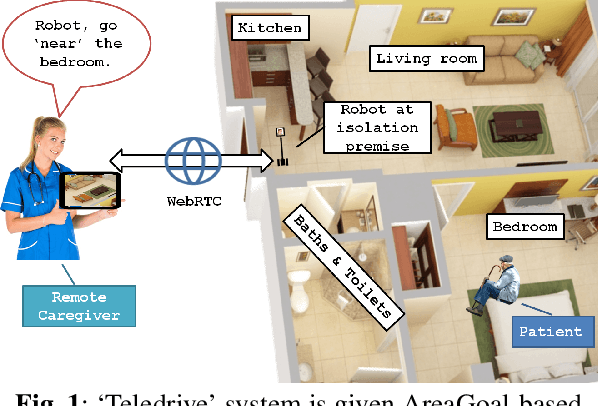
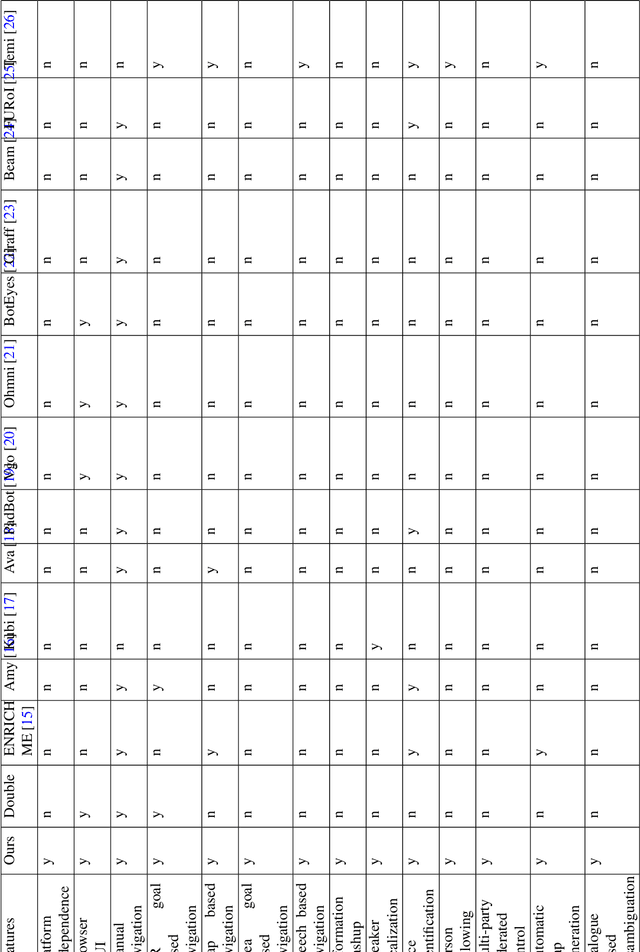
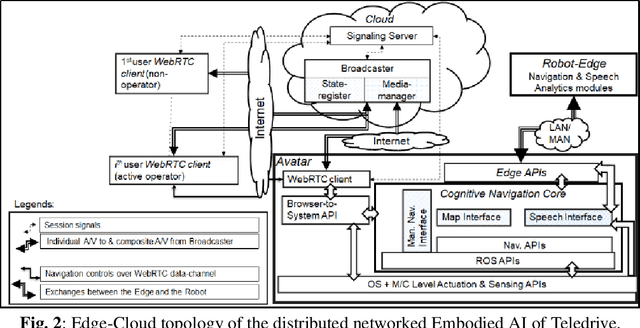

This article presents Teledrive, a telepresence robotic system with embodied AI features that empowers an operator to navigate the telerobot in any unknown remote place with minimal human intervention. We conceive Teledrive in the context of democratizing remote care-giving for elderly citizens as well as for isolated patients, affected by contagious diseases. In particular, this paper focuses on the problem of navigating to a rough target area (like bedroom or kitchen) rather than pre-specified point destinations. This ushers in a unique AreaGoal based navigation feature, which has not been explored in depth in the contemporary solutions. Further, we describe an edge computing-based software system built on a WebRTC-based communication framework to realize the aforementioned scheme through an easy-to-use speech-based human-robot interaction. Moreover, to enhance the ease of operation for the remote caregiver, we incorporate a person following feature, whereby a robot follows a person on the move in its premises as directed by the operator. Moreover, the system presented is loosely coupled with specific robot hardware, unlike the existing solutions. We have evaluated the efficacy of the proposed system through baseline experiments, user study, and real-life deployment.
* Accepted in Journal of Intelligent Robotic System
tagE: Enabling an Embodied Agent to Understand Human Instructions
Oct 24, 2023Natural language serves as the primary mode of communication when an intelligent agent with a physical presence engages with human beings. While a plethora of research focuses on natural language understanding (NLU), encompassing endeavors such as sentiment analysis, intent prediction, question answering, and summarization, the scope of NLU directed at situations necessitating tangible actions by an embodied agent remains limited. The inherent ambiguity and incompleteness inherent in natural language present challenges for intelligent agents striving to decipher human intention. To tackle this predicament head-on, we introduce a novel system known as task and argument grounding for Embodied agents (tagE). At its core, our system employs an inventive neural network model designed to extract a series of tasks from complex task instructions expressed in natural language. Our proposed model adopts an encoder-decoder framework enriched with nested decoding to effectively extract tasks and their corresponding arguments from these intricate instructions. These extracted tasks are then mapped (or grounded) to the robot's established collection of skills, while the arguments find grounding in objects present within the environment. To facilitate the training and evaluation of our system, we have curated a dataset featuring complex instructions. The results of our experiments underscore the prowess of our approach, as it outperforms robust baseline models.
DoRO: Disambiguation of referred object for embodied agents
Jul 28, 2022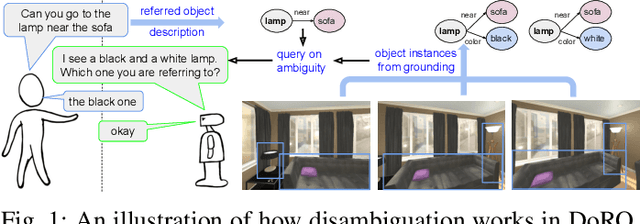
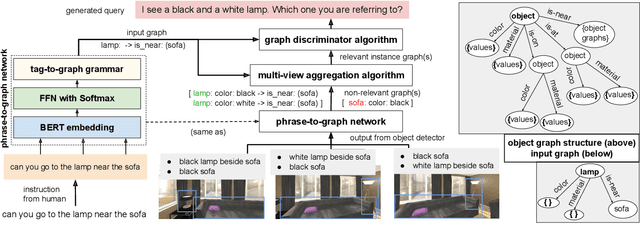
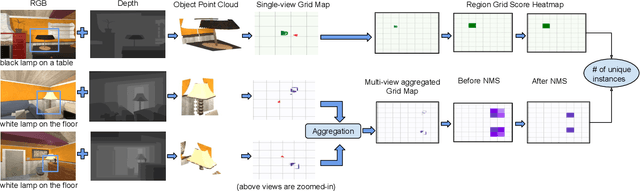
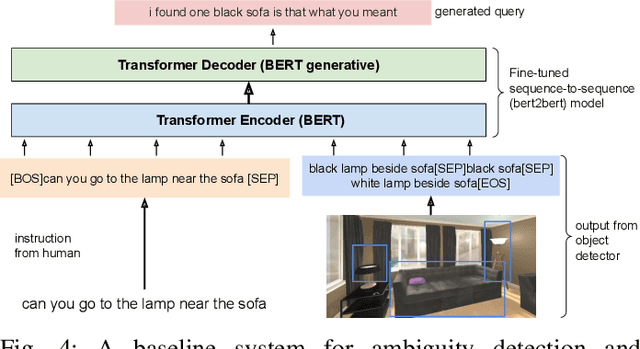
Robotic task instructions often involve a referred object that the robot must locate (ground) within the environment. While task intent understanding is an essential part of natural language understanding, less effort is made to resolve ambiguity that may arise while grounding the task. Existing works use vision-based task grounding and ambiguity detection, suitable for a fixed view and a static robot. However, the problem magnifies for a mobile robot, where the ideal view is not known beforehand. Moreover, a single view may not be sufficient to locate all the object instances in the given area, which leads to inaccurate ambiguity detection. Human intervention is helpful only if the robot can convey the kind of ambiguity it is facing. In this article, we present DoRO (Disambiguation of Referred Object), a system that can help an embodied agent to disambiguate the referred object by raising a suitable query whenever required. Given an area where the intended object is, DoRO finds all the instances of the object by aggregating observations from multiple views while exploring & scanning the area. It then raises a suitable query using the information from the grounded object instances. Experiments conducted with the AI2Thor simulator show that DoRO not only detects the ambiguity more accurately but also raises verbose queries with more accurate information from the visual-language grounding.
Talk-to-Resolve: Combining scene understanding and spatial dialogue to resolve granular task ambiguity for a collocated robot
Nov 22, 2021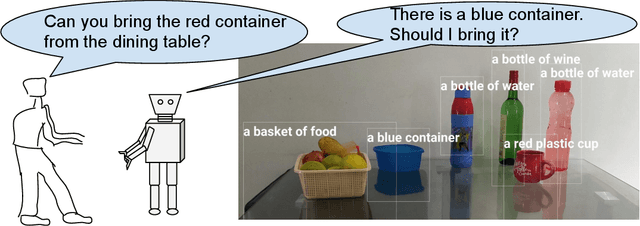
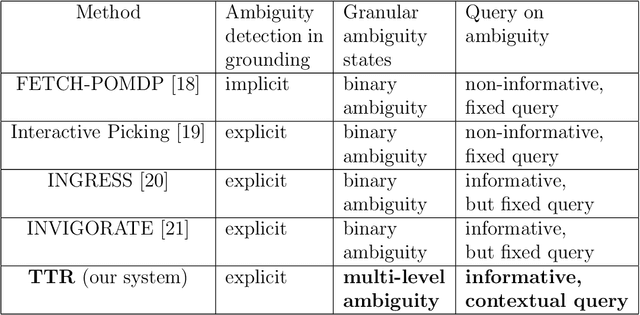
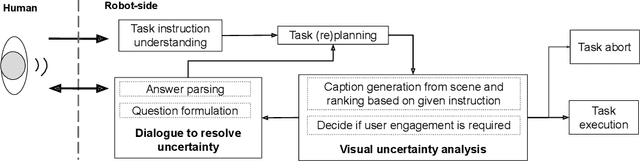
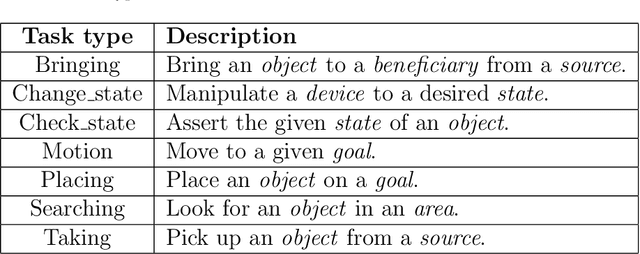
The utility of collocating robots largely depends on the easy and intuitive interaction mechanism with the human. If a robot accepts task instruction in natural language, first, it has to understand the user's intention by decoding the instruction. However, while executing the task, the robot may face unforeseeable circumstances due to the variations in the observed scene and therefore requires further user intervention. In this article, we present a system called Talk-to-Resolve (TTR) that enables a robot to initiate a coherent dialogue exchange with the instructor by observing the scene visually to resolve the impasse. Through dialogue, it either finds a cue to move forward in the original plan, an acceptable alternative to the original plan, or affirmation to abort the task altogether. To realize the possible stalemate, we utilize the dense captions of the observed scene and the given instruction jointly to compute the robot's next action. We evaluate our system based on a data set of initial instruction and situational scene pairs. Our system can identify the stalemate and resolve them with appropriate dialogue exchange with 82% accuracy. Additionally, a user study reveals that the questions from our systems are more natural (4.02 on average on a scale of 1 to 5) as compared to a state-of-the-art (3.08 on average).
Detecting socially interacting groups using f-formation: A survey of taxonomy, methods, datasets, applications, challenges, and future research directions
Aug 13, 2021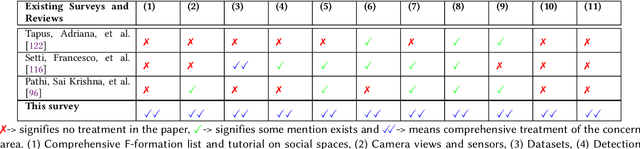
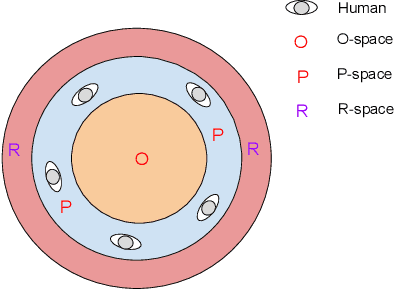
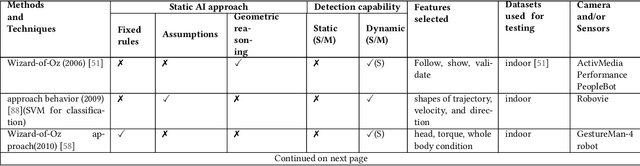
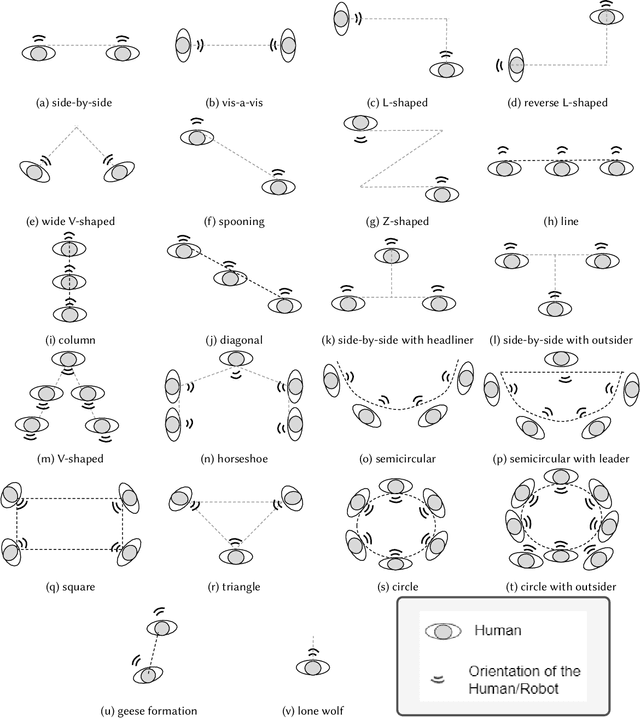
Robots in our daily surroundings are increasing day by day. Their usability and acceptability largely depend on their explicit and implicit interaction capability with fellow human beings. As a result, social behavior is one of the most sought-after qualities that a robot can possess. However, there is no specific aspect and/or feature that defines socially acceptable behavior and it largely depends on the situation, application, and society. In this article, we investigate one such social behavior for collocated robots. Imagine a group of people is interacting with each other and we want to join the group. We as human beings do it in a socially acceptable manner, i.e., within the group, we do position ourselves in such a way that we can participate in the group activity without disturbing/obstructing anybody. To possess such a quality, first, a robot needs to determine the formation of the group and then determine a position for itself, which we humans do implicitly. The theory of f-formation can be utilized for this purpose. As the types of formations can be very diverse, detecting the social groups is not a trivial task. In this article, we provide a comprehensive survey of the existing work on social interaction and group detection using f-formation for robotics and other applications. We also put forward a novel holistic survey framework combining all the possible concerns and modules relevant to this problem. We define taxonomies based on methods, camera views, datasets, detection capabilities and scale, evaluation approaches, and application areas. We discuss certain open challenges and limitations in current literature along with possible future research directions based on this framework. In particular, we discuss the existing methods/techniques and their relative merits and demerits, applications, and provide a set of unsolved but relevant problems in this domain.
Enabling human-like task identification from natural conversation
Aug 29, 2020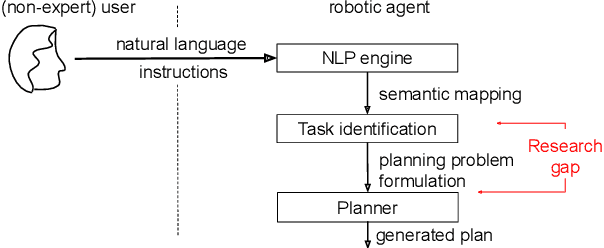
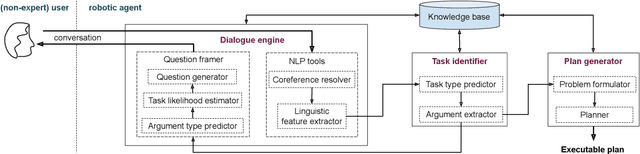
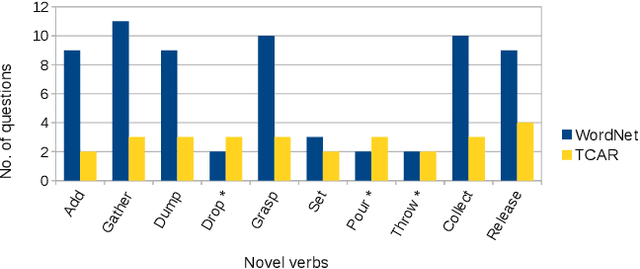
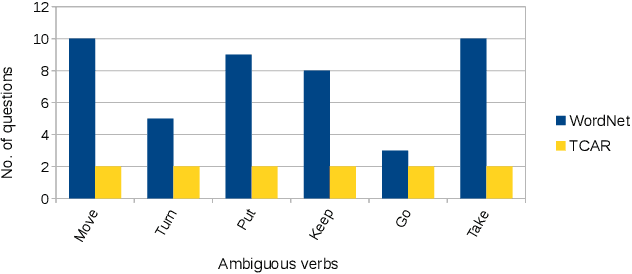
A robot as a coworker or a cohabitant is becoming mainstream day-by-day with the development of low-cost sophisticated hardware. However, an accompanying software stack that can aid the usability of the robotic hardware remains the bottleneck of the process, especially if the robot is not dedicated to a single job. Programming a multi-purpose robot requires an on the fly mission scheduling capability that involves task identification and plan generation. The problem dimension increases if the robot accepts tasks from a human in natural language. Though recent advances in NLP and planner development can solve a variety of complex problems, their amalgamation for a dynamic robotic task handler is used in a limited scope. Specifically, the problem of formulating a planning problem from natural language instructions is not studied in details. In this work, we provide a non-trivial method to combine an NLP engine and a planner such that a robot can successfully identify tasks and all the relevant parameters and generate an accurate plan for the task. Additionally, some mechanism is required to resolve the ambiguity or missing pieces of information in natural language instruction. Thus, we also develop a dialogue strategy that aims to gather additional information with minimal question-answer iterations and only when it is necessary. This work makes a significant stride towards enabling a human-like task understanding capability in a robot.
DeComplex: Task planning from complex natural instructions by a collocating robot
Aug 23, 2020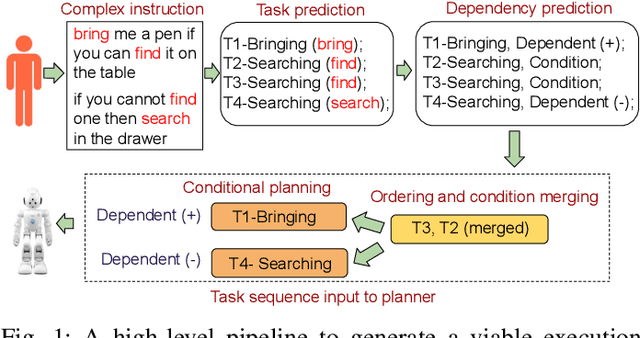
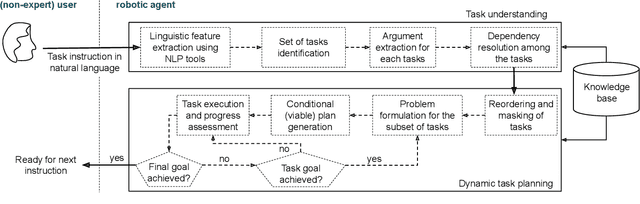
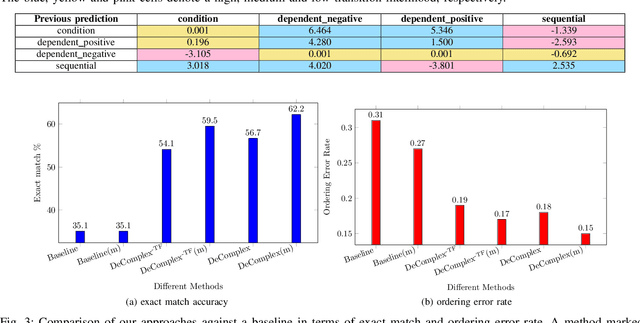
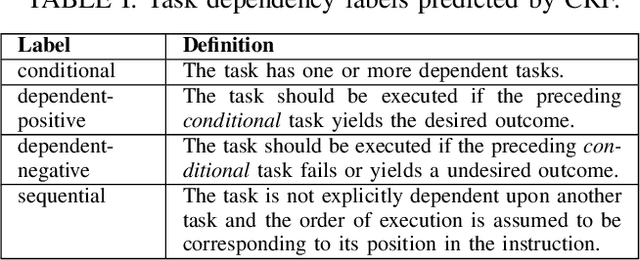
As the number of robots in our daily surroundings like home, office, restaurants, factory floors, etc. are increasing rapidly, the development of natural human-robot interaction mechanism becomes more vital as it dictates the usability and acceptability of the robots. One of the valued features of such a cohabitant robot is that it performs tasks that are instructed in natural language. However, it is not trivial to execute the human intended tasks as natural language expressions can have large linguistic variations. Existing works assume either single task instruction is given to the robot at a time or there are multiple independent tasks in an instruction. However, complex task instructions composed of multiple inter-dependent tasks are not handled efficiently in the literature. There can be ordering dependency among the tasks, i.e., the tasks have to be executed in a certain order or there can be execution dependency, i.e., input parameter or execution of a task depends on the outcome of another task. Understanding such dependencies in a complex instruction is not trivial if an unconstrained natural language is allowed. In this work, we propose a method to find the intended order of execution of multiple inter-dependent tasks given in natural language instruction. Based on our experiment, we show that our system is very accurate in generating a viable execution plan from a complex instruction.