 Add to Chrome
 Add to Firefox
 Add to Edge
FirstPass: Grounding AI Scientific Judgment in Multi-Round Editorial Outcomes
Jun 18, 2026
AI systems for peer review fail on three fronts: they train on Computer Science and Machine Learning venues alone, ignore the iterative dialogue that validates science, and evaluate on stylistic mimicry rather than real editorial judgment. We introduce FirstPass, a dataset and fine-tuned model that addresses all three. Curating 3,668 complete multi-round peer-review dialogues from Nature Communications across five scientific domains (biology, chemistry, neuroscience, physics, and earth science), we exploit mandatory transparent peer review (instituted November 2022) and verify 100% content integrity by automated audit. We fine-tune Qwen2.5-7B-Instruct via Low-Rank Adaptation (LoRA) on three tasks: review generation, reviewer updating, and revision-cycle prediction. Our key finding is that response-only loss masking is a prerequisite, not an optimization: without it, accuracy is 62.0%, below the majority baseline; with it, FirstPass achieves 80.5% accuracy and F1-macro 78.2% on predicting editorial outcomes (Standard vs. Extended revision cycles), outperforming Gemini-3.1-flash-lite-preview zero-shot by 10.4 percentage points and all baselines with statistical significance (McNemar p < 0.001). On generation, FirstPass produces reviews averaging 1,187 words, substantially closer to human references (2,155 words) than any baseline, achieving ROUGE-L 0.154 with significant gains over Qwen and DeepSeek zero-shot (p < 0.001). Deployed in the pre-submission loop as an anticipatory scientific co-author, FirstPass simulates expert critique and predicts revision cycle outcomes before submission, giving authors the judgment a trusted colleague would provide, with consistent cross-domain performance across five disciplines.

Beyond 'One Language, One Script': Quantifying Orthographic Bias in Multilingual VLMs with PuMVR
Jun 18, 2026Current Vision-Language Models (VLMs) are celebrated for their multilingual capabilities, yet they operate under a flawed assumption: that one language corresponds to a single writing system. This overlooks billions of users of multi-script languages like Punjabi, Serbian, Hindi-Urdu, Kurdish, among many others, for whom a model's capability may be fractured by orthographic bias. We introduce PuMVR (Punjabi Multimodal Visual Reasoning), the first benchmark designed to quantify script-dependent bias through 375 culturally grounded image-reasoning tasks across Punjabi's three active scripts (Gurmukhi, Shahmukhi, Roman). Evaluating 10 state-of-the-art VLMs, we expose a substantial Script Gap: models frequently solve visual puzzles in one script while failing identical tasks in another, with accuracy deltas reaching 16% and Script Consistency Rates (SCR) as low as 24.8%. Crucially, visual input boosts absolute performance but does not close this gap, the relative bias persists. Our analysis suggests reasoning patterns show limited cross-script transferability, and Chain-of-Thought pathways diverge based on script alone. We propose SCR as a core metric for script-agnostic evaluation, challenging current multilingual assessment paradigms and providing a framework for equitable AI.
Not Truly Multilingual: Script Consistency as a Missing Dimension in VLM Evaluation
Jun 17, 2026Current multilingual evaluations for Vision-Language Models (VLMs) assume a one-to-one mapping between language and orthography, overlooking billions of users of multi-script languages. We introduce PuMVR (Punjabi Multimodal Visual Reasoning), a benchmark of 1,000 strictly parallel image-text instances across Punjabi's three active scripts: Gurmukhi, Shahmukhi, and Roman. Evaluating 10 state-of-the-art VLMs, we expose a substantial and systematic Script Gap. Models frequently solve visual tasks in one script while failing identical tasks in another, with accuracy deltas reaching 16%. Crucially, visual input boosts absolute performance uniformly yet does not close the orthographic gap. Furthermore, cross-script in-context transfer is highly brittle, exposing script-locked knowledge representation. Supported by McNemar tests across all script pairs, our findings demonstrate that current "multilingual" VLMs are not truly multi-script. We propose the Script Consistency Rate (SCR), which falls as low as 24.8% on our benchmark, as a mandatory metric for script-agnostic evaluation to ensure equitable AI access. Data and code are available at: https://github.com/prabhjotschugh/Not-Truly-Multilingual-PuMVR.
Learning to Compress Time-to-Control: A Reinforcement Learning Framework for Chronic Disease Management
May 10, 2026Reinforcement learning (RL) in healthcare has had mixed results, with reward sparsity, unreliable off-policy evaluation, and deployment-simulation gap as recurring failure modes. We argue that chronic disease management is structurally a more tractable RL setting than the acute-care problems the field has primarily studied, but only if the problem is formalized to exploit chronic care's properties. We propose such a formalization. The agent's objective is to compress time-to-control (TTC) under a tiered reward calibrated to the CMS ACCESS Model. Two quantities from our companion preference-learning paper [Singh et al. 2026] enter as load-bearing structural elements: the execution intensity εbounds action availability under a constrained Markov Decision Process, and the clinician capability κweights offline-data transitions during RL training. Together they couple preference learning and RL into a two-loop architecture. We present simulation results on synthetic state machines for hypertension and type 2 diabetes. Capability-weighted offline RL outperforms uniform-weighted offline RL and the behavior policy by 15 percentage points on T2D TTC; the uniform-weighted formulation (the standard in existing healthcare RL) underperforms even the heterogeneous behavior policy. \Epsilon-aware policies generalize across deployment regimes while ε-naive policies do not.
DistributedEstimator: Distributed Training of Quantum Neural Networks via Circuit Cutting
Feb 18, 2026Circuit cutting decomposes a large quantum circuit into a collection of smaller subcircuits. The outputs of these subcircuits are then classically reconstructed to recover the original expectation values. While prior work characterises cutting overhead largely in terms of subcircuit counts and sampling complexity, its end-to-end impact on iterative, estimator-driven training pipelines remains insufficiently measured from a systems perspective. In this paper, we propose a cut-aware estimator execution pipeline that treats circuit cutting as a staged distributed workload and instruments each estimator query into partitioning, subexperiment generation, parallel execution, and classical reconstruction phases. Using logged runtime traces and learning outcomes on two binary classification workloads (Iris and MNIST), we quantify cutting overheads, scaling limits, and sensitivity to injected stragglers, and we evaluate whether accuracy and robustness are preserved under matched training budgets. Our measurements show that cutting introduces substantial end-to-end overheads that grow with the number of cuts, and that reconstruction constitutes a dominant fraction of per-query time, bounding achievable speed-up under increased parallelism. Despite these systems costs, test accuracy and robustness are preserved in the measured regimes, with configuration-dependent improvements observed in some cut settings. These results indicate that practical scaling of circuit cutting for learning workloads hinges on reducing and overlapping reconstruction and on scheduling policies that account for barrier-dominated critical paths.
Advanced Real-Time Fraud Detection Using RAG-Based LLMs
Jan 25, 2025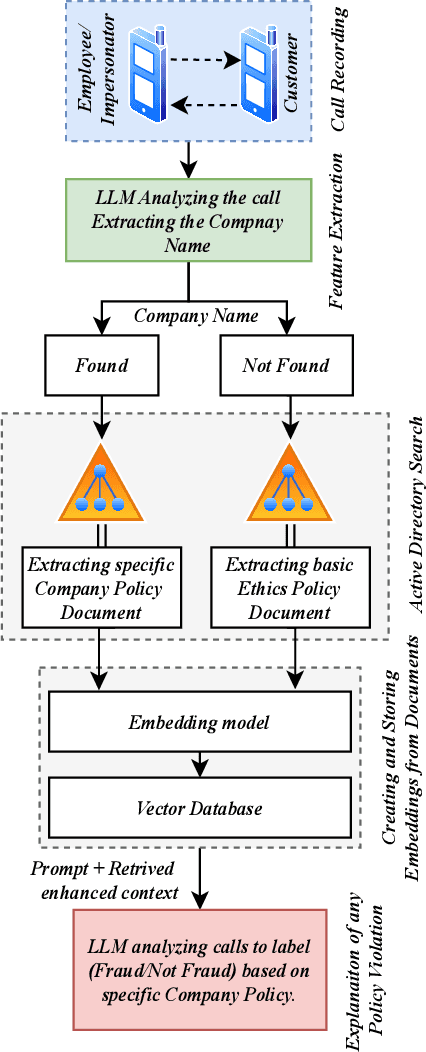
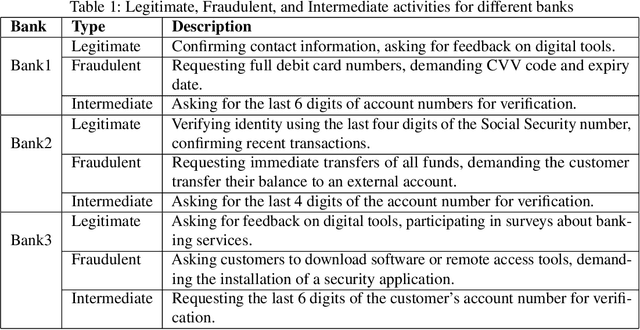
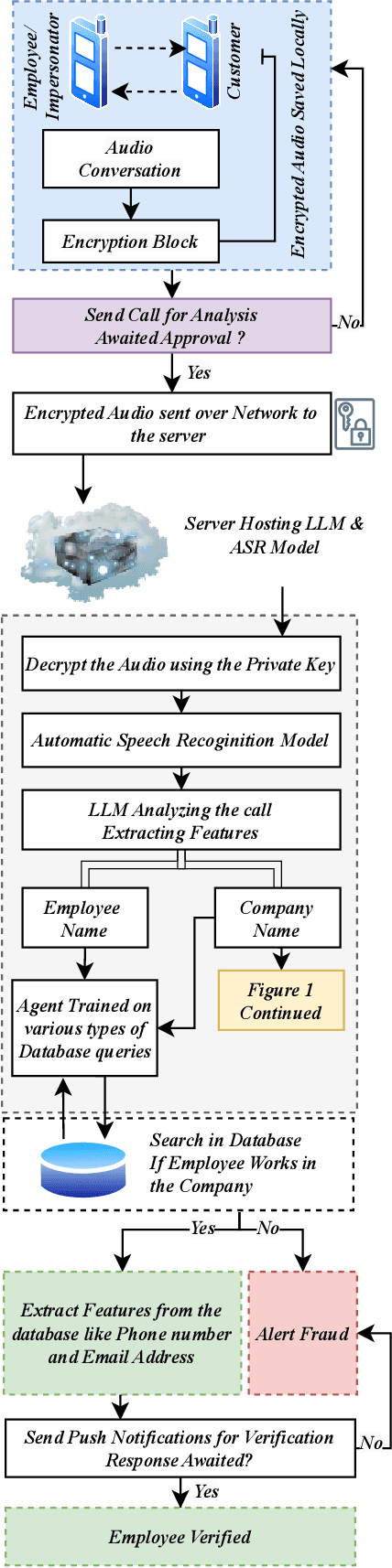
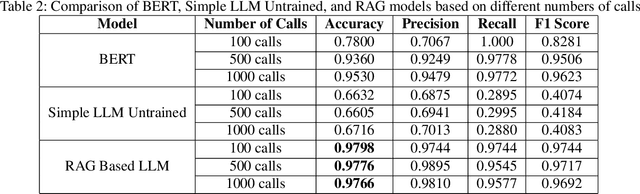
Artificial Intelligence has become a double edged sword in modern society being both a boon and a bane. While it empowers individuals it also enables malicious actors to perpetrate scams such as fraudulent phone calls and user impersonations. This growing threat necessitates a robust system to protect individuals In this paper we introduce a novel real time fraud detection mechanism using Retrieval Augmented Generation technology to address this challenge on two fronts. First our system incorporates a continuously updating policy checking feature that transcribes phone calls in real time and uses RAG based models to verify that the caller is not soliciting private information thus ensuring transparency and the authenticity of the conversation. Second we implement a real time user impersonation check with a two step verification process to confirm the callers identity ensuring accountability. A key innovation of our system is the ability to update policies without retraining the entire model enhancing its adaptability. We validated our RAG based approach using synthetic call recordings achieving an accuracy of 97.98 percent and an F1score of 97.44 percent with 100 calls outperforming state of the art methods. This robust and flexible fraud detection system is well suited for real world deployment.