 Add to Chrome
 Add to Firefox
 Add to Edge
The Illusion of Secure LLM Code: Closing the Security Gap via Iterative Reprompting
Jul 26, 2026
Large Language Models (LLMs) are increasingly integrated into software development workflows, yet their ability to autonomously generate secure authentication code remains uncertain. This paper evaluates the security architecture of authentication systems generated by five prominent AI coding assistants through a bi-modal assessment framework combining static code analysis and dynamic penetration testing, mapped to NIST SP 800-63B guidelines. The study examines model behavior across four prompting strategies Basic, Secure, NIST-Based, and Reprompting to reflect varying levels of developer guidance. Empirical results demonstrate that code generated from functional or generically secure prompts consistently omits critical protections, particularly concerning brute-force resistance, session management, and robust password handling. While providing explicit, single-shot NIST context significantly improves compliance, the findings reveal that this remains structurally inadequate. Instead, iterative Reprompting: forcing models into a contextual self-auditing loop is strictly required to achieve a comprehensive, defense-in-depth security architecture. Ultimately, this study proves that current AI coding assistants do not produce secure-by-default applications, dictating that enterprise deployments must transition from single-shot prompt engineering to continuous, standards-driven verification pipelines.

BEACON: A Multimodal Dataset for Learning Behavioral Fingerprints from Gameplay Data
May 11, 2026Continuous authentication in high-stakes digital environments requires datasets with fine-grained behavioral signals under realistic cognitive and motor demands. But current benchmarks are often limited by small scale, unimodal sensing or lack of synchronised environmental context. To address this gap, this paper introduces BEACON ( Behavioral Engine for Authentication \& Continuous Monitoring), a large-scale multimodal dataset that captures diverse skill tiers in competitive \textit{Valorant} gameplay. BEACON contains approximately 430 GB of synchronised modality data (461 GB total on-disk including auxiliary \textit{Valorant} configuration captures) from 79 sessions across 28 distinct players, estimated at 102.51 hours of active gameplay, including high-frequency mouse dynamics, keystroke events, network packet captures, screen recordings, hardware metadata, and in-game configuration context. BEACON leverages the high precision motor skills and high cognitive load that are inherent to tactical shooters, making it a rigorous stress test for the robustness of behavioral biometrics. The dataset allows for the study of continuous authentication, behavioral profiling, user drift and multimodal representation learning in a high-fidelity esports setting. The authors release the dataset and code on Hugging Face and GitHub to create a reproducible benchmark for evaluating next-generation behavioral fingerprinting and security models
Advanced Real-Time Fraud Detection Using RAG-Based LLMs
Jan 25, 2025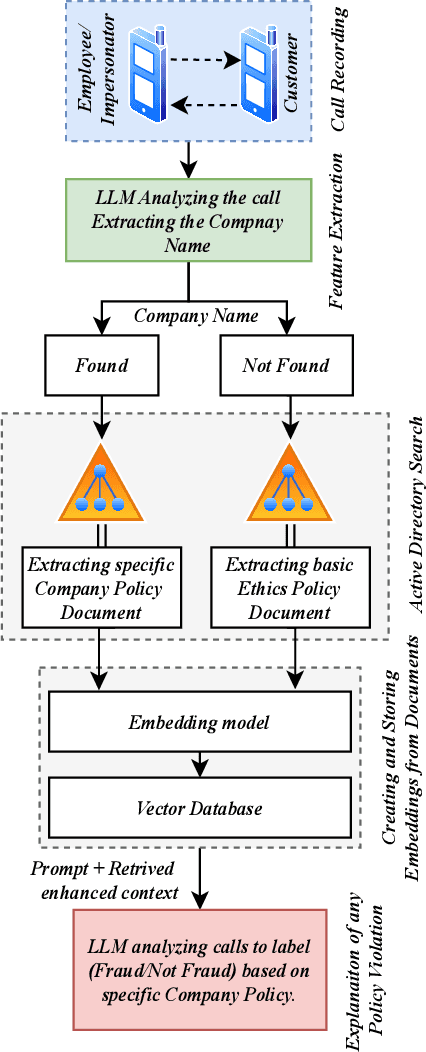
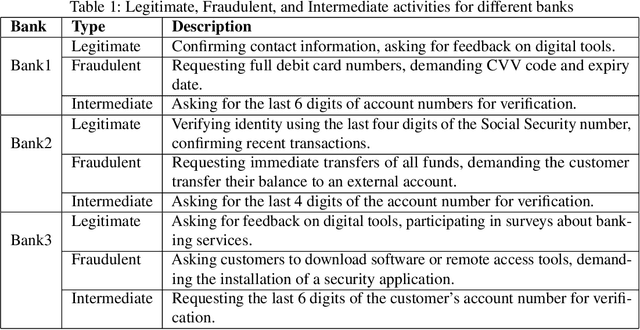
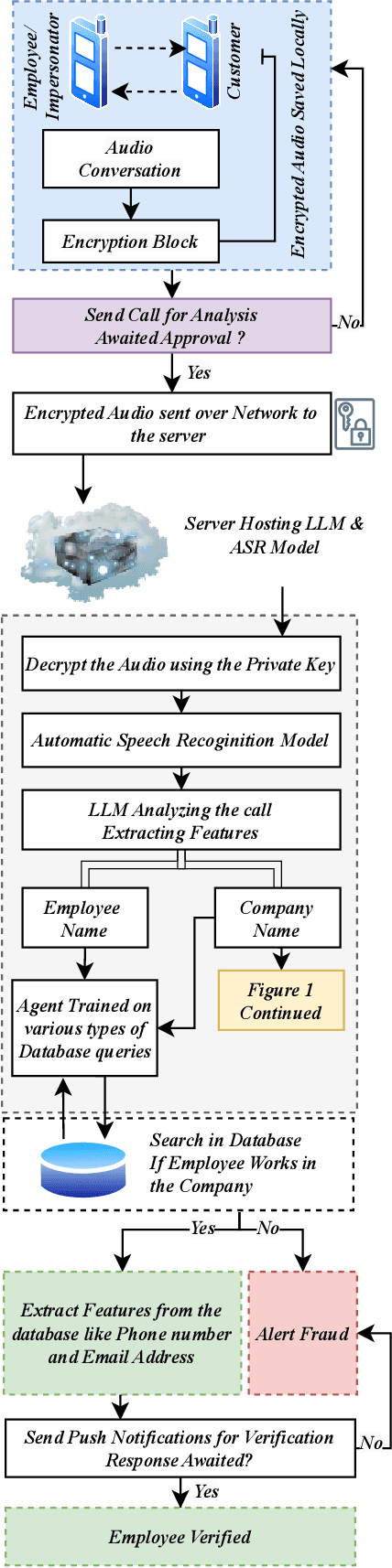
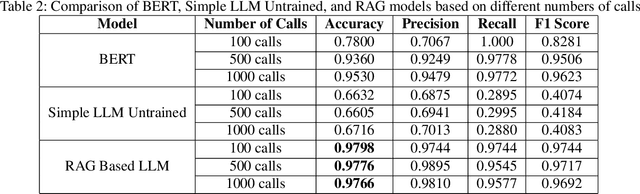
Artificial Intelligence has become a double edged sword in modern society being both a boon and a bane. While it empowers individuals it also enables malicious actors to perpetrate scams such as fraudulent phone calls and user impersonations. This growing threat necessitates a robust system to protect individuals In this paper we introduce a novel real time fraud detection mechanism using Retrieval Augmented Generation technology to address this challenge on two fronts. First our system incorporates a continuously updating policy checking feature that transcribes phone calls in real time and uses RAG based models to verify that the caller is not soliciting private information thus ensuring transparency and the authenticity of the conversation. Second we implement a real time user impersonation check with a two step verification process to confirm the callers identity ensuring accountability. A key innovation of our system is the ability to update policies without retraining the entire model enhancing its adaptability. We validated our RAG based approach using synthetic call recordings achieving an accuracy of 97.98 percent and an F1score of 97.44 percent with 100 calls outperforming state of the art methods. This robust and flexible fraud detection system is well suited for real world deployment.