 Add to Chrome
 Add to Firefox
 Add to Edge
FlowDPG: Deterministic Policy Gradient on Flow Matching Policies for Real-World Manipulation
Jun 21, 2026
Real-world reinforcement learning for robotic manipulation remains challenging, and this difficulty is amplified for flow matching policies: applying policy gradient methods to these policies is fundamentally limited by the need to backpropagate through time(BPTT) along the multi-step ODE that maps noise to actions, which is computationally prohibitive and numerically fragile. We propose FlowDPG, a DDPG-style method specifically designed for flow matching policies that distills the critic gradient into the velocity field at training time, bypassing BPTT entirely. Intuitively, FlowDPG combines two complementary vectors: the demonstration-driven velocity that keeps the action feasible, and the critic-driven correction that steers it toward higher value. Our contributions are threefold: (1) a BPTT-free distillation framework that enables stable DDPG-style policy improvement on flow matching policies, (2) a formal connection between the FlowDPG update direction and vanilla Deterministic Policy Gradient via three explicit approximations, and (3) real-world validation on a long-horizon, multi-stage, dual-arm AirPods assembly task, where FlowDPG attains a 92% end-to-end success rate, substantially outperforming recent RL methods spanning value-conditioning, auxiliary-module adaptation, and adjoint-based critic-gradient approaches. Videos and more results are provided on the project page https://flowdpg.github.io.

Diffusion-Guided Reconstruction of Everyday Hand-Object Interaction Clips
Sep 11, 2023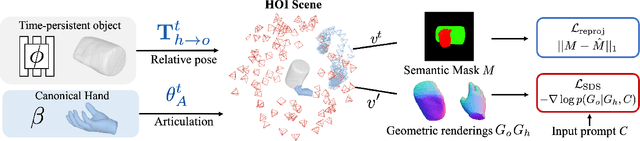
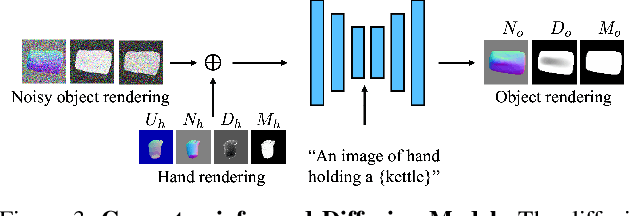
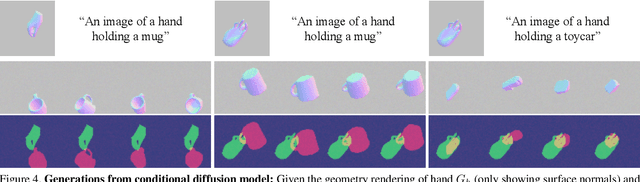
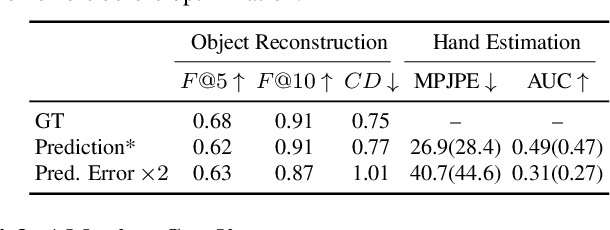
We tackle the task of reconstructing hand-object interactions from short video clips. Given an input video, our approach casts 3D inference as a per-video optimization and recovers a neural 3D representation of the object shape, as well as the time-varying motion and hand articulation. While the input video naturally provides some multi-view cues to guide 3D inference, these are insufficient on their own due to occlusions and limited viewpoint variations. To obtain accurate 3D, we augment the multi-view signals with generic data-driven priors to guide reconstruction. Specifically, we learn a diffusion network to model the conditional distribution of (geometric) renderings of objects conditioned on hand configuration and category label, and leverage it as a prior to guide the novel-view renderings of the reconstructed scene. We empirically evaluate our approach on egocentric videos across 6 object categories, and observe significant improvements over prior single-view and multi-view methods. Finally, we demonstrate our system's ability to reconstruct arbitrary clips from YouTube, showing both 1st and 3rd person interactions.