 Add to Chrome
 Add to Firefox
 Add to Edge
Discrete Flow Matching Policy Optimization
Apr 07, 2026
We introduce Discrete flow Matching policy Optimization (DoMinO), a unified framework for Reinforcement Learning (RL) fine-tuning Discrete Flow Matching (DFM) models under a broad class of policy gradient methods. Our key idea is to view the DFM sampling procedure as a multi-step Markov Decision Process. This perspective provides a simple and transparent reformulation of fine-tuning reward maximization as a robust RL objective. Consequently, it not only preserves the original DFM samplers but also avoids biased auxiliary estimators and likelihood surrogates used by many prior RL fine-tuning methods. To prevent policy collapse, we also introduce new total-variation regularizers to keep the fine-tuned distribution close to the pretrained one. Theoretically, we establish an upper bound on the discretization error of DoMinO and tractable upper bounds for the regularizers. Experimentally, we evaluate DoMinO on regulatory DNA sequence design. DoMinO achieves stronger predicted enhancer activity and better sequence naturalness than the previous best reward-driven baselines. The regularization further improves alignment with the natural sequence distribution while preserving strong functional performance. These results establish DoMinO as an useful framework for controllable discrete sequence generation.

The Binding Effect: Analyzing How Multi-Dimensional Cues Form Gender Bias in Instruction TTS
Mar 21, 2026Current bias evaluations in Instruction Text-to-Speech (ITTS) often rely on univariate testing, overlooking the compositional structure of social cues. In this work, we investigate gender bias by modeling prompts as combinations of Social Status, Career stereotypes, and Persona descriptors. Analyzing open-source ITTS models, we uncover systematic interaction effects where social dimensions modulate one another, creating complex bias patterns missed by univariate baselines. Crucially, our findings indicate that these biases extend beyond surface-level artifacts, demonstrating strong associations with the semantic priors of pre-trained text encoders and the skewed distributions inherent in training data. We further demonstrate that generic diversity prompting is insufficient to override these entrenched patterns, underscoring the need for compositional analysis to diagnose latent risks in generative speech.
Dual-Process Scaffold Reasoning for Enhancing LLM Code Debugging
Nov 11, 2025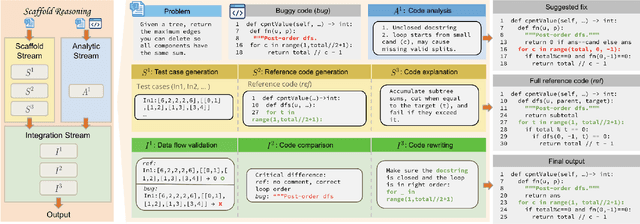
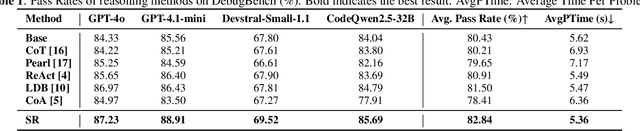
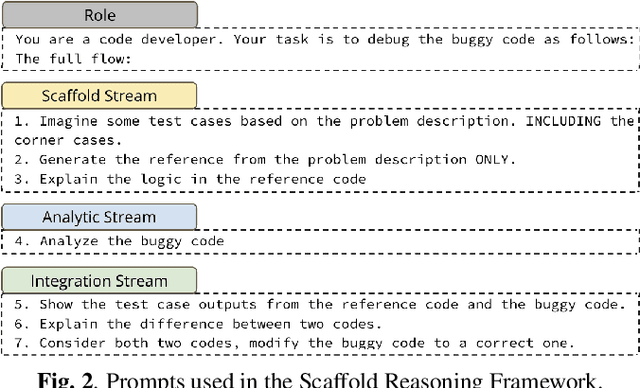

Recent LLMs have demonstrated sophisticated problem-solving capabilities on various benchmarks through advanced reasoning algorithms. However, the key research question of identifying reasoning steps that balance complexity and computational efficiency remains unsolved. Recent research has increasingly drawn upon psychological theories to explore strategies for optimizing cognitive pathways. The LLM's final outputs and intermediate steps are regarded as System 1 and System 2, respectively. However, an in-depth exploration of the System 2 reasoning is still lacking. Therefore, we propose a novel psychologically backed Scaffold Reasoning framework for code debugging, which encompasses the Scaffold Stream, Analytic Stream, and Integration Stream. The construction of reference code within the Scaffold Stream is integrated with the buggy code analysis results produced by the Analytic Stream through the Integration Stream. Our framework achieves an 88.91% pass rate and an average inference time of 5.36 seconds per-problem on DebugBench, outperforming other reasoning approaches across various LLMs in both reasoning accuracy and efficiency. Further analyses elucidate the advantages and limitations of various cognitive pathways across varying problem difficulties and bug types. Our findings also corroborate the alignment of the proposed Scaffold Reasoning framework with human cognitive processes.