 Add to Chrome
 Add to Firefox
 Add to Edge
Dual-Process Scaffold Reasoning for Enhancing LLM Code Debugging
Nov 11, 2025
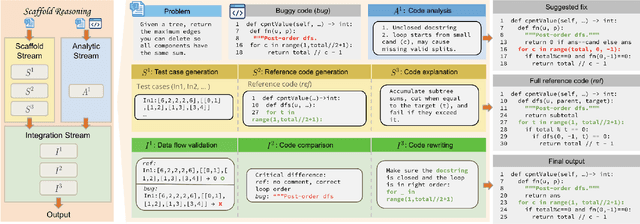
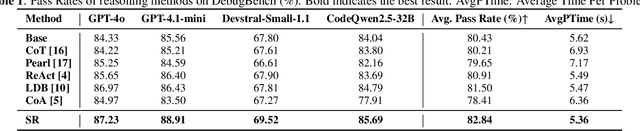
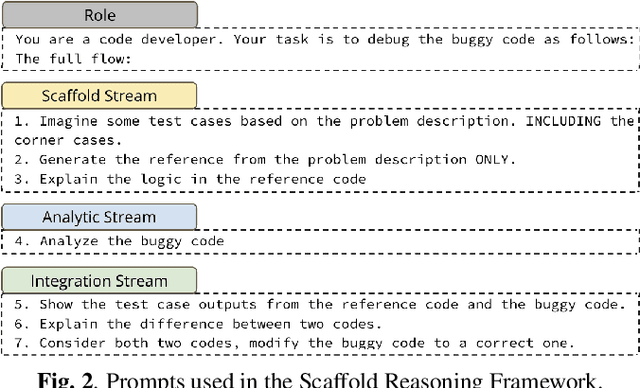

Recent LLMs have demonstrated sophisticated problem-solving capabilities on various benchmarks through advanced reasoning algorithms. However, the key research question of identifying reasoning steps that balance complexity and computational efficiency remains unsolved. Recent research has increasingly drawn upon psychological theories to explore strategies for optimizing cognitive pathways. The LLM's final outputs and intermediate steps are regarded as System 1 and System 2, respectively. However, an in-depth exploration of the System 2 reasoning is still lacking. Therefore, we propose a novel psychologically backed Scaffold Reasoning framework for code debugging, which encompasses the Scaffold Stream, Analytic Stream, and Integration Stream. The construction of reference code within the Scaffold Stream is integrated with the buggy code analysis results produced by the Analytic Stream through the Integration Stream. Our framework achieves an 88.91% pass rate and an average inference time of 5.36 seconds per-problem on DebugBench, outperforming other reasoning approaches across various LLMs in both reasoning accuracy and efficiency. Further analyses elucidate the advantages and limitations of various cognitive pathways across varying problem difficulties and bug types. Our findings also corroborate the alignment of the proposed Scaffold Reasoning framework with human cognitive processes.

Who Brings the Frisbee: Probing Hidden Hallucination Factors in Large Vision-Language Model via Causality Analysis
Dec 04, 2024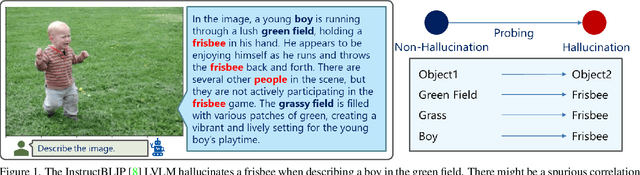
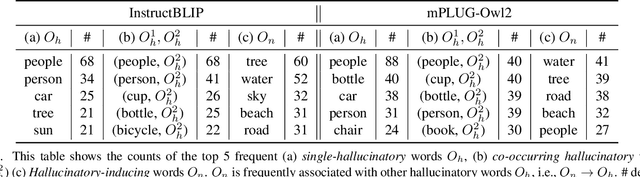

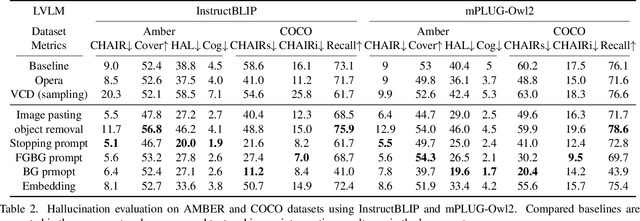
Recent advancements in large vision-language models (LVLM) have significantly enhanced their ability to comprehend visual inputs alongside natural language. However, a major challenge in their real-world application is hallucination, where LVLMs generate non-existent visual elements, eroding user trust. The underlying mechanism driving this multimodal hallucination is poorly understood. Minimal research has illuminated whether contexts such as sky, tree, or grass field involve the LVLM in hallucinating a frisbee. We hypothesize that hidden factors, such as objects, contexts, and semantic foreground-background structures, induce hallucination. This study proposes a novel causal approach: a hallucination probing system to identify these hidden factors. By analyzing the causality between images, text prompts, and network saliency, we systematically explore interventions to block these factors. Our experimental findings show that a straightforward technique based on our analysis can significantly reduce hallucinations. Additionally, our analyses indicate the potential to edit network internals to minimize hallucinated outputs.