 Add to Chrome
 Add to Firefox
 Add to Edge
The Recipe Matters More Than the Kitchen:Mathematical Foundations of the AI Weather Prediction Pipeline
Apr 01, 2026
AI weather prediction has advanced rapidly, yet no unified mathematical framework explains what determines forecast skill. Existing theory addresses specific architectural choices rather than the learning pipeline as a whole, while operational evidence from 2023-2026 demonstrates that training methodology, loss function design, and data diversity matter at least as much as architecture selection. This paper makes two interleaved contributions. Theoretically, we construct a framework rooted in approximation theory on the sphere, dynamical systems theory, information theory, and statistical learning theory that treats the complete learning pipeline (architecture, loss function, training strategy, data distribution) rather than architecture alone. We establish a Learning Pipeline Error Decomposition showing that estimation error (loss- and data-dependent) dominates approximation error (architecture-dependent) at current scales. We develop a Loss Function Spectral Theory formalizing MSE-induced spectral blurring in spherical harmonic coordinates, and derive Out-of-Distribution Extrapolation Bounds proving that data-driven models systematically underestimate record-breaking extremes with bias growing linearly in record exceedance. Empirically, we validate these predictions via inference across ten architecturally diverse AI weather models using NVIDIA Earth2Studio with ERA5 initial conditions, evaluating six metrics across 30 initialization dates spanning all seasons. Results confirm universal spectral energy loss at high wavenumbers for MSE-trained models, rising Error Consensus Ratios showing that the majority of forecast error is shared across architectures, and linear negative bias during extreme events. A Holistic Model Assessment Score provides unified multi-dimensional evaluation, and a prescriptive framework enables mathematical evaluation of proposed pipelines before training.

Kilometer-Scale Convection Allowing Model Emulation using Generative Diffusion Modeling
Aug 20, 2024Storm-scale convection-allowing models (CAMs) are an important tool for predicting the evolution of thunderstorms and mesoscale convective systems that result in damaging extreme weather. By explicitly resolving convective dynamics within the atmosphere they afford meteorologists the nuance needed to provide outlook on hazard. Deep learning models have thus far not proven skilful at km-scale atmospheric simulation, despite being competitive at coarser resolution with state-of-the-art global, medium-range weather forecasting. We present a generative diffusion model called StormCast, which emulates the high-resolution rapid refresh (HRRR) model-NOAA's state-of-the-art 3km operational CAM. StormCast autoregressively predicts 99 state variables at km scale using a 1-hour time step, with dense vertical resolution in the atmospheric boundary layer, conditioned on 26 synoptic variables. We present evidence of successfully learnt km-scale dynamics including competitive 1-6 hour forecast skill for composite radar reflectivity alongside physically realistic convective cluster evolution, moist updrafts, and cold pool morphology. StormCast predictions maintain realistic power spectra for multiple predicted variables across multi-hour forecasts. Together, these results establish the potential for autoregressive ML to emulate CAMs -- opening up new km-scale frontiers for regional ML weather prediction and future climate hazard dynamical downscaling.
Generative Data Assimilation of Sparse Weather Station Observations at Kilometer Scales
Jun 19, 2024

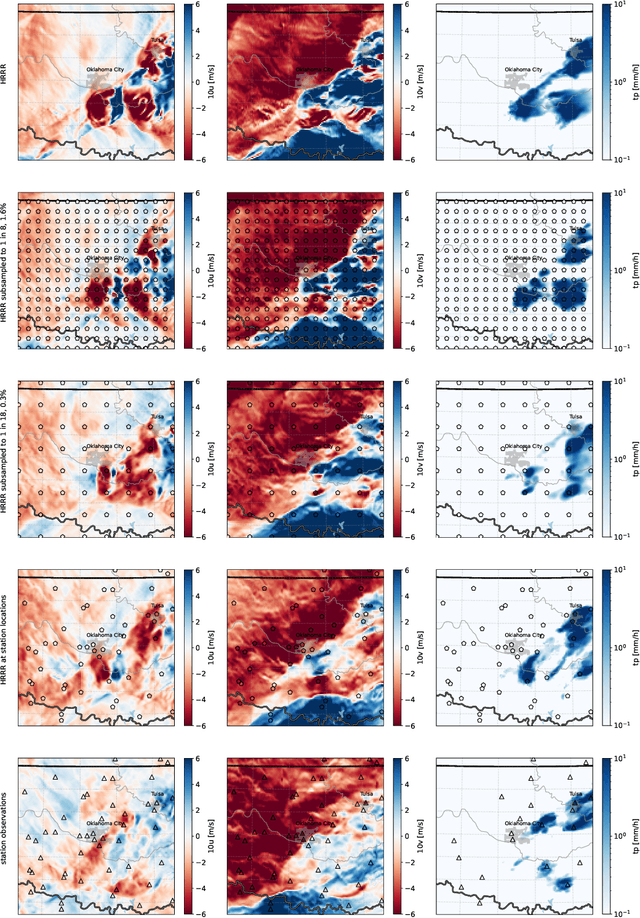
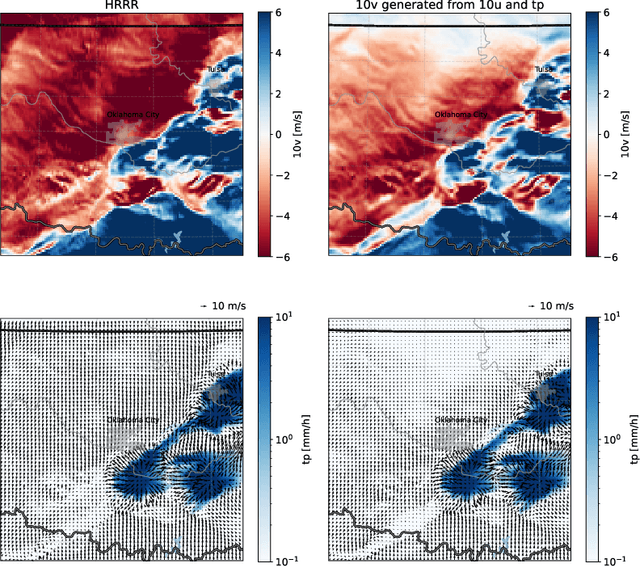
Data assimilation of observational data into full atmospheric states is essential for weather forecast model initialization. Recently, methods for deep generative data assimilation have been proposed which allow for using new input data without retraining the model. They could also dramatically accelerate the costly data assimilation process used in operational regional weather models. Here, in a central US testbed, we demonstrate the viability of score-based data assimilation in the context of realistically complex km-scale weather. We train an unconditional diffusion model to generate snapshots of a state-of-the-art km-scale analysis product, the High Resolution Rapid Refresh. Then, using score-based data assimilation to incorporate sparse weather station data, the model produces maps of precipitation and surface winds. The generated fields display physically plausible structures, such as gust fronts, and sensitivity tests confirm learnt physics through multivariate relationships. Preliminary skill analysis shows the approach already outperforms a naive baseline of the High-Resolution Rapid Refresh system itself. By incorporating observations from 40 weather stations, 10\% lower RMSEs on left-out stations are attained. Despite some lingering imperfections such as insufficiently disperse ensemble DA estimates, we find the results overall an encouraging proof of concept, and the first at km-scale. It is a ripe time to explore extensions that combine increasingly ambitious regional state generators with an increasing set of in situ, ground-based, and satellite remote sensing data streams.
DiffObs: Generative Diffusion for Global Forecasting of Satellite Observations
Apr 04, 2024


This work presents an autoregressive generative diffusion model (DiffObs) to predict the global evolution of daily precipitation, trained on a satellite observational product, and assessed with domain-specific diagnostics. The model is trained to probabilistically forecast day-ahead precipitation. Nonetheless, it is stable for multi-month rollouts, which reveal a qualitatively realistic superposition of convectively coupled wave modes in the tropics. Cross-spectral analysis confirms successful generation of low frequency variations associated with the Madden--Julian oscillation, which regulates most subseasonal to seasonal predictability in the observed atmosphere, and convectively coupled moist Kelvin waves with approximately correct dispersion relationships. Despite secondary issues and biases, the results affirm the potential for a next generation of global diffusion models trained on increasingly sparse, and increasingly direct and differentiated observations of the world, for practical applications in subseasonal and climate prediction.