 Add to Chrome
 Add to Firefox
 Add to Edge
Sketching for Convex and Nonconvex Regularized Least Squares with Sharp Guarantees
Nov 03, 2023
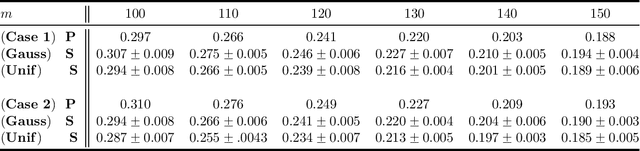
Randomized algorithms are important for solving large-scale optimization problems. In this paper, we propose a fast sketching algorithm for least square problems regularized by convex or nonconvex regularization functions, Sketching for Regularized Optimization (SRO). Our SRO algorithm first generates a sketch of the original data matrix, then solves the sketched problem. Different from existing randomized algorithms, our algorithm handles general Frechet subdifferentiable regularization functions in an unified framework. We present general theoretical result for the approximation error between the optimization results of the original problem and the sketched problem for regularized least square problems which can be convex or nonconvex. For arbitrary convex regularizer, relative-error bound is proved for the approximation error. Importantly, minimax rates for sparse signal estimation by solving the sketched sparse convex or nonconvex learning problems are also obtained using our general theoretical result under mild conditions. To the best of our knowledge, our results are among the first to demonstrate minimax rates for convex or nonconvex sparse learning problem by sketching under a unified theoretical framework. We further propose an iterative sketching algorithm which reduces the approximation error exponentially by iteratively invoking the sketching algorithm. Experimental results demonstrate the effectiveness of the proposed SRO and Iterative SRO algorithms.

Recovering Linear Causal Models with Latent Variables via Cholesky Factorization of Covariance Matrix
Nov 01, 2023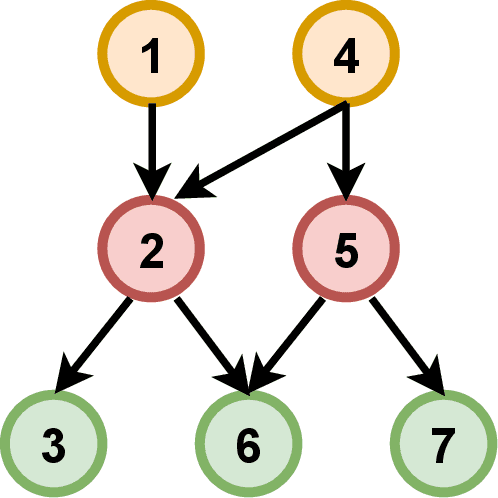
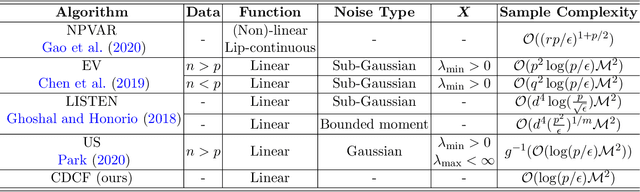
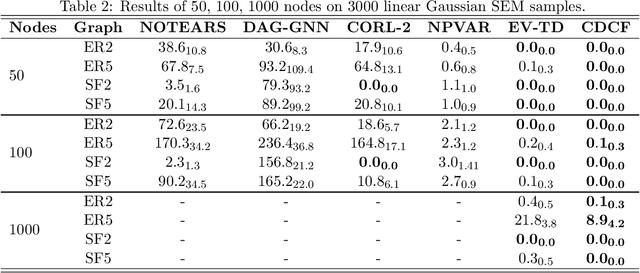
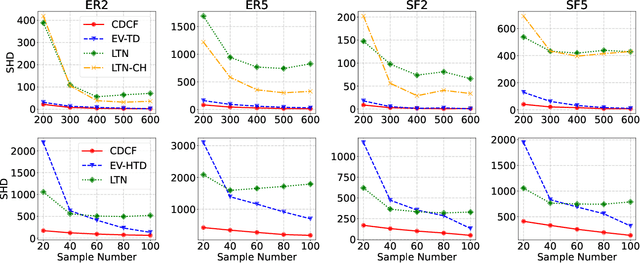
Discovering the causal relationship via recovering the directed acyclic graph (DAG) structure from the observed data is a well-known challenging combinatorial problem. When there are latent variables, the problem becomes even more difficult. In this paper, we first propose a DAG structure recovering algorithm, which is based on the Cholesky factorization of the covariance matrix of the observed data. The algorithm is fast and easy to implement and has theoretical grantees for exact recovery. On synthetic and real-world datasets, the algorithm is significantly faster than previous methods and achieves the state-of-the-art performance. Furthermore, under the equal error variances assumption, we incorporate an optimization procedure into the Cholesky factorization based algorithm to handle the DAG recovering problem with latent variables. Numerical simulations show that the modified "Cholesky + optimization" algorithm is able to recover the ground truth graph in most cases and outperforms existing algorithms.
The Phase Transition Phenomenon of Shuffled Regression
Oct 31, 2023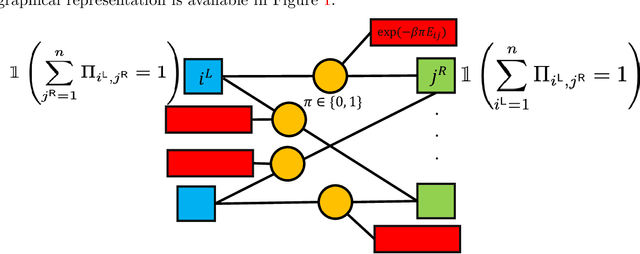
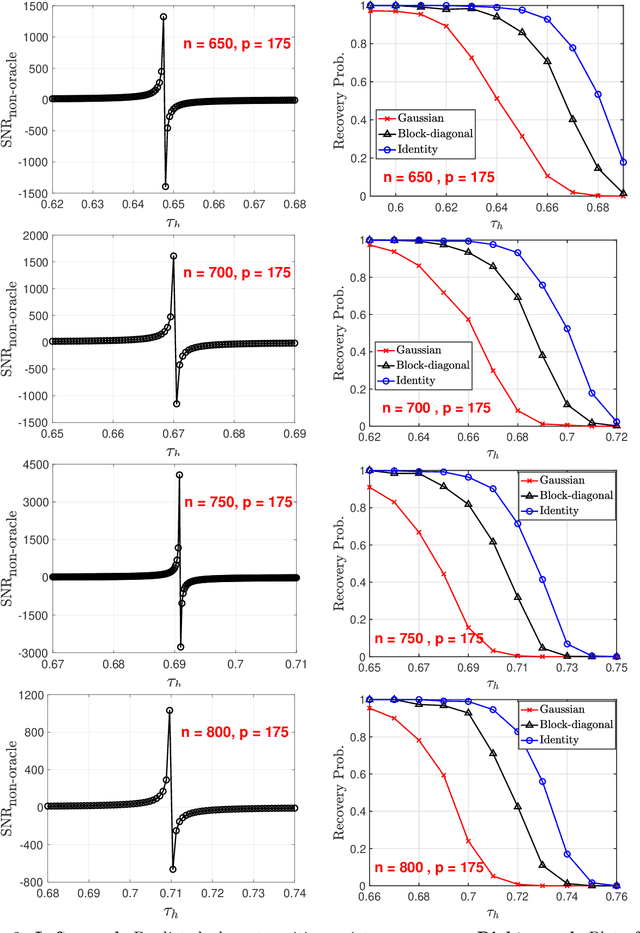
We study the phase transition phenomenon inherent in the shuffled (permuted) regression problem, which has found numerous applications in databases, privacy, data analysis, etc. In this study, we aim to precisely identify the locations of the phase transition points by leveraging techniques from message passing (MP). In our analysis, we first transform the permutation recovery problem into a probabilistic graphical model. We then leverage the analytical tools rooted in the message passing (MP) algorithm and derive an equation to track the convergence of the MP algorithm. By linking this equation to the branching random walk process, we are able to characterize the impact of the signal-to-noise-ratio ($\snr$) on the permutation recovery. Depending on whether the signal is given or not, we separately investigate the oracle case and the non-oracle case. The bottleneck in identifying the phase transition regimes lies in deriving closed-form formulas for the corresponding critical points, but only in rare scenarios can one obtain such precise expressions. To tackle this technical challenge, this study proposes the Gaussian approximation method, which allows us to obtain the closed-form formulas in almost all scenarios. In the oracle case, our method can fairly accurately predict the phase transition $\snr$. In the non-oracle case, our algorithm can predict the maximum allowed number of permuted rows and uncover its dependency on the sample number.
STANLEY: Stochastic Gradient Anisotropic Langevin Dynamics for Learning Energy-Based Models
Oct 19, 2023We propose in this paper, STANLEY, a STochastic gradient ANisotropic LangEvin dYnamics, for sampling high dimensional data. With the growing efficacy and potential of Energy-Based modeling, also known as non-normalized probabilistic modeling, for modeling a generative process of different natures of high dimensional data observations, we present an end-to-end learning algorithm for Energy-Based models (EBM) with the purpose of improving the quality of the resulting sampled data points. While the unknown normalizing constant of EBMs makes the training procedure intractable, resorting to Markov Chain Monte Carlo (MCMC) is in general a viable option. Realizing what MCMC entails for the EBM training, we propose in this paper, a novel high dimensional sampling method, based on an anisotropic stepsize and a gradient-informed covariance matrix, embedded into a discretized Langevin diffusion. We motivate the necessity for an anisotropic update of the negative samples in the Markov Chain by the nonlinearity of the backbone of the EBM, here a Convolutional Neural Network. Our resulting method, namely STANLEY, is an optimization algorithm for training Energy-Based models via our newly introduced MCMC method. We provide a theoretical understanding of our sampling scheme by proving that the sampler leads to a geometrically uniformly ergodic Markov Chain. Several image generation experiments are provided in our paper to show the effectiveness of our method.
Faster Algorithms for Generalized Mean Densest Subgraph Problem
Oct 17, 2023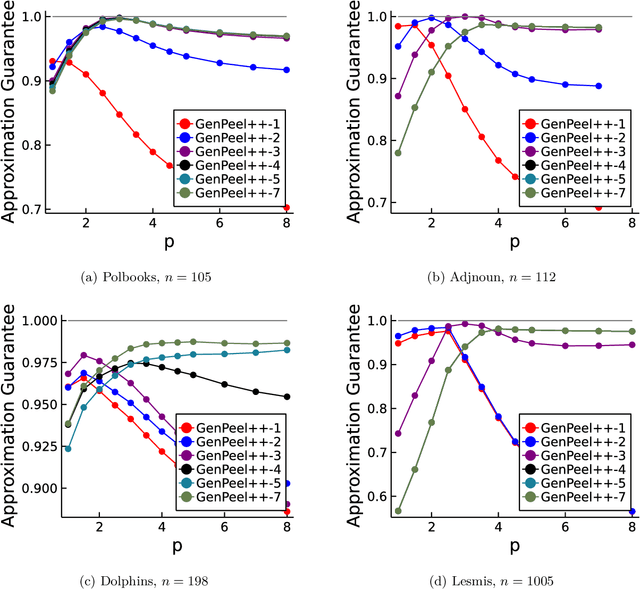
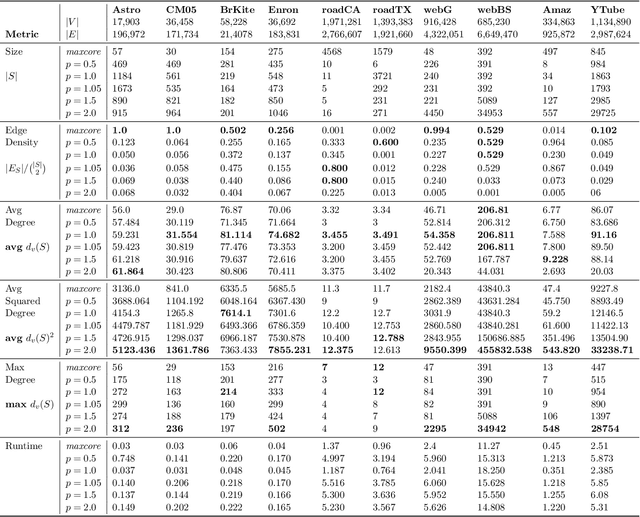
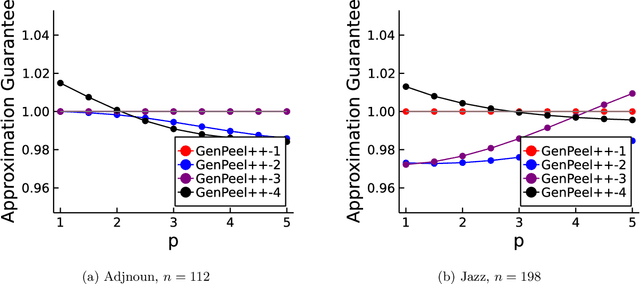
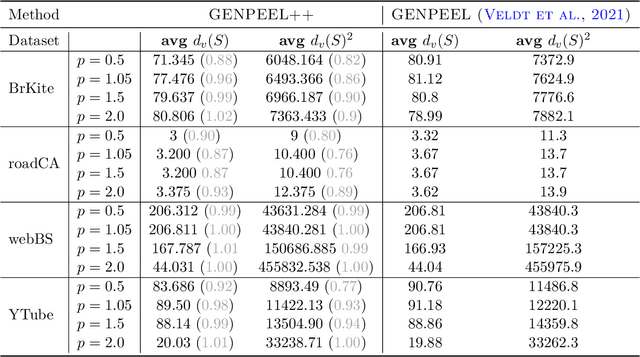
The densest subgraph of a large graph usually refers to some subgraph with the highest average degree, which has been extended to the family of $p$-means dense subgraph objectives by~\citet{veldt2021generalized}. The $p$-mean densest subgraph problem seeks a subgraph with the highest average $p$-th-power degree, whereas the standard densest subgraph problem seeks a subgraph with a simple highest average degree. It was shown that the standard peeling algorithm can perform arbitrarily poorly on generalized objective when $p>1$ but uncertain when $0<p<1$. In this paper, we are the first to show that a standard peeling algorithm can still yield $2^{1/p}$-approximation for the case $0<p < 1$. (Veldt 2021) proposed a new generalized peeling algorithm (GENPEEL), which for $p \geq 1$ has an approximation guarantee ratio $(p+1)^{1/p}$, and time complexity $O(mn)$, where $m$ and $n$ denote the number of edges and nodes in graph respectively. In terms of algorithmic contributions, we propose a new and faster generalized peeling algorithm (called GENPEEL++ in this paper), which for $p \in [1, +\infty)$ has an approximation guarantee ratio $(2(p+1))^{1/p}$, and time complexity $O(m(\log n))$, where $m$ and $n$ denote the number of edges and nodes in graph, respectively. This approximation ratio converges to 1 as $p \rightarrow \infty$.
Optimal Estimator for Linear Regression with Shuffled Labels
Oct 02, 2023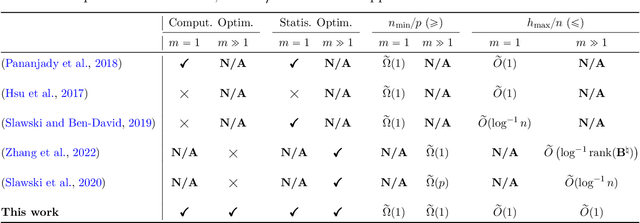
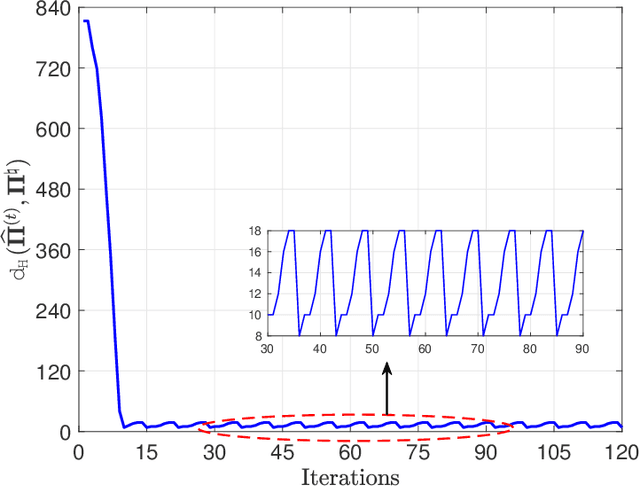
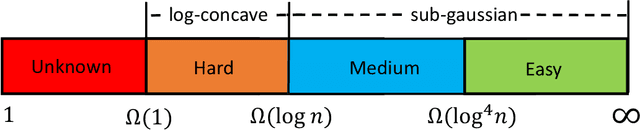
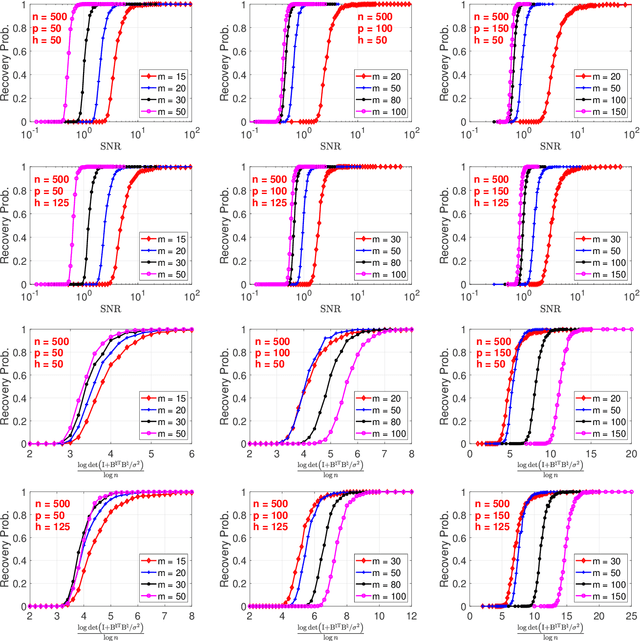
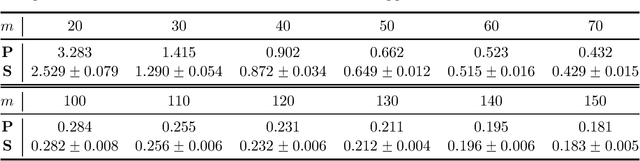
This paper considers the task of linear regression with shuffled labels, i.e., $\mathbf Y = \mathbf \Pi \mathbf X \mathbf B + \mathbf W$, where $\mathbf Y \in \mathbb R^{n\times m}, \mathbf Pi \in \mathbb R^{n\times n}, \mathbf X\in \mathbb R^{n\times p}, \mathbf B \in \mathbb R^{p\times m}$, and $\mathbf W\in \mathbb R^{n\times m}$, respectively, represent the sensing results, (unknown or missing) corresponding information, sensing matrix, signal of interest, and additive sensing noise. Given the observation $\mathbf Y$ and sensing matrix $\mathbf X$, we propose a one-step estimator to reconstruct $(\mathbf \Pi, \mathbf B)$. From the computational perspective, our estimator's complexity is $O(n^3 + np^2m)$, which is no greater than the maximum complexity of a linear assignment algorithm (e.g., $O(n^3)$) and a least square algorithm (e.g., $O(np^2 m)$). From the statistical perspective, we divide the minimum $snr$ requirement into four regimes, e.g., unknown, hard, medium, and easy regimes; and present sufficient conditions for the correct permutation recovery under each regime: $(i)$ $snr \geq \Omega(1)$ in the easy regime; $(ii)$ $snr \geq \Omega(\log n)$ in the medium regime; and $(iii)$ $snr \geq \Omega((\log n)^{c_0}\cdot n^{{c_1}/{srank(\mathbf B)}})$ in the hard regime ($c_0, c_1$ are some positive constants and $srank(\mathbf B)$ denotes the stable rank of $\mathbf B$). In the end, we also provide numerical experiments to confirm the above claims.
Adversarial Attacks on Video Object Segmentation with Hard Region Discovery
Sep 25, 2023Video object segmentation has been applied to various computer vision tasks, such as video editing, autonomous driving, and human-robot interaction. However, the methods based on deep neural networks are vulnerable to adversarial examples, which are the inputs attacked by almost human-imperceptible perturbations, and the adversary (i.e., attacker) will fool the segmentation model to make incorrect pixel-level predictions. This will rise the security issues in highly-demanding tasks because small perturbations to the input video will result in potential attack risks. Though adversarial examples have been extensively used for classification, it is rarely studied in video object segmentation. Existing related methods in computer vision either require prior knowledge of categories or cannot be directly applied due to the special design for certain tasks, failing to consider the pixel-wise region attack. Hence, this work develops an object-agnostic adversary that has adversarial impacts on VOS by first-frame attacking via hard region discovery. Particularly, the gradients from the segmentation model are exploited to discover the easily confused region, in which it is difficult to identify the pixel-wise objects from the background in a frame. This provides a hardness map that helps to generate perturbations with a stronger adversarial power for attacking the first frame. Empirical studies on three benchmarks indicate that our attacker significantly degrades the performance of several state-of-the-art video object segmentation models.
Triple-View Knowledge Distillation for Semi-Supervised Semantic Segmentation
Sep 22, 2023To alleviate the expensive human labeling, semi-supervised semantic segmentation employs a few labeled images and an abundant of unlabeled images to predict the pixel-level label map with the same size. Previous methods often adopt co-training using two convolutional networks with the same architecture but different initialization, which fails to capture the sufficiently diverse features. This motivates us to use tri-training and develop the triple-view encoder to utilize the encoders with different architectures to derive diverse features, and exploit the knowledge distillation skill to learn the complementary semantics among these encoders. Moreover, existing methods simply concatenate the features from both encoder and decoder, resulting in redundant features that require large memory cost. This inspires us to devise a dual-frequency decoder that selects those important features by projecting the features from the spatial domain to the frequency domain, where the dual-frequency channel attention mechanism is introduced to model the feature importance. Therefore, we propose a Triple-view Knowledge Distillation framework, termed TriKD, for semi-supervised semantic segmentation, including the triple-view encoder and the dual-frequency decoder. Extensive experiments were conducted on two benchmarks, \ie, Pascal VOC 2012 and Cityscapes, whose results verify the superiority of the proposed method with a good tradeoff between precision and inference speed.
Word Embedding with Neural Probabilistic Prior
Sep 21, 2023To improve word representation learning, we propose a probabilistic prior which can be seamlessly integrated with word embedding models. Different from previous methods, word embedding is taken as a probabilistic generative model, and it enables us to impose a prior regularizing word representation learning. The proposed prior not only enhances the representation of embedding vectors but also improves the model's robustness and stability. The structure of the proposed prior is simple and effective, and it can be easily implemented and flexibly plugged in most existing word embedding models. Extensive experiments show the proposed method improves word representation on various tasks.
Fully Transformer-Equipped Architecture for End-to-End Referring Video Object Segmentation
Sep 21, 2023Referring Video Object Segmentation (RVOS) requires segmenting the object in video referred by a natural language query. Existing methods mainly rely on sophisticated pipelines to tackle such cross-modal task, and do not explicitly model the object-level spatial context which plays an important role in locating the referred object. Therefore, we propose an end-to-end RVOS framework completely built upon transformers, termed \textit{Fully Transformer-Equipped Architecture} (FTEA), which treats the RVOS task as a mask sequence learning problem and regards all the objects in video as candidate objects. Given a video clip with a text query, the visual-textual features are yielded by encoder, while the corresponding pixel-level and word-level features are aligned in terms of semantic similarity. To capture the object-level spatial context, we have developed the Stacked Transformer, which individually characterizes the visual appearance of each candidate object, whose feature map is decoded to the binary mask sequence in order directly. Finally, the model finds the best matching between mask sequence and text query. In addition, to diversify the generated masks for candidate objects, we impose a diversity loss on the model for capturing more accurate mask of the referred object. Empirical studies have shown the superiority of the proposed method on three benchmarks, e.g., FETA achieves 45.1% and 38.7% in terms of mAP on A2D Sentences (3782 videos) and J-HMDB Sentences (928 videos), respectively; it achieves 56.6% in terms of $\mathcal{J\&F}$ on Ref-YouTube-VOS (3975 videos and 7451 objects). Particularly, compared to the best candidate method, it has a gain of 2.1% and 3.2% in terms of P$@$0.5 on the former two, respectively, while it has a gain of 2.9% in terms of $\mathcal{J}$ on the latter one.