 Add to Chrome
 Add to Firefox
 Add to Edge
Active-SWE: Benchmarking Coding Agents for Proactive Bug Fixing without Issue Reports
Aug 05, 2026
Coding agents powered by large language models (LLMs) are increasingly adopted in software engineering (SWE) scenarios, capable of fixing a specific bug in large-scale codebase. However, existing SWE benchmarks typically assume that high-quality issue reports with detailed information are always available, which is easily violated in practice due to the complexity of report acquisition and curation. To address this, we introduce Active-SWE, a benchmark for evaluating coding agents on proactively discovering and fixing multiple bugs without report guidance, covering 1,663 tasks across six bug categories and eight languages. Beyond shifting the focus from existing reactive bug fixing to proactive bug fixing, Active-SWE enables a more in-depth evaluation by expanding the scope from fixing a specific recorded bug to multiple-bug fixing and potential bug discovery scenarios. To construct Active-SWE, we propose a novel difficulty-aware task formulation pipeline with a dual-track evaluation framework, facilitating comprehensive evaluation of proactive bug-fixing capability. Extensive experiments reveal that most state-of-the-art coding agents struggle with proactive bug-fixing tasks, demonstrating limited performance in locating and resolving recorded bugs, handling multiple bug fixing scenarios, and discovering valid potential bugs.

Soft Synergies: Model Order Reduction of Hybrid Soft-Rigid Robots via Optimal Strain Parameterization
May 21, 2024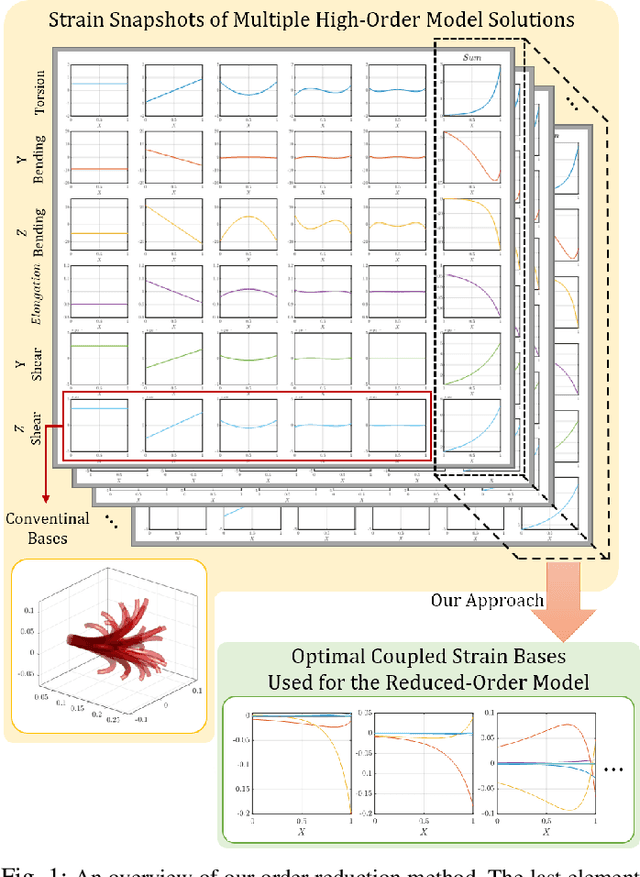
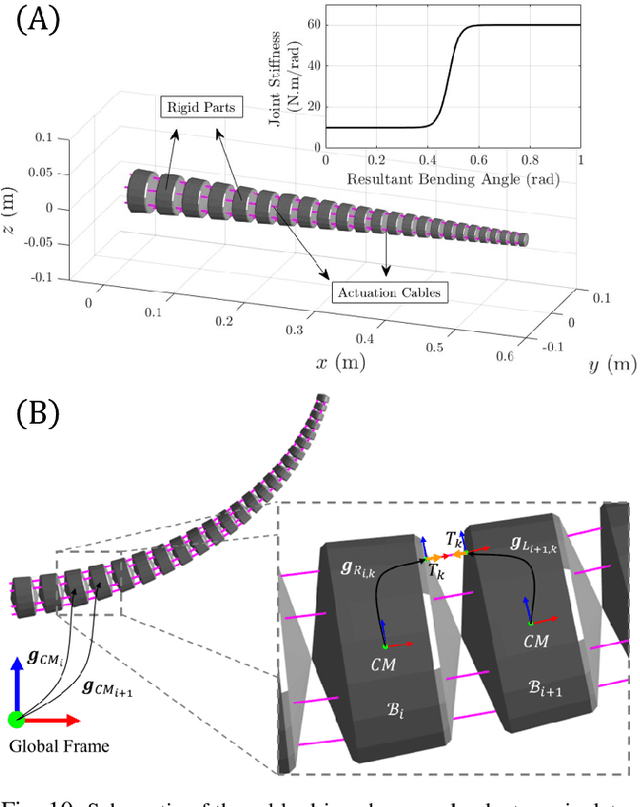
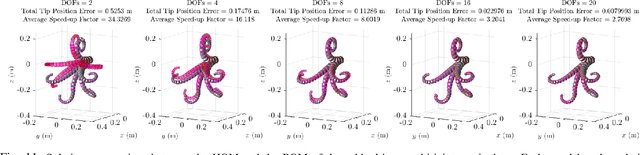
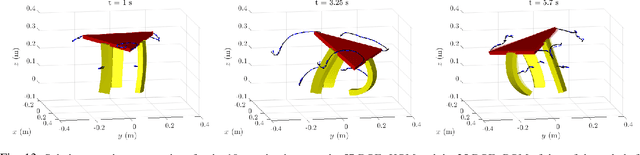
Soft robots offer remarkable adaptability and safety advantages over rigid robots, but modeling their complex, nonlinear dynamics remains challenging. Strain-based models have recently emerged as a promising candidate to describe such systems, however, they tend to be high-dimensional and time consuming. This paper presents a novel model order reduction approach for soft and hybrid robots by combining strain-based modeling with Proper Orthogonal Decomposition (POD). The method identifies optimal coupled strain basis functions -- or mechanical synergies -- from simulation data, enabling the description of soft robot configurations with a minimal number of generalized coordinates. The reduced order model (ROM) achieves substantial dimensionality reduction while preserving accuracy. Rigorous testing demonstrates the interpolation and extrapolation capabilities of the ROM for soft manipulators under static and dynamic conditions. The approach is further validated on a snake-like hyper-redundant rigid manipulator and a closed-chain system with soft and rigid components, illustrating its broad applicability. Finally, the approach is leveraged for shape estimation of a real six-actuator soft manipulator using only two position markers, showcasing its practical utility. This POD-based ROM offers significant computational speed-ups, paving the way for real-time simulation and control of complex soft and hybrid robots.