 Add to Chrome
 Add to Firefox
 Add to Edge
Comparative Study of ECG Denoising Methods for Wearable Applications
Jul 13, 2026
Reliable electrocardiogram (ECG) monitoring in wearable and space environments requires effective denoising of signals corrupted by non-stationary electromyogram (EMG) interference. This paper presents a comparative evaluation of model-based and DL-based denoising techniques for upper-arm ECG recordings acquired under real conditions. The model-based methods include three empirical mode decomposition (EMD) variants and a discrete wavelet transform (DWT) approach, while the deep learning (DL) side is represented by a stacked denoising autoencoder (SDAE) and a physics-informed neural network (PINN). All methods are evaluated on real acquisitions under both relaxed and voluntary muscle contraction conditions, using root mean squared error (RMSE), Pearson correlation, and peak-to-peak signal-to-noise ratio (PPSNR) as performance metrics. Results reveal a fundamental trade-off: DL methods achieve superior morphological reconstruction, while DWT provides the strongest noise suppression, highlighting complementary strengths for wearable cardiac monitoring applications.

Channel Characterization of Implantable Intrabody Communication through Experimental Measurements
Jul 01, 2024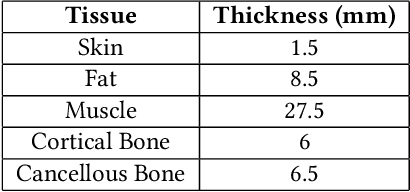
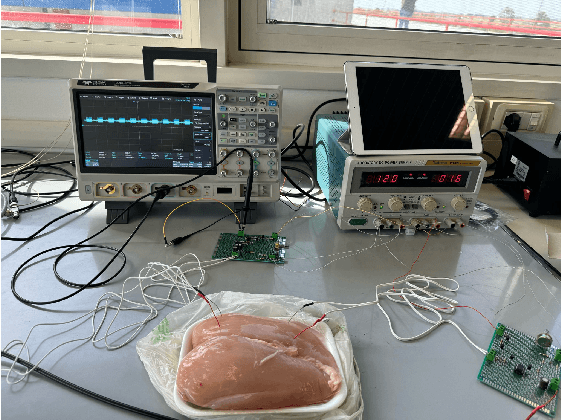
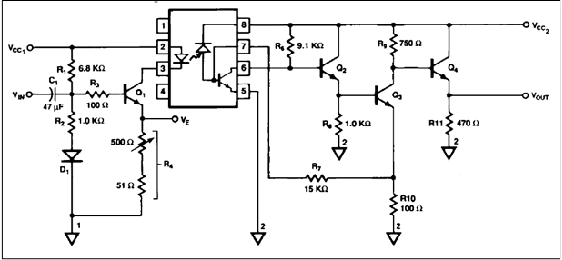
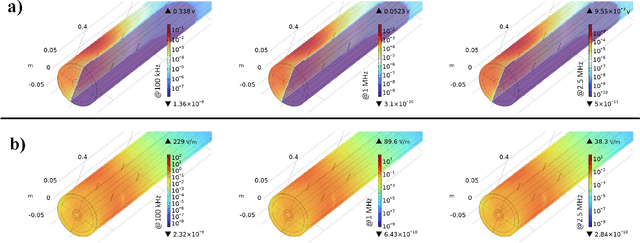
Intrabody communication (IBC), is a promising technology that can be utilized for data transmission across the human body. In this study, a galvanic coupled (GC)-based IBC channel has been investigated for implantable configuration both theoretically and experimentally in the frequency range of 0 to 2.5 MHz. Theoretical studies were performed by using finite element method (FEM) based simulation software, called Comsol Multiphysics. A cylindrical human arm was modeled with realistic values. Experimental studies were carried out with chicken breast tissue as a substitute for human tissue. The pseudorandom noise (PN) sequences were transmitted to investigate the correlative channel sounder of tissue model. Results showed that the frequency affects signal propagation through the tissue model. Additionally, it is crucial to cancel common-mode noise in the IBC channel to enhance communication quality.