 Add to Chrome
 Add to Firefox
 Add to Edge
Zero knowledge verification for frontier AI training is possible
Jun 03, 2026
Frontier AI governance frameworks increasingly use cumulative training compute as the primary criterion for designating high-impact models, but enforcement rests on self-reporting because no technical verification primitive for training exists. Any future international agreement on frontier AI faces the same problem at higher stakes: coordinated regulation of technologies with significant externalities has historically rested on technical verification, without which agreements are declaratory. Recent governance analyses judge zero-knowledge proofs a promising candidate but currently impractical at frontier scale [26, 4]. We argue the impracticality is paradigm-bound rather than fundamental, and propose a verification architecture for frontier dense pre-training combining a pre-committed training specification, inter-node network observations, and on-the-fly Merkle commitments of intermediate computation, verified through a zero-knowledge Virtual Machine (zkVM) with native BF16/FP32 precompiles. The proof checks the actual floating-point computation the GPU performed rather than a fixed-point approximation, and preserves model-architecture confidentiality through a private training specification. The protocol produces three proof types: a genesis proof at initialisation, in-training step proofs across the run, and ex-ante attestations enforcing policy-relevant claims as running invariants, turning the training record into a governance-enforceable artefact. We estimate a deployable proof of concept within approximately 36 months at single-digit-percent training-side overhead, against a six-to-ten-year cycle for verification-grade custom silicon. Thirteen open research and engineering problems are catalogued as a research agenda for external contribution

The Singapore Consensus on Global AI Safety Research Priorities
Jun 25, 2025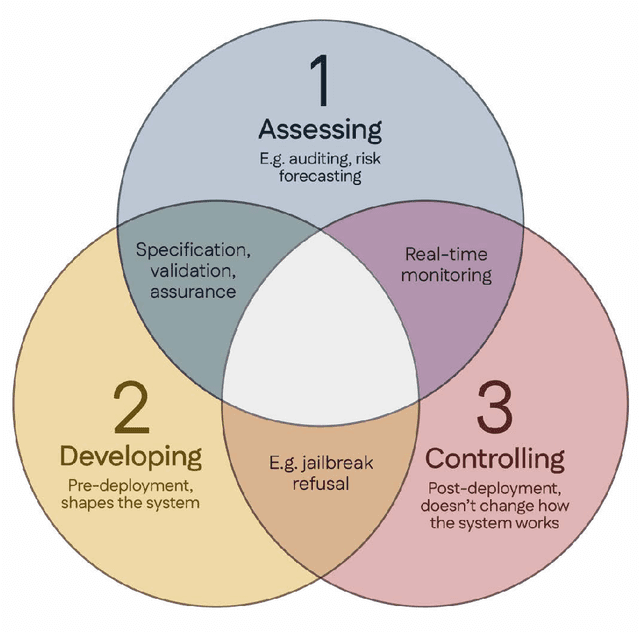
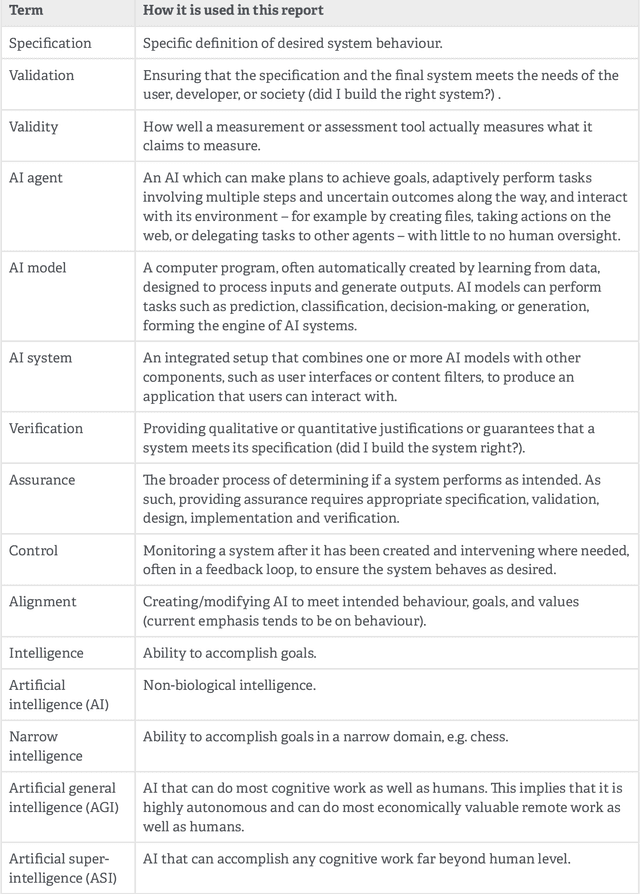
Rapidly improving AI capabilities and autonomy hold significant promise of transformation, but are also driving vigorous debate on how to ensure that AI is safe, i.e., trustworthy, reliable, and secure. Building a trusted ecosystem is therefore essential -- it helps people embrace AI with confidence and gives maximal space for innovation while avoiding backlash. The "2025 Singapore Conference on AI (SCAI): International Scientific Exchange on AI Safety" aimed to support research in this space by bringing together AI scientists across geographies to identify and synthesise research priorities in AI safety. This resulting report builds on the International AI Safety Report chaired by Yoshua Bengio and backed by 33 governments. By adopting a defence-in-depth model, this report organises AI safety research domains into three types: challenges with creating trustworthy AI systems (Development), challenges with evaluating their risks (Assessment), and challenges with monitoring and intervening after deployment (Control).