 Add to Chrome
 Add to Firefox
 Add to Edge
Zero knowledge verification for frontier AI training is possible
Jun 03, 2026
Frontier AI governance frameworks increasingly use cumulative training compute as the primary criterion for designating high-impact models, but enforcement rests on self-reporting because no technical verification primitive for training exists. Any future international agreement on frontier AI faces the same problem at higher stakes: coordinated regulation of technologies with significant externalities has historically rested on technical verification, without which agreements are declaratory. Recent governance analyses judge zero-knowledge proofs a promising candidate but currently impractical at frontier scale [26, 4]. We argue the impracticality is paradigm-bound rather than fundamental, and propose a verification architecture for frontier dense pre-training combining a pre-committed training specification, inter-node network observations, and on-the-fly Merkle commitments of intermediate computation, verified through a zero-knowledge Virtual Machine (zkVM) with native BF16/FP32 precompiles. The proof checks the actual floating-point computation the GPU performed rather than a fixed-point approximation, and preserves model-architecture confidentiality through a private training specification. The protocol produces three proof types: a genesis proof at initialisation, in-training step proofs across the run, and ex-ante attestations enforcing policy-relevant claims as running invariants, turning the training record into a governance-enforceable artefact. We estimate a deployable proof of concept within approximately 36 months at single-digit-percent training-side overhead, against a six-to-ten-year cycle for verification-grade custom silicon. Thirteen open research and engineering problems are catalogued as a research agenda for external contribution

The Evaluation Game: Beyond Static LLM Benchmarking
May 19, 2026As jailbreaks, adversarially crafted inputs that bypass safety constraints, continue to be discovered in Large Language Models, practitioners increasingly rely on fine-tuning as a defensive strategy. Yet the theoretical foundations underlying this robustness fine-tuning remain underexplored. We introduce a game-theoretic framework in which the interaction between an evaluator (auditing the model for jailbreaks) and a trainer is formalized as a two-player game. A key feature of our approach is the use of group actions, a mathematical structure that captures symmetries and transformations, to formally represent data augmentation. The simplest non-trivial instance is the circle with cyclic translation groups, where we exhibit various regimes depending on the trainer's generalization range. Below a critical threshold, the evaluator maintains a constant miss ratio for linearly many rounds, whereas other settings can yield very different behaviors. We further provide empirical evidence supporting locality-dependence of the model: for the three model families we tested (Llama, Qwen and Mistral), we have significant evidence that fine-tuning on adversarial prompts induces only local generalization, with refusal rates on test examples highly correlated with the distance to the fine-tuning prompts. Our framework recasts the central object of adversarial evaluation: a benchmark is not a static set of prompts but an orbit under the evaluator's group action, and audit protocols that ignore trainer-side adaptation cannot distinguish a genuine fix from a memorized patch.
Task formulation for Extracting Social Determinants of Health from Clinical Narratives
Jan 26, 2023
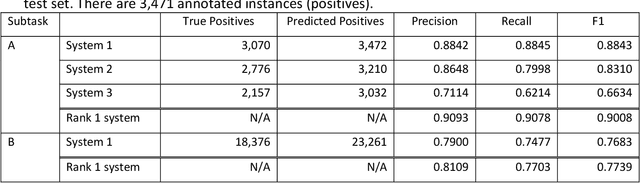
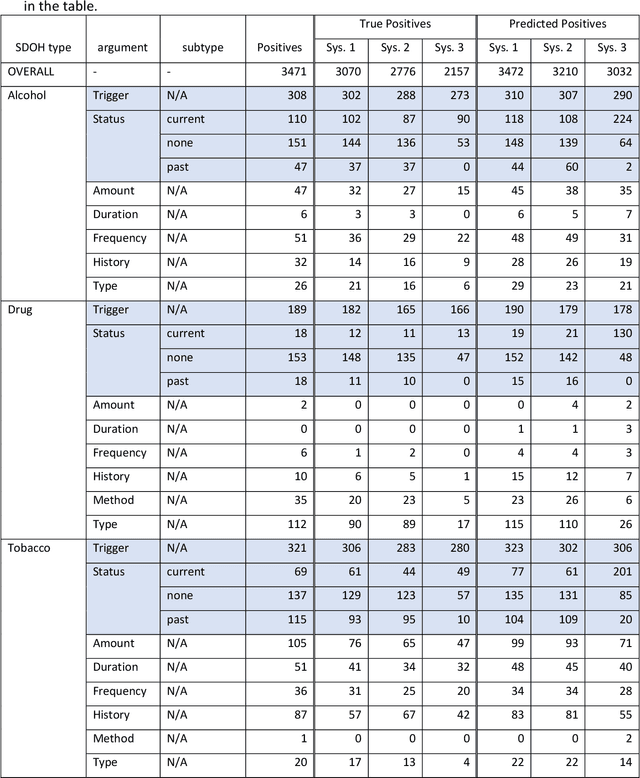
Objective: The 2022 n2c2 NLP Challenge posed identification of social determinants of health (SDOH) in clinical narratives. We present three systems that we developed for the Challenge and discuss the distinctive task formulation used in each of the three systems. Materials and Methods: The first system identifies target pieces of information independently using machine learning classifiers. The second system uses a large language model (LLM) to extract complete structured outputs per document. The third system extracts candidate phrases using machine learning and identifies target relations with hand-crafted rules. Results: The three systems achieved F1 scores of 0.884, 0.831, and 0.663 in the Subtask A of the Challenge, which are ranked third, seventh, and eighth among the 15 participating teams. The review of the extraction results from our systems reveals characteristics of each approach and those of the SODH extraction task. Discussion: Phrases and relations annotated in the task is unique and diverse, not conforming to the conventional event extraction task. These annotations are difficult to model with limited training data. The system that extracts information independently, ignoring the annotated relations, achieves the highest F1 score. Meanwhile, LLM with its versatile capability achieves the high F1 score, while respecting the annotated relations. The rule-based system tackling relation extraction obtains the low F1 score, while it is the most explainable approach. Conclusion: The F1 scores of the three systems vary in this challenge setting, but each approach has advantages and disadvantages in a practical application. The selection of the approach depends not only on the F1 score but also on the requirements in the application.